What should you clarify before committing to a terminal lease? Start with how your front desk accepts payments, then match the equipment proposal to that workflow. Medical office payment terminal leasing can structure how a practice acquires equipment, but the lease alone does not provide payment processing or a merchant account.
Executech Lease Group (ELG) offers equipment leasing through the merchant-services and payments-technology ecosystem. Merchants evaluate proposals through an independent sales organization (ISO) or agent. Keeping the equipment proposal separate from the practice’s payment-services arrangement makes it easier to understand which agreement covers each obligation.
This guide explains how to map equipment needs, compare fair-market-value (FMV), lease-to-own, and hardware-subscription structures, and review a proposal. You’ll also see how lease-end options differ and which next step fits your role as a medical office or merchant-services partner.
Key Takeaways
- Assess medical office payment terminal leasing by listing the equipment scope, payment locations, users, and operational priorities before comparing proposals.
- Distinguish a standalone card terminal from a broader point-of-sale (POS) system so the proposal matches the equipment you need.
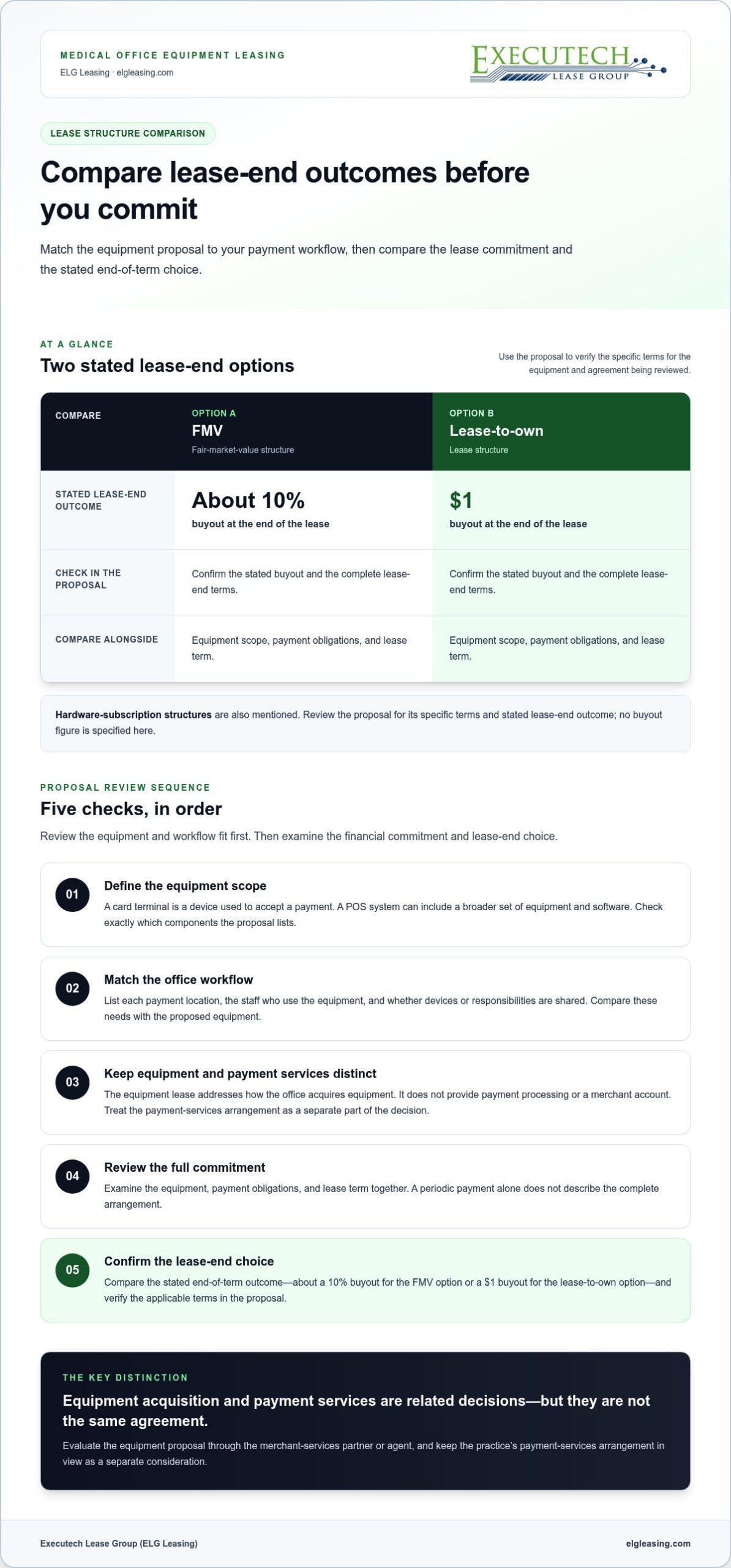
- Compare the stated lease-end outcomes: ELG’s FMV option ends with about a 10% buyout, while its lease-to-own option ends with a $1 buyout.
- Review a proposal in order: confirm the equipment and workflow fit, then examine the lease commitment and end-of-term choice.
- Keep equipment leasing separate from payment services, and use the vendor relationship path when evaluating an ELG proposal with a merchant-services partner.
Why Medical Offices Consider Payment Terminal Leasing
The practical question is how your office will acquire terminal equipment that fits the way staff accept payments. Buying equipment outright is one route; leasing is another way to structure the acquisition. Leasing does not guarantee a lower total cost, a better payment experience, or improved business results. Begin with the office’s workflow, then review the equipment proposal and its terms.
Practice owners, office managers, and merchant-services partners may each contribute useful information. Owners consider the financial commitment, office managers know the daily tasks and staff needs, and merchant-services partners can discuss how proposed equipment relates to the practice’s existing payment arrangement. Equipment selection and payment services are connected, but they are separate decisions.
Which medical-office workflows should shape the equipment proposal?
List the locations where staff accept payments and the people who will use each device. For example, note whether payments are handled at a front counter, at a shared desk, or in another location. These are prompts for describing the current workflow, not assumptions about what equipment a medical office needs.
- Payment locations: Record each place where staff currently accept payments.
- Users: Identify the staff members who use each terminal and whether equipment is shared.
- Operational priorities: Note what the equipment needs to support during routine payment interactions.
Separate observed needs from assumptions about clinical or patient systems. A terminal proposal by itself does not establish that equipment connects to practice software or supports a particular workflow. Record those requirements separately while assessing the equipment scope.
What leasing can and cannot decide for your office
Leasing addresses how the office acquires equipment. It does not establish the practice’s complete payment setup, supply a merchant account, or process payments. A terminal lease also does not define processor terms, establish clinical-software compatibility, or promise a particular business outcome. Treat the equipment proposal and payment-services arrangement as related but distinct parts of the decision.
A lease is a financial commitment, not free equipment. Review the equipment, payment obligations, term, and lease-end terms as a complete arrangement. Don’t judge a proposal by its periodic payment alone: the structure and intended outcome at the end of the lease also matter. The following sections compare lease structures and provide a practical review process.
Medical office payment terminal leasing is easier to assess once you have documented the office’s needs. ELG provides equipment lease options through the payments-technology ecosystem, with merchants evaluating proposals through an ISO or agent. ELG’s equipment leasing programs relate to acquiring equipment and do not replace the practice’s payment-services arrangement. Start with the workflow, then compare the proposed equipment and lease terms.
Match a Medical Office Payment Terminal to the Actual Use Case
A useful proposal names the equipment and connects it to the office’s payment tasks. Document payment locations, staff roles, and how often the workflow changes. This gives practice owners, office managers, and merchant-services partners a shared reference when comparing the proposal with what the office needs the equipment to support.
Terminal or POS system: define the equipment scope
A card terminal is a device used to accept a payment. POS means point-of-sale. A POS system can include a broader set of equipment and software used to support sales or payment activity, so a terminal proposal may cover less than a complete POS system. Check the components listed in the proposal. Don’t assume they include specific integrations, features, or medical-software compatibility.
Use case: Payments at a fixed counter
Equipment proposed: A standalone card terminal or a broader POS system
Users: Staff assigned to the counter
Question to resolve: Does the proposal list only a terminal, or additional equipment and software?
Use case: Payments at a shared desk
Equipment proposed: The terminal or POS components identified in the proposal
Users: Staff members sharing the payment location
Question to resolve: Who uses the equipment, and how often do responsibilities change?
Use case: Payments in more than one location
Equipment proposed: The number and type of devices specified for those locations
Users: Staff working at each location
Question to resolve: Does the proposed equipment scope account for each payment location?
Compare the office’s stated use with the actual proposal, not with assumed device capabilities. Don’t presume that a terminal or POS system will work with every processor or office system. Treat compatibility as a specific question about the proposed equipment and relevant documentation, separate from the lease comparison.
Questions to resolve before reviewing a terminal proposal
Make the proposal concrete before comparing its terms. List each device or system component, its intended payment location, and its users. Note whether staff assignments or workflows change often. Record processor requirements separately from the equipment scope. This inventory gives the office and its merchant-services partner a clear basis for discussing what the proposal includes without assuming an integration or clinical-system connection.
- What equipment and components are explicitly listed?
- Which payment location is each proposed device intended to serve?
- Who will use the equipment, and how frequently do assignments change?
- Which processor requirements need separate consideration?
Medical office payment terminal leasing is easier to assess when the proposal reflects the office’s actual use. Vendors, ISOs, and agents preparing a proposal can use ELG’s vendor inquiry path to discuss becoming an ELG vendor.
Compare Medical Office Equipment Lease Structures Before Choosing
Once the equipment matches the office’s needs, compare how each program structures the commitment and what happens at the end. Medical office payment terminal leasing is not one standard arrangement. FMV, lease-to-own, and hardware-subscription options have different terms and end-of-term outcomes. No structure is automatically cheaper or right for every practice.
ELG’s leasing programs give vendors, ISOs, and agents options to consider when preparing equipment proposals. Compare the agreement with the equipment scope, the practice’s intended ownership outcome, and its plans for using the equipment over time.
How to compare FMV and lease-to-own options
FMV and lease-to-own options have different lease-end outcomes. ELG’s FMV option has 12, 24, 36, 48, or 60-month terms and ends with about a 10% buyout. ELG’s lease-to-own option offers the same term choices and ends with a $1 buyout. Consider the office’s plans for the equipment at the end of the term, and read the proposal for the specific terms that apply. Don’t assume details beyond those stated in the agreement.
A longer or shorter commitment may affect how the practice plans for equipment needs, but the term alone does not establish which option costs less overall. Compare the full payment commitment and stated end-of-term choice, not just the term or periodic payment.
When to assess a hardware subscription separately
A hardware subscription is a separate equipment arrangement, not another name for lease-to-own. ELG’s terminal and POS hardware subscriptions run for 12-60 months and include a hardware warranty for the subscription term. Compare the stated subscription terms with the office’s equipment plans. Don’t assume the arrangement includes free upgrades, cancellation rights, or a particular service turnaround.
Use the same comparison points for each proposal. Record:
- Payment commitment: The term and payment obligations stated in the agreement.
- Ownership outcome: The stated lease-end path for that program.
- Equipment planning: Whether the practice expects to keep using the equipment or plan for a different arrangement later.
- Scope: The specific terminal or POS equipment included, so you compare equivalent proposals.
Keep payment processing and equipment leasing distinct. A lease does not determine processor terms or establish that a payment workflow meets healthcare privacy or payment-card requirements. For background on the separate payment-processing considerations, see HIPAA Compliant Credit Card Processing. Use that topic to inform the payment-services discussion, not as a substitute for comparing lease terms.
A useful comparison matches the same equipment scope against each program’s payment commitment and stated lease-end outcome. This gives the practice and its merchant-services partner a clear basis for reviewing the proposal without treating one structure as a universal fit.
Use This Medical Office Checklist to Review a Terminal Lease Proposal
Review a proposal in a consistent order. First compare the listed equipment with the office’s stated use. Then examine the program structure, payment obligations, and lease-end language. Keep the payment-services arrangement in view, but don’t treat it as part of the equipment lease unless the documents say so.
Five steps for assessing the proposal
- Confirm the equipment scope. Compare the listed terminal or POS equipment with the office’s payment locations, intended users, and operational priorities. Check that the proposal describes the equipment being considered. Don’t rely on assumptions about software, integrations, or system compatibility.
- Identify the program and term. Note whether the proposal uses an FMV, lease-to-own, or hardware-subscription structure, and record the term stated in the documents. The program and term should be clear enough to compare with the office’s equipment plans.
- Review payment obligations. Read the agreement for the stated payment commitment and any other terms that affect what the office agrees to pay. Consider the full commitment, not an isolated payment amount.
- Locate the lease-end provisions. Find the language describing the outcome at the end of the term. Compare it with the program structure in the proposal. Don’t assume that one program’s end-of-term terms apply to another.
- Separate equipment from payment services. Identify which document governs the equipment and which covers payment processing or other services. Review processor terms in the relevant service arrangement rather than treating them as an automatic feature of the terminal lease.
Keep the proposal and related agreements together while reviewing them. If the equipment list, term, or lease-end language differs between documents, resolve which terms apply before comparing the arrangements. This document check helps keep the equipment decision grounded in the written proposal.
How merchant-services partners fit into the decision
Merchants evaluate equipment proposals through an ISO or agent. The merchant-services partner can help connect the equipment discussion with the practice’s payment setup, while the lease documents define the equipment commitment. Keep those roles distinct. A processor relationship does not establish that a particular terminal is compatible or portable across processors. Don’t assume either without support in the relevant arrangements.
The POS equipment leasing guide can help frame a discussion about equipment proposals. Medical office payment terminal leasing is best assessed with the equipment scope, program structure, and documents side by side. ELG’s Apply Now page is for vendor inquiries, not a merchant financing application.
How ELG Supports Medical Office Terminal Leasing Decisions
Medical office payment terminal leasing involves two connected decisions: which equipment the practice needs and how it will acquire that equipment. ELG is an equipment lease brokerage serving the payments-technology ecosystem. Its equipment scope includes credit-card terminals and POS systems. ELG handles the equipment lease, not the payment transaction.
That distinction keeps the proposal clear. ELG does not process payments, provide merchant accounts, or control a practice’s processor obligations. A terminal lease also does not establish that a device will work with every processor or office system. Merchants evaluate equipment proposals through an ISO or agent, keeping equipment terms separate from payment-services arrangements.
What ELG’s role means for a medical office
The proposal should make clear which equipment is being leased and how the financial arrangement is structured. The practice can use its merchant-services relationship to assess the proposed equipment in the context of its payment setup, while reviewing the lease as a separate equipment commitment. This keeps equipment leasing distinct from payment processing and avoids assuming that a lease changes processor terms.
Check what each document covers. The equipment agreement sets out its lease terms; the processor or merchant-services agreement covers its own obligations. Direct questions about compatibility, software, and processor arrangements to the relevant service discussion. Don’t infer an integration, portability, or payment feature from the equipment lease alone.
A clear next step for offices and industry partners
Medical offices can discuss equipment needs and proposals through the merchant-services relationship they use to evaluate equipment. Vendors, ISOs, and agents can use ELG’s vendor relationship path to discuss equipment proposals. The Apply Now page is for vendor inquiries, not merchant financing applications or credit decisions.
For partners, understanding how equipment proposals fit into the vendor relationship helps keep discussions focused. Review the proposed equipment, lease structure, and responsibilities stated in each agreement. That gives the medical office and its merchant-services partner a clear basis for discussing equipment acquisition without confusing it with payment acceptance.
Medical offices should evaluate equipment proposals through their merchant-services relationship. Industry partners can use ELG’s vendor inquiry path to discuss working with ELG.
Move From Equipment Needs to a Clear Proposal
Use your workflow notes to start a focused conversation with your merchant-services partner. Medical office payment terminal leasing is easier to assess when the equipment scope and lease terms are clear and separate from payment-processing arrangements.
For vendor-side proposals, ELG offers no-money-down equipment leasing. No-money-down does not mean the equipment is free or that there are no financial obligations. ELG provides credit decisions in 1-2 business hours. That timing applies to the credit decision only, not funding or delivery. FMV and lease-to-own options have distinct lease-end choices, so make the intended outcome clear in the proposal.
With the equipment details and terms in front of you, the discussion can stay practical. A well-defined proposal gives the medical office and its merchant-services partner a clear basis for evaluating the equipment arrangement.
Discuss becoming an ELG vendor
Industry partners can take the next step by discussing a vendor relationship with ELG.
Frequently Asked Questions
Does ELG require money down?
No. ELG offers no-money-down equipment leasing. This does not mean the equipment is free or remove the financial obligations in the agreement. For a medical office, review the proposed equipment, payment schedule, and contract term together. List the devices the practice expects to acquire, then compare that scope with the written proposal instead of considering the down-payment requirement on its own.
How do ELG’s FMV and lease-to-own options differ?
The lease-end outcomes differ. ELG’s FMV option offers 12, 24, 36, 48, or 60-month terms and ends with about a 10% buyout. ELG’s lease-to-own option offers the same term choices and ends with a $1 buyout. Match each buyout to its specific program and consider which stated outcome fits the office’s equipment plans.
How quickly does ELG make a credit decision?
ELG provides credit decisions in 1-2 business hours. This is the timing for the credit decision only, not a schedule for funding, delivery, or other transaction steps. Keep the decision separate from subsequent arrangements involving funding or equipment logistics when planning the proposal process.
Does ELG process payments for a medical office?
No. ELG does not process payments or supply merchant accounts. Its role is equipment leasing. Keep the equipment proposal and payment-service documents separate so each agreement can be reviewed for the obligations it covers. This is useful when the office is considering terminal equipment while also reviewing or updating its payment-services arrangements.
What does ELG’s hardware subscription include?
ELG offers terminal and POS hardware subscriptions with 12-60-month terms, including a hardware warranty for the subscription term. Identify the equipment covered and compare the written subscription terms with the office’s equipment plan. The warranty applies for the subscription term; don’t assume the arrangement includes upgrades, cancellation rights, or a particular service turnaround.
Can ELG guarantee that a leased terminal works with every payment processor?
No. Compatibility must be assessed for the specific equipment and processor arrangement. For a medical office, use the proposal and relevant documentation to establish what they support rather than treating a lease as proof of compatibility. This keeps device selection grounded in the equipment and payment setup under consideration.
Is ELG’s Apply Now page a financing application for a medical office?
No. The Apply Now page is for vendor inquiries, not merchant financing applications or credit decisions. Medical offices evaluate equipment proposals through an ISO or agent. Vendors, ISOs, and agents can use the page to discuss an ELG vendor relationship. Choose the path that fits your role: merchants work through their merchant-services relationship, while industry partners use the vendor inquiry route.

Article by
Robert Ensminger
Robert Ensminger is the founder and CEO of Executech Lease Group (ELG Leasing), which specializes in equipment leasing and financing solutions for the merchant-services, payments, POS, and FinTech industries. With more than 20 years of industry experience, Robert helps independent sales organizations, payment processors, POS providers, and software companies develop practical leasing, subscription, and SaaS-monetization programs. He founded ELG in 2010 and guided the company to recognition on the Inc. 5000. His work focuses on responsive service, transparent program structures, and helping ELG’s partners close more business while creating sustainable revenue.