
Paying cash for payment equipment isn’t always the right fit for your business. Capital expenditure alternatives for merchants can help you acquire the terminals or point-of-sale (POS) system you need while managing upfront cash and ongoing obligations. The useful comparison is not just the initial payment. It’s the full contract structure, including the term, payment schedule, warranty, and equipment end terms.
A large equipment purchase can tie up cash you may need for inventory, staffing, or routine operations. That makes it worth comparing options carefully, especially when lease structures and ownership arrangements seem difficult to distinguish. This guide covers cash purchases, business borrowing, equipment leases, and hardware subscriptions. You’ll see how each can affect cash timing, contractual commitments, and what happens to the equipment at the end of an agreement.
Equipment leasing is separate from payment processing. Executech Lease Group (ELG) leases merchant equipment, including POS systems, credit-card terminals, and ATMs. ELG does not process payments or provide merchant accounts. As you compare alternatives, start with the equipment your operations require, how long you expect to use it, and whether you want to own it. No single structure is automatically cheaper or right for every merchant. The goal is to choose an arrangement that fits your equipment needs and cash priorities.
Key Takeaways
- Capital expenditure alternatives for merchants include cash purchases, borrowing, equipment leases, and hardware subscriptions. Each has a different payment and commitment structure.
- Compare options by upfront payment, term, ownership intent, warranty coverage, and fit with your operating workflow.
- Clarify what you want to happen at the end of an agreement. ELG’s FMV lease and lease-to-own options have different buyouts.
- Before comparing proposals, define who will use the equipment, how many units you need, and when you expect to replace them.
- Read the written agreement to understand its payment obligations, equipment details, and end-of-term terms.
What Capital Expenditure Alternatives Mean for Merchant Equipment
Start with the business task: identify the equipment needed to support transactions, then decide how to acquire it. Capital expenditure (CapEx) refers to spending on equipment or other assets intended to support a business over time. For merchants, examples include payment terminals, point-of-sale (POS) systems, and ATMs. This article focuses on the equipment and its role in operations, not its accounting or tax classification.
For merchants, CapEx is an investment in equipment that supports business operations over time. The phrase “Capital expenditure alternatives for merchants” refers to different ways to obtain that equipment. The alternatives don’t change what a terminal, POS system, or ATM does. They change how the business acquires and pays for it.
Which merchant purchases commonly count as equipment investments?
Consider the hardware used where a customer transaction or service interaction takes place. A credit-card terminal supports payment acceptance, a POS system supports checkout, and an ATM provides cash access. The practical question is whether the hardware serves an ongoing business function and meets a defined operational need.
That need may arise when opening a new operation, changing a workflow, replacing equipment, or adding capacity. An upgrade can prompt the same acquisition decision, even if the business already uses similar hardware. Write down the reason for the purchase first. For example, distinguish between replacing a terminal that no longer suits the workflow and adding devices to support a new checkout process. A clear use case helps keep the proposal focused on the equipment the business needs.
Why look beyond paying the full amount upfront?
Paying the full amount at the outset is one way to acquire equipment. But using available cash for hardware may compete with other priorities, such as inventory, staffing, or routine operating expenses. That doesn’t mean cash is unavailable or that paying upfront is inherently a poor choice. It means payment timing belongs in the comparison.
Other acquisition arrangements spread obligations over a contract term. The trade-off is between making an immediate payment and taking on a commitment that continues over time. Compare both against the equipment’s expected use and the business’s cash priorities. The choice should reflect how the equipment supports operations and how the business wants to structure the acquisition, not an assumption that one route is always preferable.
Keep the operational need separate from the payment arrangement. First identify what the equipment must do. Then compare the acquisition structure against that requirement. This makes it easier to see whether a proposal covers the right hardware and whether its payment and end-of-term terms suit the business.
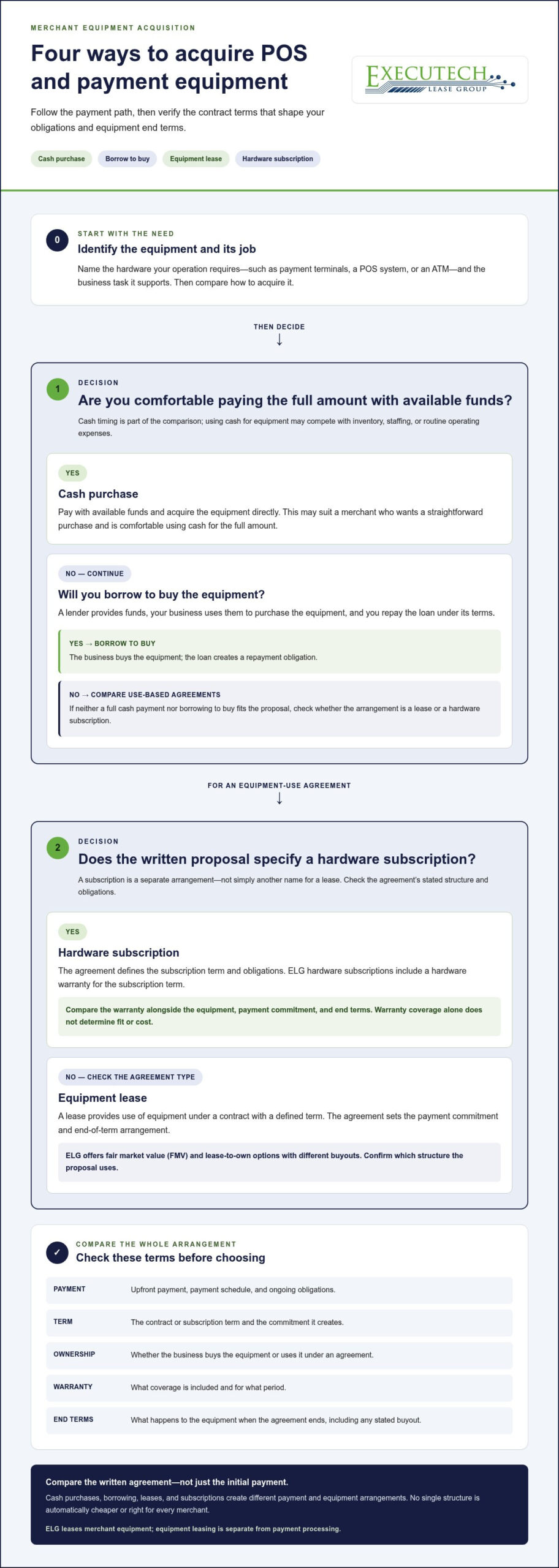
Four Ways Merchants Can Acquire POS Systems and Payment Equipment
Once you’ve identified the equipment your operation needs, compare the acquisition path as carefully as the device. Cash purchases, borrowing, leases, and hardware subscriptions differ in how the equipment is acquired, what the business agrees to pay, and whether ownership is part of the arrangement. Capital expenditure alternatives for merchants aren’t interchangeable labels. Each creates a different relationship between your business, the equipment, and the agreement.
Purchase with cash or borrow to buy
A cash purchase is direct: your business pays for the equipment with available funds and acquires it. This may suit a merchant who wants a straightforward purchase and is comfortable using cash for the full amount.
Borrowing separates the equipment purchase from the source of funds. A lender provides funds, your business uses them to buy the equipment, and you repay the loan under its terms. The U.S. Small Business Administration describes several business borrowing options in its SBA loans and funding information. The key distinction is that borrowing to buy equipment creates a loan repayment obligation, while an equipment lease provides use of equipment under a lease contract. Compare the payment obligations and ownership intent in the actual proposal instead of assuming either structure is more affordable.
Lease or subscribe to equipment
A lease gives your business use of equipment under a contract with a defined term. The agreement sets the payment commitment and end-of-term arrangement. ELG offers fair market value (FMV) and lease-to-own options with different buyouts, so check which structure the proposal uses. POS equipment leasing programs offer a way to acquire payment hardware through payments structured over an agreed term.
A hardware subscription is a separate arrangement, not simply another name for a lease. Its agreement defines the subscription term and obligations. ELG’s hardware subscriptions include a hardware warranty for the subscription term. Include that warranty in your comparison, while also considering the equipment, payment commitment, and end terms. Warranty coverage alone does not determine whether a subscription fits your operations or costs less.
Match the route to the equipment need
Start with the scale and purpose of the acquisition. Replacing one terminal raises different questions from acquiring a full POS system or several devices for different workflows. List the equipment and quantities you need, how long you expect to use them, and whether ownership matters at the end of the agreement. For more detail on lease structures, use this POS equipment leasing guide.
Keep hardware and software decisions distinct. A lease or subscription may cover equipment, while cloud-based POS software is a separate product with its own terms. ELG also provides financing for cloud-based SaaS POS software, tailored to the merchant-services and payment-processing industry. ELG does not process payments or provide merchant accounts. A business interested in a vendor relationship can use ELG’s vendor partnership inquiry. Merchants should assess the equipment and terms in the proposal they are considering.
How to Compare Merchant CapEx Alternatives Without Assuming One Is Cheaper
Start with the written terms, not just the monthly payment or a headline such as “no money down.” Capital expenditure alternatives for merchants shift cash timing and contractual responsibilities in different ways. The table summarizes common structures and highlights details to compare in a specific proposal.
| Option | Upfront payment | Term | Ownership intent | Warranty and operational fit |
|---|---|---|---|---|
| Cash purchase | Pay for the equipment upfront. | No equipment contract term. | Purchase the equipment directly. | Warranty depends on the purchase terms; consider whether the full payment suits current cash priorities. |
| Borrowing | Depends on the loan arrangement. | Set by the loan agreement. | Use borrowed funds to purchase equipment; repay under the loan terms. | Warranty depends on the equipment agreement; assess the repayment commitment alongside operating needs. |
| FMV lease | Depends on the proposal. No-money-down means no down payment, not no financial obligation. | ELG options are 12, 24, 36, 48, or 60 months. | Lease structure; ELG’s option ends with about a 10% buyout. | Review the warranty terms in the proposal and consider how the equipment supports the workflow. |
| Lease-to-own | Depends on the proposal. | ELG options run 12 to 60 months. | Lease-to-own; ELG’s option ends with a $1 buyout. | Review the warranty terms and whether the ownership path matches your plans. |
| Hardware subscription | Depends on the subscription agreement. | ELG subscriptions run 12 to 60 months. | Subscription arrangement; review the agreement for its equipment end terms. | ELG includes a hardware warranty for the subscription term; weigh the structure against ongoing equipment needs. |
Compare cash timing and contractual commitments
For each proposal, identify what is due at the start, what payments continue, and how long the commitment lasts. A no-money-down arrangement means no down payment; it doesn’t mean the equipment is free or remove the obligation to pay under the contract. Compare the full written terms, including the payment schedule and end-of-term language, rather than judging by one feature.
Compare ownership intent and equipment fit
FMV and lease-to-own are distinct structures. ELG’s FMV option ends with about a 10% buyout; its lease-to-own option ends with a $1 buyout. Don’t apply one option’s end structure to the other or assume details such as renewal or cancellation terms. Use the agreement to understand the arrangement being offered.
Keep the equipment decision separate from payment processing. A terminal or POS lease doesn’t provide payment processing or determine processor obligations. Nor does it promise compatibility with every setup. Compare the specific equipment, contract, and operational requirements together. Without the proposal’s figures and terms, a reliable total-cost comparison isn’t possible.
A Merchant’s Practical Checklist for Choosing an Equipment Alternative
A clear decision starts with the operating need, not the payment structure. Use this sequence to define the equipment, compare offers on equal terms, and make a decision you can explain to your team.
- Map the workflow. Identify where the equipment will be used and what it needs to support, such as checkout or customer service. Note the intended users and any workflow requirements that affect placement or quantity.
- Separate essentials from optional additions. List the equipment needed for the core operation, then record upgrades or extra features separately. This keeps the proposal focused on what the business needs.
- Set the equipment count and replacement timing. Record how many terminals, POS systems, or other devices the operation requires. Note whether you’re filling a new need, expanding capacity, or replacing equipment, and when you need it.
- Review available cash and competing priorities. Consider how an upfront payment would fit alongside other planned business needs. For a contract, compare the payment obligations with the expected operating period. The right comparison depends on your cash priorities and the agreement.
- Compare proposals on the same basis. Line up the equipment description, term, payment schedule, and any stated warranty. Keep the hardware and contract structure consistent. A proposal for one terminal is not directly equivalent to one covering a larger setup.
- Check ownership intent and lease-end terms. Decide whether you want to own the equipment, use it under a lease, or subscribe to it. Compare that goal with the agreement’s stated end-of-term structure. Don’t assume two agreements have the same outcome just because both provide equipment.
- Review the written agreement before deciding. Confirm that it describes the equipment and obligations you intended to evaluate. Read the payment and term provisions alongside the lease-end language, and resolve any mismatch between the proposal and your intended outcome before proceeding.
Define the need, compare the structures, inspect the terms, then decide. This keeps the equipment’s operational purpose at the center of the choice and makes Capital expenditure alternatives for merchants easier to assess without treating one structure as automatically superior.
Merchants may review equipment proposals through an independent sales organization (ISO) or agent. An ISO works in the merchant-services channel, and an agent can help present equipment options. Keep the roles clear: equipment acquisition and payment processing are separate decisions. Assess the equipment agreement on its own terms.
How ELG Equipment Leasing Fits a Merchant’s Acquisition Decision
For merchants comparing Capital expenditure alternatives for merchants, ELG provides an equipment-leasing option within the United States merchant-services ecosystem. ELG focuses on payment technology, including point-of-sale (POS) systems, credit-card terminals, and ATMs. Its role is to arrange equipment leasing, not payment processing or merchant accounts.
This distinction keeps equipment acquisition separate from payment-processing arrangements. Review each agreement for its own scope and obligations. Leasing equipment does not set processing terms or resolve obligations with a processor.
Compare ELG’s equipment lease structures
ELG offers FMV and lease-to-own equipment lease options. They serve different ownership intentions, so focus on which structure aligns with your plans. ELG’s FMV option ends with about a 10% buyout, while the lease-to-own option ends with a $1 buyout. Check the proposal’s term, payment schedule, equipment description, and lease-end language rather than relying on the option name alone.
The ELG leasing programs overview describes the structures relevant to your acquisition decision. Use the written agreement to understand the commitments attached to the option you’re evaluating and how those terms fit your equipment needs.
Understand no-money-down and decision timing
ELG offers no-money-down equipment leasing. This describes the down-payment feature. It doesn’t mean the equipment is free or remove the agreement’s financial obligations. Read the proposal to understand its full terms.
ELG provides credit decisions in 1-2 business hours. That timing applies to the credit decision only. It doesn’t promise approval, funding, equipment delivery, or installation.
Choose the right next conversation
Merchants can review equipment proposals and contract terms through their merchant-services relationship. Keep that process distinct from a vendor-partnership inquiry. The ELG Apply Now page is for businesses interested in discussing a vendor relationship, not for submitting a merchant financing application or requesting a credit decision on an equipment proposal.
Turn Your Equipment Plan Into a Clear Next Step
Use your next equipment review to create a simple decision record: what the business needs, why it needs it, and who will assess the agreement. Keeping that information together can make future equipment reviews more deliberate and help your team connect acquisition choices to changing workflows.
Capital expenditure alternatives for merchants work best as part of an intentional operating plan, not as a choice made on payment timing alone. If you support merchants by offering payment technology or equipment solutions, discuss an ELG vendor relationship to explore how equipment leasing fits your business.
Discuss becoming an ELG vendor
Frequently Asked Questions
Does no-money-down equipment leasing mean the equipment is free?
No. ELG offers no-money-down equipment leasing, which means there is no down payment. It does not mean the equipment is free or remove the obligation to pay under the agreement. Compare the complete payment schedule and contract term with your equipment plan before deciding.
How fast does ELG make an equipment lease decision?
ELG provides credit decisions in 1-2 business hours. This is the decision timing only, not a transaction completion schedule or a promise of approval, funding, equipment delivery, or installation.
Does ELG process payments or provide merchant accounts?
No. Keep questions about payment acceptance, merchant-account arrangements, and processor responsibilities separate from the equipment review. Assess the hardware and its contract terms on their own.
Is ELG’s Apply Now page a merchant financing application?
No. The Apply Now page is for discussing an ELG vendor relationship, not for submitting an individual merchant financing request. Merchants evaluating equipment should review the proposal through their merchant-services relationship. Businesses interested in a vendor partnership can use the page to start that separate discussion.
How do ELG’s FMV and lease-to-own options differ?
They are distinct lease structures with different buyouts. ELG’s FMV option ends with about a 10% buyout, while the lease-to-own option ends with a $1 buyout. Check the written proposal to see which option applies and review its stated end terms.
Can an ISO or sales agent discuss an equipment leasing partnership with ELG?
Yes. An independent sales organization (ISO) or sales agent can use the vendor-partnership inquiry to discuss a potential relationship with ELG. A clear description of the business and its role in the merchant-services channel helps keep the conversation focused on the partnership, separate from a merchant’s equipment proposal or individual credit decision.

Article by
Robert Ensminger
Robert Ensminger is the founder and CEO of Executech Lease Group (ELG Leasing), which specializes in equipment leasing and financing solutions for the merchant-services, payments, POS, and FinTech industries. With more than 20 years of industry experience, Robert helps independent sales organizations, payment processors, POS providers, and software companies develop practical leasing, subscription, and SaaS-monetization programs. He founded ELG in 2010 and guided the company to recognition on the Inc. 5000. His work focuses on responsive service, transparent program structures, and helping ELG’s partners close more business while creating sustainable revenue.