
The monthly payment can look manageable while the agreement commits your business to terms you haven’t fully compared. With merchant hardware lease agreements, the obligations behind that number matter: how long payments continue, who owns the equipment, and what choices you have when the term ends.
It’s easy to focus on the monthly figure, especially when contract language makes different offers hard to compare. But a lower payment doesn’t explain the full commitment. Before signing, review the agreement as a whole and check how its terms fit your business.
This guide explains what to review, including the lease structure, payment obligations, equipment ownership, end-of-term options, and the relationship between a hardware lease and other agreements. You’ll learn how to compare proposals consistently, what questions to ask the provider, and which documents to read before deciding.
Key Takeaways
- Check that the equipment description and quantity match the setup you expect to receive.
- Review the full payment schedule and total obligations, not just the monthly amount.
- Compare merchant hardware lease agreements using the same equipment, term, payment schedule, and service assumptions.
- Get the complete agreement and any referenced documents. List questions about ownership and end-of-term choices before signing.
- Explore ELG’s merchant equipment lease options, including 12-60-month terms, FMV, lease-to-own, and subscription-based programs.
What merchant hardware lease agreements cover: why the details matter
A merchant hardware lease agreement sets out the terms for using specified business equipment, making payments, and meeting related responsibilities. It differs from buying equipment outright. A purchase generally transfers ownership under the sale terms, while a lease describes access to equipment and the obligations that apply during the agreement. The written terms determine ownership and what happens at the end of the term.
That’s why merchant hardware lease agreements deserve a full review, not just a quick scan of a sales summary. A summary may describe the proposed equipment or payment, but the complete agreement and any documents it references explain the commitment. Before deciding, check that the paperwork matches the offer you received.
For another perspective on terminal lease agreements, watch this video:
Which merchant technology may be covered by an agreement?
The equipment list might include credit card terminals, a POS system, or Clover devices. Check that the agreement identifies the equipment and quantity you expect, rather than relying on a general description of the setup. If a proposal also includes cloud-based SaaS POS software, distinguish that service from the physical hardware. The software and hardware may have separate terms or be covered together, depending on the offer. Don’t assume a lease includes software, support, or every device in a proposed package.
Who may be involved in the agreement?
Identify the merchant and leasing provider named in the paperwork. An ISO, sales agent, or payment processor may help present or arrange an offer, but that doesn’t establish who handles each obligation. Before signing, confirm the right contact for each issue.
- Support: Who handles questions about using the equipment?
- Billing: Which company collects payments and answers billing questions?
- Equipment issues: Who do you contact about a malfunction, repair, or replacement? What does the agreement say about responsibility?
- Agreement terms: Who can explain the contract and any documents it references?
Get the answers in writing. Clear responsibilities help you understand the full arrangement before you commit.
Which clauses to examine in a merchant hardware lease agreement
Review the agreement against the offer you received. The monthly payment is only one part of the commitment. The equipment description, term, payment schedule, responsibilities, and end-of-term wording all affect what you’re agreeing to. If a clause is unclear, ask the provider to explain it in writing before signing.
Payment, term, and equipment descriptions
Start with the equipment schedule or description. Confirm that it matches the proposed setup, including the number of credit card terminals or POS devices and any software or services specifically included. Don’t assume a software subscription or support is part of the hardware agreement unless the paperwork says so.
Next, locate the agreement’s start and end dates, stated term, payment amount, and payment frequency. Compare each item with the offer presented to you. Then review how the agreement describes your full payment obligation across the term, including any other amounts or conditions it identifies. Don’t rely on the monthly figure alone.
Ask how changes will be recorded. If the equipment list changes, a device is replaced, or you add hardware, find out whether the provider will issue an amendment, a new schedule, or another written document. Keep copies of the final agreement and any updates.
Responsibilities, renewal, and end-of-term language
Find the clauses covering equipment care, service requests, damage, and returns. Check who you contact about equipment issues, what steps the agreement describes, and who is responsible for return arrangements or costs if equipment must be sent back. Details vary by agreement, so verify them rather than assume.
Read the renewal, cancellation, default, and end-of-term provisions carefully. Look for how the agreement defines each situation, what notice or steps it requires, and what options it gives you when the term ends. Don’t assume you can cancel early, that the agreement renews automatically, or that you’ll own the equipment. Ask the provider to clarify any condition or outcome that isn’t explicit.
The Office of the Comptroller of the Currency provides a broader regulatory view on lease agreements. Use it as background, not as a substitute for reviewing your contract or getting qualified advice about a specific legal question.
- Match: Check the equipment, quantity, and included items against the written offer.
- Calculate: Review the term, payment schedule, and total stated obligations.
- Clarify: Check service, damage, return, renewal, cancellation, default, and end-of-term language.
- Document: Ask for explanations and agreed changes in writing.
Once you’ve identified the terms that matter, you can explore an ELG application with clearer questions about the agreement and equipment you’re considering.
How to compare merchant hardware lease agreements fairly
A fair comparison starts with the same assumptions. If one proposal covers more devices, includes software, or uses a different term, its payment won’t be directly comparable to another offer. Standardize the details first, then assess the full commitment. This prevents the headline monthly amount from driving the decision on its own.
Compare FMV and lease-to-own terms without assuming the outcome
Fair Market Value (FMV) and lease-to-own are distinct program categories. Don’t assume either will cost less or suit your business better based on the label. Compare the ownership treatment and end-of-term choices stated in each agreement, along with the payment schedule and responsibilities. Review program information alongside the actual proposed terms.
If you’re reviewing a guide such as POS Lease to Own Guide for Merchants and ISOs 2026, use it to frame questions, not to replace the provider’s written agreement. The contract sets out the specific offer you’re evaluating.
Build a like-for-like agreement comparison
Put each proposal into the same comparison table. Fill in each field from the written offer. If information is missing or unclear, mark it for follow-up rather than filling the gap with an assumption.
- Equipment: Devices, quantities, and any listed software or services.
- Term: The stated duration and any relevant start-date details.
- Payments: Amount, schedule, and total stated payment obligations.
- Included services: Only services or software explicitly included in the offer.
- Responsibilities: Who handles support, equipment care, and return arrangements.
- End of term: The ownership, return, renewal, or other options described in the agreement.
Compare monthly payments, but keep them separate from total obligations and end-of-term responsibilities. A lower monthly amount alone doesn’t establish a lower overall commitment. Include software or subscription charges only when they appear in the written offer. Check whether they’re part of the same agreement or documented separately.
Merchant hardware lease agreements are easier to assess when you compare the same equipment, term, payment schedule, and service assumptions side by side. A broader resource, such as 12-60 Month Credit Card and POS Equipment Leases Guide, can help you organize your review, but don’t infer terms that aren’t stated in your proposal. Ask the provider to explain unclear points in writing before deciding.
Once your comparison is complete, you can begin an ELG application with a clearer view of the equipment and agreement terms you want to discuss.
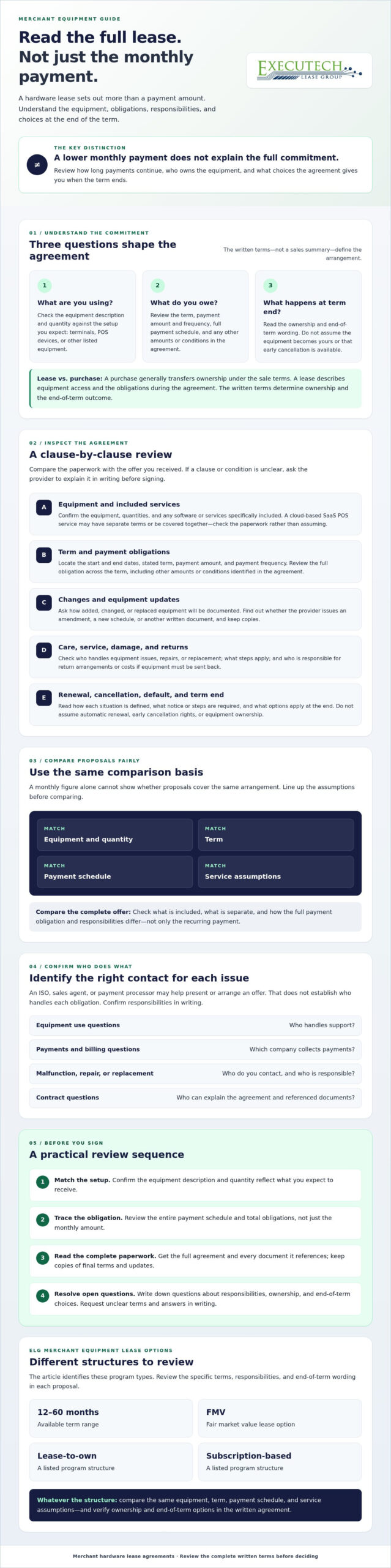
Steps before signing a merchant hardware lease agreement
Use the same review sequence before you commit: confirm the equipment, read the full paperwork, list questions, compare the written options, then decide. This helps prevent a sales summary or verbal explanation from standing in for the actual terms.
A practical pre-signing review checklist
- Confirm the setup. Match the equipment and quantity in the agreement to the hardware your business needs. Check whether expected software or services are actually included.
- Read the complete agreement. Obtain the full contract and every schedule, addendum, or other document it references. Review them together to understand how the terms fit.
- Check the obligations. Compare the stated term and payment schedule with the offer. Note responsibilities for equipment care, service requests, damage, returns, and end-of-term decisions.
- Write down questions. Flag unclear fees, responsibilities, renewal language, or end-of-term wording. Ask the provider for clear written answers and keep them with your agreement documents.
- Compare, then decide. Evaluate each written option using the same equipment and assumptions. Don’t proceed until you understand the material differences and have addressed unresolved questions.
Keep a copy of the version you reviewed, along with any written clarification or updated equipment schedule. If the final paperwork changes, compare those changes with your notes before signing. A verbal assurance may help identify what to ask, but it doesn’t replace clear terms in the documents you receive.
When to seek additional review
Some clauses can have consequences that are difficult to assess from a short explanation. If you can’t determine what an ambiguous or consequential term means, consider asking a qualified attorney or financial professional to review it in light of your business’s circumstances. This can be useful if you and the provider disagree about how a provision should be understood. No general checklist can determine the legal effect of a specific agreement.
If you’re still reviewing possible structures, consult ELG’s leasing program details for program information. Then compare that information with the actual contract you’re asked to sign. Merchant hardware lease agreements should be evaluated on their written terms, not on a program label or informal summary.
Explore merchant hardware lease options with ELG
Executech Lease Group focuses on merchant technology, including credit card terminals, POS systems, and Clover devices. Its program categories include 12-60-month terms, Fair Market Value (FMV) leases, lease-to-own options, and subscription-based leases. The right fit depends on the equipment you need and the written terms you’re prepared to accept.
ELG provides equipment leasing and related financing options. It doesn’t provide direct payment processing or standalone consumer electronics leases. Keep these distinctions clear as you review a proposal: a hardware lease is a separate decision from choosing how your business processes payments.
Match the program category to the technology
If you’re evaluating physical equipment, start with the relevant credit card terminal or POS program information. Compare the proposed devices and agreement terms with your business requirements. If the offer also includes cloud-based SaaS POS software, check how the software is described and whether its costs and terms appear in the written agreement. Don’t assume software is included in every hardware program.
Review ELG’s program information for an overview of available merchant equipment leasing programs. If you’re considering financing for cloud-based POS software, assess that component separately and confirm exactly what the written offer covers.
Take the next step with clear expectations
Merchants and payment professionals can submit an application for consideration. An application isn’t a promise of approval or a particular term. Before accepting any proposed arrangement, review the full agreement and referenced documents, including the equipment list, payment schedule, responsibilities, and end-of-term language. Ask the appropriate provider to clarify anything that remains unclear.
Program summaries describe categories, not every obligation in an individual agreement. Use them to identify questions, then rely on the actual paperwork to understand the offer. Compare the written terms with your equipment needs and other options. That keeps the decision grounded in the full commitment, not just the program name or monthly payment.
If you’re ready to take the next step, you can apply with ELG for consideration. Review the proposed written terms carefully before deciding whether they fit your business.
Review the terms, then move forward with confidence
Strong decisions start with the paperwork. Confirm the equipment and stated term, review the payment schedule and total obligations, and understand your responsibilities and end-of-term choices. Compare proposals using the same assumptions. If a clause is unclear, get an explanation in writing before signing. This is how to assess merchant hardware lease agreements beyond the monthly payment.
Executech Lease Group specializes in merchant equipment leasing, with 12-60-month credit card and POS equipment lease terms. Program categories include Fair Market Value (FMV), lease-to-own, and subscription-based options. Review the proposed agreement to see which terms apply to your situation.
When you’re ready to take the next step, submit an application for consideration.
Take your time, ask clear questions, and choose an arrangement you understand. A careful review helps you move forward with a clearer view of your commitment.
Frequently Asked Questions
What is a merchant hardware lease agreement?
A merchant hardware lease agreement is a written contract that sets out the terms for using specified business equipment, making payments, and meeting related responsibilities. It may cover credit card terminals, POS systems, or other listed merchant devices. Unlike buying equipment outright, leasing doesn’t necessarily mean you own the hardware. Check the agreement for the term, payment schedule, equipment-care responsibilities, and what happens when the term ends.
What should I check before signing a POS equipment lease?
Check that the equipment description and quantity match the setup you expect. Then review the stated term, payment schedule, total payment obligations, and any included software or services. Find the clauses describing support, maintenance, damage, returns, renewal, cancellation, and end-of-term choices. Obtain the full agreement and any referenced documents, not just a sales summary. Ask the provider to clarify unclear terms in writing before signing.
Can a merchant lease a credit card terminal without leasing a full POS system?
A merchant can explore credit card terminal leasing without assuming a full POS system is part of the arrangement. Executech Lease Group offers credit card terminal leasing as well as POS equipment leasing. Confirm that the written proposal lists only the hardware and services you want, and ask whether any software or additional equipment is included. The agreement, not a general program description, should make the specific arrangement clear.
What is the difference between an FMV lease and a lease-to-own agreement?
FMV and lease-to-own are different lease program categories, and the agreement determines the specific terms. Don’t assume ownership, purchase options, or end-of-term choices from the program name alone. Compare the payment schedule, how the contract describes ownership, and the options it states for the end of the term. Executech Lease Group offers both categories, but review the proposed written terms to understand what applies to your offer.
What happens at the end of a merchant hardware lease?
The agreement describes what happens when the lease term ends. Depending on its terms, it may address returning the equipment, continuing the arrangement, or another end-of-term option. Don’t assume the equipment automatically becomes yours or that you can simply stop payments. Look for deadlines, return instructions, and any responsibilities tied to the equipment, then ask the provider to clarify unclear language before signing.
Does a merchant hardware lease include POS software?
Not necessarily. A hardware agreement may cover physical equipment only, while cloud-based SaaS POS software may be offered under separate or additional terms. Executech Lease Group provides financing for cloud-based SaaS POS software, but that doesn’t mean software comes with every hardware lease. Check the written offer for the software or service name, its charges, and whether its terms appear in the same agreement or a separate document.
How can I compare two merchant hardware lease agreements?
Compare merchant hardware lease agreements using the same equipment list, term, and service assumptions. For each offer, record the payment schedule, total stated obligations, included software or services, equipment responsibilities, and end-of-term wording. Mark missing or unclear terms instead of filling gaps with assumptions. Ask each provider for written clarification, then compare the complete documents. A lower monthly payment alone doesn’t show which agreement is the better fit overall.

Article by
Robert Ensminger
Robert Ensminger is the founder and CEO of Executech Lease Group (ELG Leasing), which specializes in equipment leasing and financing solutions for the merchant-services, payments, POS, and FinTech industries. With more than 20 years of industry experience, Robert helps independent sales organizations, payment processors, POS providers, and software companies develop practical leasing, subscription, and SaaS-monetization programs. He founded ELG in 2010 and guided the company to recognition on the Inc. 5000. His work focuses on responsive service, transparent program structures, and helping ELG’s partners close more business while creating sustainable revenue.