The right mobile credit card machine lease is not simply the one with the lowest monthly payment. It is the structure that fits your payment workflow, equipment plans, and preferences at the end of the term. Before moving forward, get clear on the equipment, recurring obligations, lease term, and applicable buyout.
A lease covers equipment. Payment processing covers how transactions are handled, and the agreements are separate. Keeping that distinction in mind helps you compare options without treating a terminal lease as a processing contract or assuming a credit decision means the equipment is ready to use.
This guide explains how mobile terminal leasing works, compares fair market value (FMV) and lease-to-own structures, and identifies terms to review before proceeding. An FMV equipment lease ends with about a 10% buyout, while a lease-to-own equipment lease ends with a $1 buyout. These figures apply to their respective structures and are end-of-lease figures, not monthly payments or total equipment prices.
Key Takeaways
- A mobile credit card machine lease covers terminal equipment. Payment processing remains a separate agreement.
- Compare 12-, 24-, 36-, 48-, and 60-month terms, as well as the FMV and lease-to-own end-of-lease structures.
- Assess your payment workflow, equipment requirements, and plans for the device alongside the recurring lease obligations.
- Review the written agreement for its term, payment schedule, and applicable end-of-lease figure.
- Executech Lease Group (ELG) is an equipment lease brokerage serving the U.S. merchant-services and payments-technology ecosystem.
What a Mobile Credit Card Machine Lease Covers, and What It Does Not
A mobile credit card machine is a payment terminal used at a checkout location that can move or change, rather than only at a fixed counter. A business might use one to take payments at different points in its operation. The terminal is one part of the payment workflow, not the entire payment arrangement.
A mobile credit card machine lease covers access to terminal equipment through recurring lease obligations. Payment processing is a separate service agreement that governs how transactions are handled. Keeping the agreements distinct makes it easier to identify what the equipment lease covers and where to look for processing terms.
How a mobile terminal fits into a merchant’s payment workflow
At a mobile or changing checkout, the terminal is the equipment used to accept a customer’s payment. A separate payment-processing relationship handles the transactions. The two arrangements may work together operationally, but they are not the same contract. For example, a business may take payments at different checkout points while its processing relationship remains governed by its own agreement.
Executech Lease Group (ELG) focuses on equipment leasing. ELG does not process payments, provide a merchant account, set transaction pricing, or control a processor’s obligations. Those matters sit outside the equipment lease. A terminal lease is not enrollment in payment processing, nor is it a promise that a particular processor, device, or integration will work together. Assess the equipment and processing relationship separately when planning your workflow.
What a mobile terminal lease does and does not include
A mobile credit card machine lease is an equipment-financing arrangement with recurring payments over the agreed term. It gives your business access to the leased equipment under the contract. It does not make the equipment free or automatically transfer ownership. The agreement sets out the payment obligation and applicable end-of-lease structure, so do not assume possession means ownership.
No-money-down refers only to the down-payment requirement. It does not remove recurring lease payments or other obligations under the agreement. Review the payment schedule and written terms; treat the absence of a down payment as one feature of the arrangement, not as a statement that the equipment costs nothing.
Equipment support is a separate consideration. ELG does not provide equipment warranties, maintenance, repairs, replacements, or swap-out coverage. Any warranty comes only from the equipment manufacturer, under the manufacturer’s terms. Keep the lease agreement and manufacturer warranty information distinct as you review your obligations.
For merchants and payment-industry businesses assessing equipment arrangements, ELG’s equipment leasing programs explain the available lease structures. Start with the essential distinction: the lease concerns equipment, while processing concerns transactions. That makes it easier to review each agreement for the terms it actually covers.
Mobile Credit Card Machine Lease Terms: Understand the Structure Before Comparing
Compare a lease on two dimensions: its term and its end-of-lease structure. A mobile credit card machine lease can involve recurring obligations throughout the selected term, while the buyout figure applies at the end. Reviewing both helps you compare options without focusing on one feature or assuming all leases work the same way.
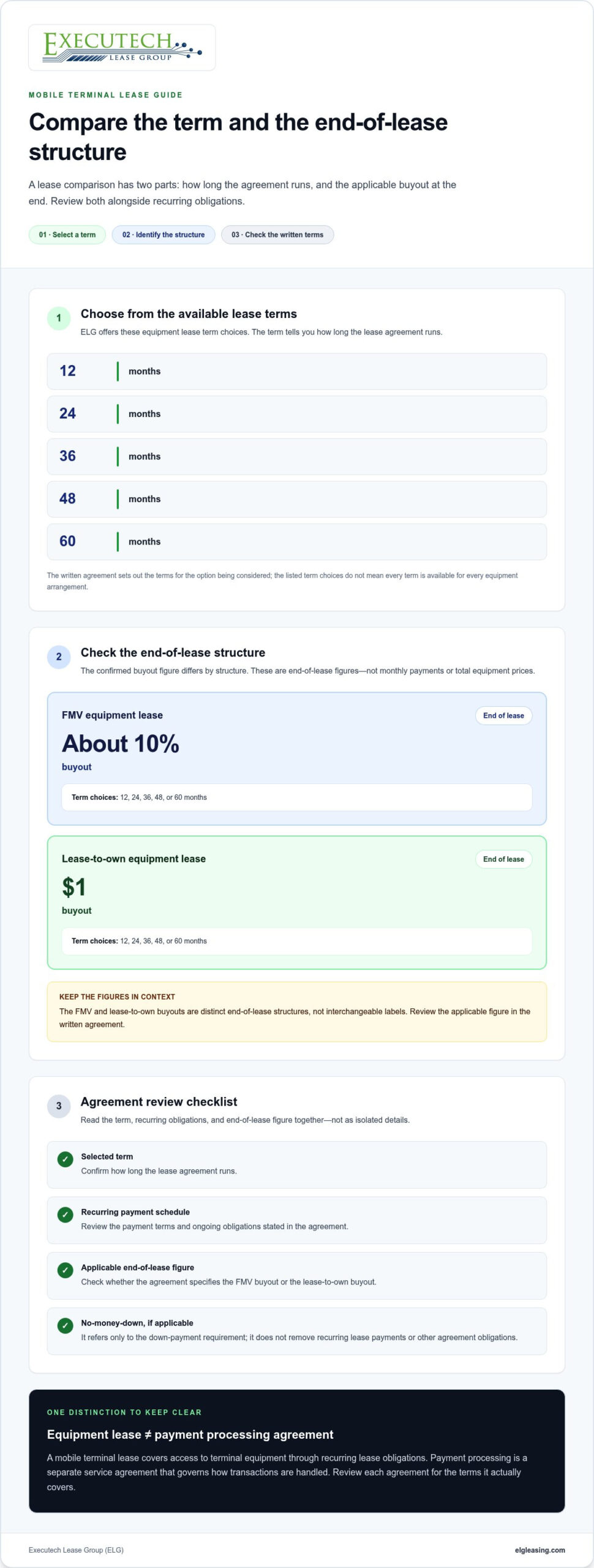
ELG offers equipment lease term choices of 12, 24, 36, 48, or 60 months. The confirmed end-of-lease figure depends on the structure: an FMV equipment lease ends with about a 10% buyout, while a lease-to-own equipment lease ends with a $1 buyout. These are distinct options, not interchangeable labels.
FMV equipment lease and lease-to-own: the confirmed difference
The key difference is the stated buyout at the end of the lease. The comparison below separates the confirmed details without assuming how a buyout is calculated or adding other end-of-term choices. ELG’s equipment leasing program details provide further context on the structures.
| Lease structure | Term choices | Confirmed end-of-lease figure |
|---|---|---|
| FMV equipment lease | 12, 24, 36, 48, or 60 months | About a 10% buyout |
| Lease-to-own equipment lease | 12, 24, 36, 48, or 60 months | $1 buyout |
These are end-of-lease buyouts, not monthly payments or total equipment prices. The table does not mean every term is available for every equipment arrangement. The written agreement sets out the terms for the option you are considering.
How to read term length and ongoing obligations
A term tells you how long the lease agreement runs. By itself, it does not explain the full payment obligation or what applies at the end. Read the selected term alongside the recurring payment terms and applicable buyout figure. This gives you a fuller basis for comparing structures than looking at one number alone.
No-money-down means there is no down payment. It does not remove recurring lease payments or other obligations stated in the agreement. Before moving forward, review the written terms for the selected structure, including the term, payment schedule, and applicable end-of-lease figure. Do not assume an option’s name answers questions that should be clear in the agreement.
Once you have identified the structure and terms that match your plans, submit a vendor or partner inquiry to ELG to start a conversation about equipment leasing. The inquiry form is for vendors and industry partners, not a financing application or credit-decision submission.
Is Leasing a Mobile Credit Card Machine a Fit for Your Business?
A lease may fit when scheduled equipment payments align with how your business plans and budgets for terminal use. It may be a less suitable match if you need equipment only briefly, expect your requirements to change soon, or prefer to own equipment outright. The decision depends on the device’s role in your operations and the obligations you are prepared to take on.
Separate the equipment decision from payment processing. A terminal lease does not set transaction pricing, establish your merchant account, or define processor obligations. Evaluate those agreements on their own terms, then decide whether a lease structure fits your equipment needs.
When recurring equipment payments may suit the business
Scheduled payments may suit a business that prefers to plan for equipment through recurring obligations rather than make an upfront purchase. Consider how often and where you will use the terminal, whether you expect that need to continue, and how the proposed lease term fits your plans. A payment schedule is useful only if it works within your operating budget throughout the agreement.
There are trade-offs. Recurring payments can make an equipment commitment easier to map across a budget, but they remain obligations for the agreement’s term. Leasing does not automatically lower the total cost or improve cash flow. Compare the full written terms with the purchase alternative and your expected period of use.
When ownership or a different approach may deserve comparison
If you expect to keep equipment for an extended period, prefer ownership, or anticipate a change in workflow, compare leasing with purchasing and other equipment plans. Focus on whether the agreement’s duration matches your actual use. A mismatch between the term and your operating plans can matter more than the appeal of a single payment feature. ELG’s POS equipment leasing information offers context for evaluating equipment lease structures.
Use this framework to weigh the decision:
- Potential fit: You have a clear, ongoing use for the terminal, and the recurring obligations fit your budget and equipment plan.
- Points to weigh: You may need greater flexibility, prefer ownership, or are unsure whether the equipment will remain useful for the full term.
- Separate review: You need to assess processor pricing and account terms independently from equipment lease obligations.
For example, a business that serves customers at changing checkout locations may value access to terminal equipment while keeping its processing arrangement separate. If its checkout setup or equipment needs could change, weigh that uncertainty against the proposed commitment. The practical question is not whether leasing is always better. It is whether this equipment, structure, and term fit the business’s operating plans.
Before deciding, compare your intended use, payment preferences, ownership goals, and the written agreement. This turns a broad leasing question into a business-fit decision you can assess against your actual needs.
How to Evaluate a Mobile Terminal Lease Before Moving Forward
A useful review follows a clear sequence: map how the terminal will be used, identify equipment requirements, compare lease structures, then read the written obligations. This grounds a mobile credit card machine lease decision in your workflow. Keep payment processing agreements separate as you review; processor pricing and account terms are not defined by the equipment lease.
Four checks before selecting a lease structure
Work through these checks in order. Each one narrows the decision and gives you a specific point to compare with the agreement.
- Map the use. Note where transactions will happen, whether the checkout location changes, and how the terminal fits into day-to-day operations. Describe your workflow rather than assuming a particular device capability.
- Identify equipment needs. Define what the terminal needs to support in your setup. Focus on your operational requirements, and do not assume a particular model, integration, or processor compatibility.
- Match the commitment horizon. Compare your expected period of use with the lease term choices. The agreement’s duration should make sense for the equipment plan you have identified.
- Compare the selected structure. Read the agreement for the end-of-lease figure that applies to the option you are considering. Confirm whether it identifies an FMV or lease-to-own structure rather than assuming they share the same terms.
These checks connect equipment needs to contract terms. They also help distinguish the lease obligation from any separate processor agreement, which may address transaction pricing, account terms, and payment handling.
What the decision stage does, and doesn’t, tell you
ELG provides credit decisions in 1-2 business hours. That timeframe applies only to the credit-decision stage. It does not guarantee approval or promise funding, equipment delivery, or installation within that period. Treat each as a separate stage, and do not plan operations around the assumption that a decision means equipment is ready to use.
Before signing, read the written agreement for the recurring payment obligation, selected term, and applicable end-of-lease figure. Make sure you understand what the document says about your arrangement. If the proposal is no-money-down, remember that this refers to the down-payment requirement; recurring obligations under the agreement still apply.
ELG’s lease program information provides context on equipment lease structures. Review the selected agreement for its specific terms, and keep a credit decision separate from any expectations about funding or equipment deployment. This helps you assess the lease on its actual terms.
How Executech Lease Group (ELG) Supports Mobile Terminal Equipment Leasing
ELG is a U.S. equipment lease brokerage serving the merchant-services and payments-technology ecosystem. It focuses on leasing POS systems and credit-card terminals, including mobile terminal arrangements. Its role is equipment leasing, not managing the payment services that process transactions.
This distinction helps merchants and industry partners identify which agreement addresses which responsibility. A mobile credit card machine lease concerns equipment and lease obligations. Payment processing, merchant accounts, transaction pricing, and processor obligations are separate. ELG does not process payments or determine the terms of a merchant’s processor relationship.
What ELG’s role means for merchants and industry partners
For a merchant, separating these roles makes it easier to review the equipment agreement on its own terms. For vendors, ISOs, and MSPs, ELG provides an equipment-leasing resource within the broader merchant-services ecosystem. Equipment support is separate, too: ELG does not provide warranties, maintenance, repairs, or replacements. Any equipment warranty comes only from the manufacturer.
The distinction matters in practice. An equipment lease is not a merchant account, a processing service, or a commitment by a processor. Submitting a vendor inquiry is also not a financing application or a request for a credit decision. Each process has a different purpose.
A clear next step for an equipment-leasing conversation
Before moving ahead, identify three points in the written agreement: the selected term, the recurring obligations, and the applicable end-of-lease figure. A credit decision is a separate stage from funding or equipment deployment, and it does not establish when equipment will be delivered or installed.
ELG’s equipment-leasing focus gives merchants and industry partners a defined starting point for a conversation about terminal and POS equipment. Prepare a clear description of the equipment need and your business or partner context. Keep the equipment arrangement distinct from processing terms and equipment support expectations.
Vendors, ISOs, and MSPs can submit a relevant vendor or partner inquiry to connect with ELG about equipment leasing. The form is for an inquiry, not a financing application or credit-decision submission.
Turn Your Lease Review Into a Confident Next Step
A well-chosen mobile credit card machine lease should fit the way your team works and make responsibilities clear. Before moving forward, align the people responsible for checkout operations, equipment budgeting, and payment processing. Each person can review the terms that affect their part of the arrangement.
Capture your intended use and key equipment requirements in a short internal note. Keep the lease document and processor agreement organized separately so your team can refer to the right terms as plans evolve. This simple handoff can make the decision easier to communicate and put into practice.
Vendors, ISOs, and MSPs exploring an equipment-leasing relationship with ELG can submit a partner inquiry to start the conversation.
With a clear plan and defined responsibilities, you can assess the structure against your business needs.
Frequently Asked Questions
What is a mobile credit card machine lease?
A mobile credit card machine lease is an equipment agreement for a payment terminal used away from a fixed checkout. It sets out the lease term and recurring obligations, while payment processing is separate. ELG offers equipment lease term choices of 12, 24, 36, 48, or 60 months. Compare the selected term with how long you expect to use the terminal, then review the written agreement for your specific obligations.
Does ELG require money down, and does that mean the equipment is free?
Does ELG require money down? ELG offers no-money-down equipment leasing. That does not mean the equipment is free or that there are no ongoing lease obligations. Review the agreement’s payment schedule and other terms when budgeting for the equipment.
What lease terms are available for mobile credit card machines?
ELG’s equipment lease term choices are 12, 24, 36, 48, and 60 months. These are agreement durations, not monthly payment amounts or total costs. Compare the expected period of use with the term in the equipment agreement. The written agreement defines your specific payment obligations and applicable conditions.
How fast does ELG make a credit decision?
How fast does ELG make a decision? ELG provides credit decisions in 1-2 business hours. Keep that separate from the funding and equipment-deployment stages. The decision timeframe does not guarantee approval or establish when equipment will be delivered or installed.
How do ELG’s FMV and lease-to-own buyouts differ?
How do the two buyouts differ? ELG’s FMV option ends with about a 10% buyout. Its lease-to-own option ends with a $1 buyout. Those are end-of-lease figures. They are not monthly payment amounts or total equipment prices.
Does ELG process payments for a mobile credit card machine?
Does ELG process payments? No. ELG does not process payments. Its equipment-leasing role is separate from payment processing. A merchant’s processor handles the separate processing relationship, including its applicable terms. The equipment lease does not set transaction pricing, supply a merchant account, or determine processor obligations.

Article by
Robert Ensminger
Robert Ensminger is the founder and CEO of Executech Lease Group (ELG Leasing), which specializes in equipment leasing and financing solutions for the merchant-services, payments, POS, and FinTech industries. With more than 20 years of industry experience, Robert helps independent sales organizations, payment processors, POS providers, and software companies develop practical leasing, subscription, and SaaS-monetization programs. He founded ELG in 2010 and guided the company to recognition on the Inc. 5000. His work focuses on responsive service, transparent program structures, and helping ELG’s partners close more business while creating sustainable revenue.