
Pin pad equipment leasing can help payment businesses acquire the terminals and point-of-sale equipment their setup requires. Before comparing options, separate the equipment lease from the payment-processing relationship, then review the lease term, ongoing obligations, and end-of-term terms.
A PIN pad is one part of a payment setup. Leasing equipment does not, by itself, determine who processes transactions or establish that a device is compatible with a particular processor or system. No money down means no down payment is required, not that the equipment is free or that lease payments and other obligations disappear.
This guide explains how a PIN pad fits into a payment setup, what to compare across lease structures, and which contract details to review. Executech Lease Group (ELG) is an equipment lease brokerage focused on the payments-technology ecosystem. ELG leases equipment separately from payment processing, so you can assess the hardware agreement and the processing relationship on their own terms.
Key Takeaways
- Identify whether you need a customer-facing PIN pad, a complete credit-card terminal, or a POS system before comparing equipment options.
- Compare the lease term, ongoing obligations, and end-of-term structure. These details define different parts of the agreement.
- ELG offers equipment lease terms of 12, 24, 36, 48, or 60 months, with FMV and lease-to-own options.
- Assess the equipment need and written lease obligations together. Do not assume leasing costs less than buying.
- Prepare for a focused leasing conversation by defining the hardware you need and the lease structure you want to evaluate.
What PIN Pad Equipment Does in a Payment Setup
A PIN pad is customer-facing equipment used to enter payment information during a card transaction, including a personal identification number when required. It describes a device and its role, not necessarily the full checkout setup. Defining that scope first helps you compare equipment proposals that cover the same needs.
A credit-card terminal or POS system refers to a broader equipment category. A PIN pad may be one component in that setup rather than a complete system. When describing what you need, note whether you are evaluating an individual device or a wider collection of payment equipment. The exact configuration depends on the equipment and payment arrangement.
A PIN pad is a customer-facing payment-entry component within a wider terminal or POS setup.
How a PIN Pad Fits Beside a Terminal or POS System
Think of a PIN pad as a specific piece of payment equipment, while a terminal or POS system describes a broader setup. That distinction matters when defining what a lease covers. A request for one device is not necessarily equivalent to a request for a complete terminal or POS system.
For example, a merchant might be reviewing a PIN pad as one component of checkout hardware, while a separate equipment review concerns a complete terminal or POS system. List the equipment being considered and the role each device is expected to serve. Do not assume that every device works with every processor or integration.
Before discussing an equipment arrangement, make a simple inventory of the hardware involved. Identify the PIN pad, any terminal or POS equipment, and how the devices fit into the checkout setup. This helps keep the conversation specific and makes it easier to compare proposals with the same equipment scope.
Who Evaluates PIN Pad Equipment Leasing
Merchants assess payment hardware in relation to their operations and checkout setup. Industry professionals may also evaluate Pin pad equipment leasing as part of their payment-technology work, including ISOs, independent agents, vendors, resellers, and POS dealers. Each benefits from describing the equipment and its intended role clearly.
A merchant might begin by identifying whether the request concerns one PIN pad or a larger equipment setup. A vendor or agent might describe the payment hardware being considered and the merchant’s intended use. In either case, defining the equipment scope helps distinguish an individual device from a complete terminal or POS system.
How PIN Pad Equipment Lease Structures Differ
Lease structure affects the obligations during the term and the terms that apply at its end. Compare the lease duration, the equipment covered, the ongoing payment obligations, and the stated end-of-term option. ELG offers equipment lease terms of 12, 24, 36, 48, or 60 months. The buyout figures below apply to specific lease structures. They are not monthly payments or the total equipment price.
FMV Equipment Lease and Lease-to-Own Compared
ELG’s FMV equipment lease and lease-to-own equipment lease have different term-end buyouts. Use the distinction to compare the options, then read the written agreement for the obligations that apply to the specific equipment and term.
| Lease structure | Term-end buyout | What to compare |
|---|---|---|
| FMV equipment lease | About 10% of original equipment cost | Term, ongoing lease obligations, and stated end-of-lease terms |
| Lease-to-own equipment lease | $1 | Term, ongoing lease obligations, and stated end-of-lease terms |
These figures apply to their respective ELG lease structures. They are not monthly payments, total equipment prices, or universal terms for every lease. Review ELG’s equipment leasing programs to compare the structures. For additional industry context, the Journal of Equipment Lease Financing publishes research on equipment leasing.
What No-Money-Down Does, and Does Not, Mean
No-money-down means no down payment is required. It does not mean free equipment, no lease payments, or no ongoing obligations. The lease still has a term and payment responsibilities. Review the written terms as a whole, including the applicable end-of-term buyout, rather than focusing only on the initial payment requirement.
For Pin pad equipment leasing, compare the documented obligations instead of assuming one structure will cost less. Consider the equipment you need, the lease term, and the stated lease-end option. No money down describes the down-payment requirement; it does not describe the full financial commitment.
Before starting a leasing conversation, identify the equipment under consideration and the lease structure you want to evaluate. You can outline those details through ELG’s equipment leasing inquiry form. The form is a contact mechanism, not a financing application.
How to Assess a PIN Pad Lease Without Assuming It Is Cheaper
A lease is a contract commitment, not proof that a business will spend less than it would by purchasing equipment. Compare the proposal with the equipment you need, your operating plans, and the written obligations. A useful review starts with what the agreement covers and whether its terms fit your business, rather than assuming leasing or buying is always the better choice.
Leasing suitability depends on your equipment needs and the specific contract terms. Use this checklist to organize your review:
- Equipment scope: Identify the PIN pad or other payment hardware covered by the proposal. Compare it with the equipment your operations require.
- Operational fit: Consider where the device fits in your checkout setup and how it relates to hardware already in use. Do not assume compatibility across systems.
- Written obligations: Read the lease document for the commitments it specifies. Base your comparison on the written terms, not assumptions about what a contract usually includes.
- Term: Consider the length of the agreement alongside how long you expect to use the equipment. Do not evaluate the term in isolation.
- End-of-lease structure: Identify the stated end-of-term option and any buyout described in the agreement. Treat it as a distinct part of the commitment.
Questions to Compare Before Choosing a Structure
Build a side-by-side comparison from the written information for each option. Record the equipment covered, lease term, obligations during the term, and stated end-of-lease structure. This makes differences easier to spot without relying on assumptions about rates, fees, residual formulas, savings, or cancellation rights. If a contract term is unclear, resolve its meaning before using it in your comparison.
Pin pad equipment leasing should reflect the hardware need, not just a broad equipment label. A request for one PIN pad and a request for a wider setup may involve different equipment scopes. Check that the written equipment description matches what you intend to evaluate. Specific descriptions help prevent unlike proposals from being treated as equivalent.
Keep Equipment Leasing Separate from Processing
Organize documents by what each one governs. In the lease agreement, locate the equipment description, payment commitments, term, and end-of-term provisions. Keep records about transaction services, account arrangements, and processor requirements separate. This makes it easier to find the relevant terms without combining distinct agreements into one assumed set of obligations.
When reviewing a hardware change, note operational questions about your current setup separately from lease terms. Do not assume that a lease changes another agreement or establishes device compatibility. Assess the equipment and its contract on their stated terms, and review processing arrangements according to their own documentation.
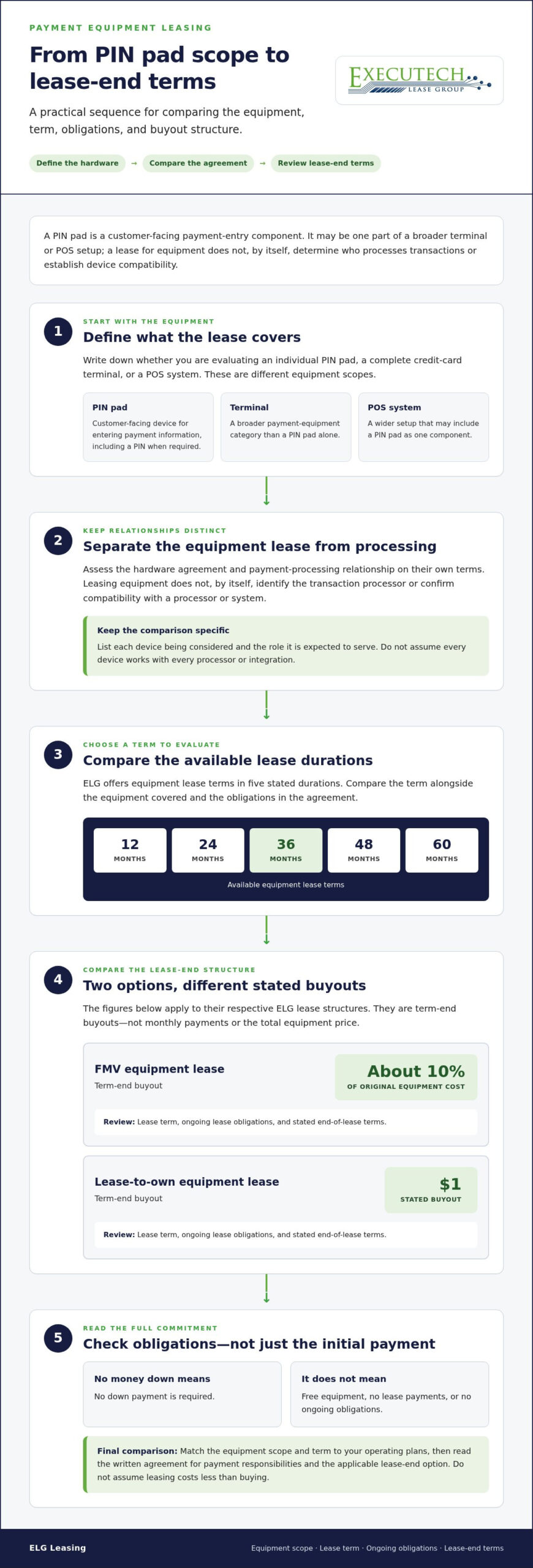
A Practical Path to Evaluating PIN Pad Leasing
A focused review starts with the hardware, then moves to the lease terms. This order helps merchants and payment-industry professionals define the equipment request before comparing contractual obligations. It also keeps the credit-decision stage separate from later steps, which have their own timelines.
- Define the equipment need. Describe whether you are evaluating a PIN pad on its own or as part of a wider payment-equipment setup. Note the checkout operation the equipment is meant to serve. Specifics keep the discussion centered on the hardware involved.
- Describe the operating context. Summarize how the equipment fits into your current payment setup and identify relevant processor or system relationships. An equipment lease does not establish device compatibility or change processor obligations.
- Set the lease questions. Identify the term and end-of-lease structure you want to understand. If you are comparing options, record the stated obligations and end-of-term terms for each.
- Review the agreement. Read the written lease terms against your equipment need before making a decision. Clarify which equipment the agreement covers and distinguish lease responsibilities from payment-processing terms.
Prepare the Equipment and Lease Questions
Bring the hardware description and business context together with the lease points you want to evaluate. For example, note whether your request concerns an individual payment-entry device or a broader equipment setup, then identify the term and end-of-lease structure under review. Prepare any questions about the equipment description, ongoing obligations, and term-end option before beginning the conversation.
Understand the Decision Stage
Our goal is to deliver credit decisions in under 2 business hours. That timeframe applies only to the credit-decision stage. It is not a promise of approval and does not set a timeline for funding, equipment deployment, or installation. Keep those stages distinct as you plan: a credit decision addresses the credit review, not the timing of later steps.
For ISOs, merchant-services professionals, vendors, and other payment-industry partners, a concise inquiry can make the initial equipment conversation more focused. Include the payment-equipment need and the lease questions you want to explore. This gives the discussion a practical starting point without assuming a particular result.
How Executech Lease Group (ELG Leasing) Approaches Payment Equipment Leasing
ELG is a U.S. equipment lease brokerage focused on the payments-technology ecosystem. Its equipment focus includes payment terminals and POS systems. For businesses and industry partners evaluating payment equipment, ELG offers no-money-down equipment leasing, FMV equipment leases, and lease-to-own equipment leases.
ELG does not provide equipment warranties, maintenance, repairs, or replacements. Any equipment warranty comes from the manufacturer. As you review the equipment agreement, identify the applicable manufacturer warranty information and keep those responsibilities separate from the lease.
ELG’s Role in the Merchant-Services Ecosystem
ELG serves merchants, ISOs, independent agents, vendors, resellers, and POS dealers. Each audience may approach payment-equipment leasing from a different business perspective. Merchants may be assessing hardware for their operations, while agents and vendors may be discussing equipment options with merchants. A clear description of the equipment and business context gives the conversation a practical starting point.
Distinguish an individual PIN pad from a complete POS setup before discussing lease options. This helps define the equipment under consideration without assuming compatibility with every processor or integration. ELG’s equipment leasing programs provide information about payment-equipment lease structures.
Start an Appropriate Equipment-Leasing Conversation
Prepare a concise description of the equipment, its intended role, and the lease questions you want to discuss. Merchants can outline the hardware need and the structure they want to evaluate. Vendors, ISOs, and merchant-services professionals can describe the payment-equipment opportunity and their role in the conversation. This keeps the inquiry focused on the equipment and lease options.
ELG’s inquiry page is a contact mechanism for starting an equipment-leasing conversation, not a financing application or a request for a credit decision. Describe the equipment and contract questions clearly so the scope of the discussion is easy to understand.
Pin pad equipment leasing can be a focused starting point for reviewing payment hardware. Prepare the equipment details and the questions you want answered, then use ELG’s inquiry page to begin the conversation.
Make Your Next Equipment Decision With Clarity
Turn your equipment needs into a focused leasing conversation. Before you begin, write down what you are evaluating, how it fits your business, and which points you want clarified in the agreement. Include the equipment scope, lease term, ongoing obligations, and end-of-term structure so the discussion stays specific.
Pin pad equipment leasing is a business decision, not a one-size-fits-all formula. Compare the proposed arrangement with your operating plans, then use the conversation to address the details that remain unclear. A concise equipment brief can help you understand the decision in front of you.
Gather your equipment details and lease questions, then begin an inquiry with ELG to discuss payment-equipment leasing.
Frequently Asked Questions
Does ELG require money down for PIN pad equipment leasing?
ELG offers no-money-down equipment leasing. That does not mean the equipment is free or that there are no ongoing lease obligations. Review the payment commitment, term, and equipment covered as part of your business’s equipment budget.
How fast does ELG make a credit decision?
Our goal is to deliver credit decisions in under 2 business hours. Keep that separate from the funding and equipment-deployment stages. The decision timeframe does not guarantee approval or establish when equipment will be deployed.
How do ELG’s FMV and lease-to-own buyouts differ?
ELG’s FMV option ends with about a 10% buyout. Its lease-to-own option ends with a $1 buyout. Those are end-of-lease figures, not monthly payments or the total equipment price. Review the written terms to identify which structure applies.
Does ELG process payments for merchants leasing PIN pads?
No. ELG does not process payments. Its equipment-leasing role is separate from payment processing. A merchant can discuss equipment leasing with ELG while maintaining a separate payment-processing relationship.
Can PIN pad equipment leasing be separated from a merchant’s processing relationship?
Yes. Equipment leasing is separate from payment processing. A merchant can evaluate a PIN pad lease as an equipment agreement while treating processor terms and obligations as part of a distinct relationship. That separation does not establish device compatibility or change processing terms. Review each arrangement according to its own documentation.
Does ELG provide repairs or replacements if leased PIN pad equipment needs service?
No. ELG does not provide repairs, maintenance, or equipment replacements. Any warranty comes from the equipment manufacturer, not ELG. Refer to the applicable manufacturer warranty information and the equipment agreement to understand their respective terms.

Article by
Robert Ensminger
Robert Ensminger is the founder and CEO of Executech Lease Group (ELG Leasing), which specializes in equipment leasing and financing solutions for the merchant-services, payments, POS, and FinTech industries. Robert helps ISOs, payment processors, POS providers, and software companies build practical equipment leasing programs. He founded ELG in 2010. His work focuses on responsive service, transparent program structures, SaaS-monetization programs, and helping ELG’s partners close more business while creating sustainable revenue.