
The right POS lease isn’t chosen by the monthly payment alone. It’s also shaped by what you want to happen when the term ends. A POS equipment finance lease sets out your obligations for the equipment, but it doesn’t determine your payment-processing relationship or cover every cost connected to your POS setup.
Predictable payments matter, but so do the lease structure and contract details. Executech Lease Group (ELG) offers equipment leases with terms of 12, 24, 36, 48, or 60 months, including FMV and lease-to-own options.
This guide explains what to review in a lease agreement, how FMV and lease-to-own buyouts differ, and which responsibilities deserve your attention before you commit. It also explains how equipment leasing relates to payment processing, so you can keep the equipment agreement separate from the services that handle transactions.
Key Takeaways
- Confirm which POS systems or card terminals the agreement covers, and keep equipment obligations separate from payment-processing services.
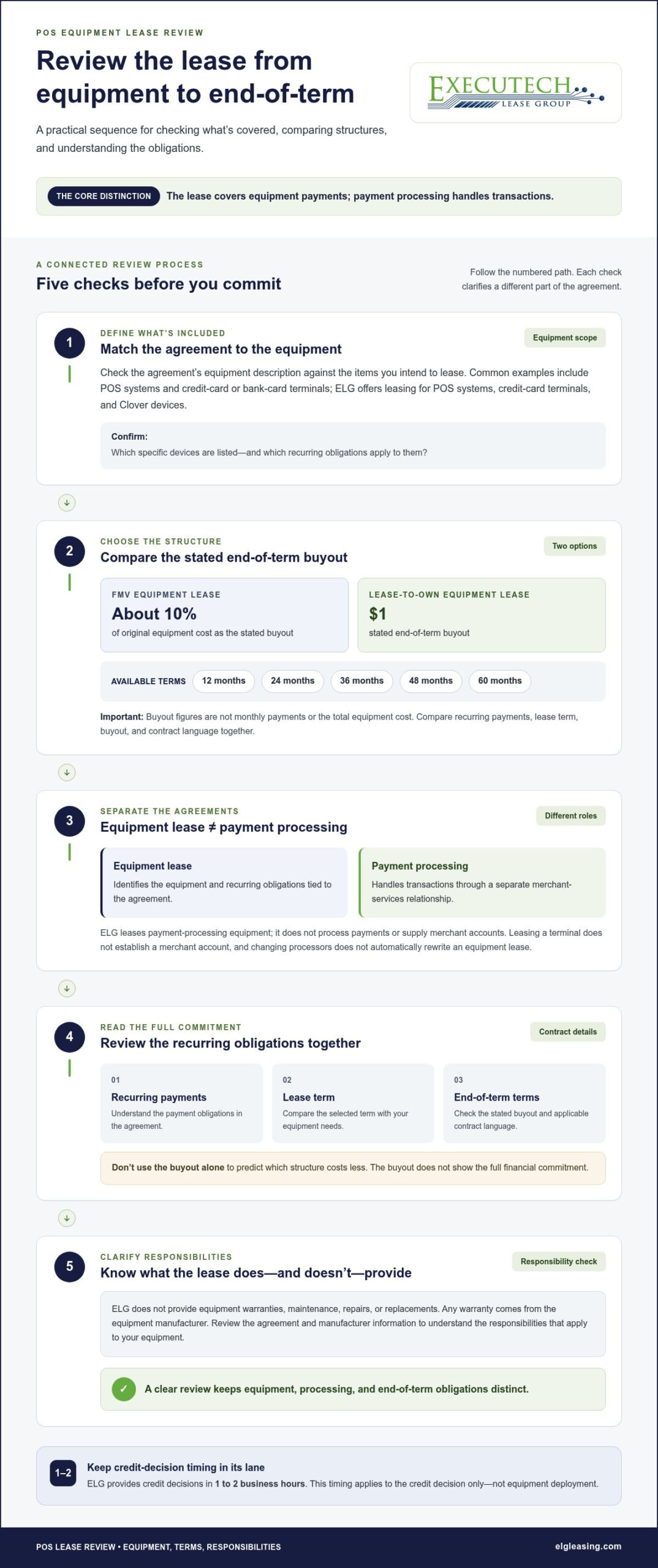
- Compare FMV and lease-to-own by their end-of-term buyouts: about 10% of original equipment cost for an ELG FMV lease, versus $1 for lease-to-own.
- Evaluate a POS equipment finance lease by identifying the equipment, choosing a structure, reviewing obligations, and clarifying responsibilities.
- Our goal is to deliver credit decisions in under 2 business hours. That timing applies only to the credit decision, not equipment deployment.
- Compare ELG’s 12-, 24-, 36-, 48-, and 60-month terms with your equipment needs and end-of-term plans.
What a POS Equipment Finance Lease Covers, and What It Does Not
A POS equipment finance lease is an agreement for payment equipment. It identifies the equipment being leased and the recurring obligations tied to the agreement. It isn’t a merchant account or a service for routing and processing transactions. Keeping those roles separate makes it easier to understand what the lease covers and what remains part of your payment-processing relationship.
In plain English, a POS lease covers equipment payments; payment processing handles transactions. The agreements serve different purposes. A lease can provide access to POS equipment with no money down, but that does not mean the equipment is free or that there are no ongoing obligations. Recurring lease payments and other applicable contract terms still apply.
Which equipment can a POS equipment lease cover?
Common examples include POS systems and credit-card or bank-card terminals used in a merchant’s checkout setup. ELG offers leasing for POS systems and credit-card terminals, including Clover devices. The agreement identifies the specific equipment covered, so review its description carefully. Check that the listed equipment matches the items you intend to lease, and understand which items the recurring obligations apply to.
How is equipment leasing different from payment processing?
Your equipment lease and your payment-processing relationship are separate arrangements. ELG leases payment-processing equipment. It does not process payments or supply merchant accounts. The equipment lease does not set processor pricing or change your obligations under a separate processing agreement. The signed equipment agreement defines the terms that apply to the lease.
This distinction is practical, not just technical. Changing payment processors does not automatically rewrite an equipment lease. Likewise, leasing a terminal does not establish a merchant account or determine how transactions are processed. Review the documents separately: one addresses equipment, while the other addresses processing services.
Before committing, identify the equipment named in the lease and read the payment and end-of-term terms alongside it. Don’t assume that a general reference to a “POS system” includes every device or setup you use. The agreement should identify the equipment covered and the recurring obligations you’re accepting.
- Equipment: POS systems and credit-card or bank-card terminals.
- Lease: The equipment and the associated recurring contract obligations.
- Processing: A separate merchant-services relationship, not supplied by ELG.
ELG’s POS equipment lease programs focus on payment equipment. ELG does not provide equipment warranties, maintenance, repairs, or replacements. Any warranty comes from the equipment manufacturer. Treat those responsibilities as separate from the lease, and review the agreement to understand which equipment it covers and which obligations continue over the term.
FMV vs. Lease-to-Own: Compare POS Lease End-of-Term Structures
Start the comparison with your end-of-term preference. Do you want an FMV structure or a lease-to-own structure? ELG’s FMV option ends with a buyout of about 10% of original equipment cost. Its lease-to-own option ends with a $1 buyout. Neither figure is a monthly payment or the total price of the equipment.
| Structure | Confirmed buyout | End-of-term preference it may suit |
|---|---|---|
| FMV equipment lease | About 10% of original equipment cost | You prefer the FMV structure and its stated buyout amount. |
| Lease-to-own equipment lease | $1 | You prefer the lease-to-own structure and its stated buyout amount. |
Use the table to distinguish the structures, not to predict which one costs less. The buyout amounts alone don’t show the full financial commitment. Review the recurring payments, lease term, and applicable contract language together before deciding. For general background on finance-lease terminology, the Corporate Finance Institute’s finance lease overview provides additional context. The signed agreement governs the terms of your lease.
When does the FMV equipment lease structure fit?
ELG’s FMV equipment lease ends with a buyout of about 10% of original equipment cost. Consider the stated end-of-term amount alongside your preference for the FMV option. Don’t treat the figure as a monthly installment or an estimate of total lease cost. It also doesn’t establish a renewal or return arrangement. Review the agreement for the terms that apply to your lease.
How does lease-to-own differ from an FMV lease?
ELG’s lease-to-own equipment lease ends with a $1 buyout. That amount applies only to this structure. Compared with the FMV lease’s buyout of about 10% of original equipment cost, it is a different stated end-of-term amount, not proof that the lease costs less overall. The fit depends on your preferred structure and the complete payment and contract terms.
To compare the options, use the same questions for each one: What recurring payments apply? What is the lease term? What buyout does the agreement state? Which obligations continue throughout the term? Comparing like with like focuses your decision on the actual commitments rather than a single figure. Don’t assume that the buyout alone determines the monthly payment or the total amount paid under the agreement.
ELG’s lease program options provide a starting point for reviewing the structures. If you’re ready to discuss which POS lease structure fits your plans, send ELG an inquiry about POS leasing.
How to Evaluate POS Lease Terms Before You Commit
A careful review turns a POS equipment finance lease from a headline payment into a clear set of responsibilities. Read the agreement in sequence: confirm the equipment it covers, compare structures, inspect the payment and contract terms, then clarify responsibilities outside the lease. This approach helps you compare the actual commitments without assuming leasing always costs less than buying or improves cash flow.
No money down doesn’t mean no ongoing lease obligations. Review the complete payment schedule and applicable contract terms before signing.
- Identify the equipment. Match the equipment named in the agreement to the payment equipment needed for your business or merchant deployment. Check that the written description reflects the items you intend to lease. Don’t assume a general reference to a POS system covers every device in a setup.
- Select the structure. Compare the FMV and lease-to-own options by their stated end-of-term buyouts and your intended outcome. Focus on which structure aligns with your plans, not on an assumption that one must cost less.
- Inspect the obligations. Review the recurring payment schedule, lease term, and other applicable agreement terms as a whole. Make sure you understand the commitments across the full term rather than judging the agreement by one payment or buyout figure.
- Clarify responsibilities. Separate the lease obligations from equipment warranty matters and other responsibilities described in the agreement. Any warranty comes from the equipment manufacturer, not the leasing company.
Match the equipment and lease structure to your business plan
Start with the payment equipment required for your business or merchant deployment. Then consider your preferred end-of-term outcome and compare the FMV and lease-to-own structures on that basis. Their confirmed buyouts differ, but that alone doesn’t establish total cost or make either option universally preferable. Base your decision on the written terms and your plans for the equipment.
Review the agreement’s obligations and exclusions
Read the complete payment schedule and applicable contract language, including sections that describe responsibilities and exclusions. Don’t infer rights or services that the agreement doesn’t state. In particular, don’t assume a lease includes equipment repairs, maintenance, replacements, upgrades, or a particular cancellation option. Keep manufacturer warranty information separate from the lease terms. Consult a tax professional with tax questions.
Before committing, make sure the equipment description, selected structure, recurring payments, and responsibilities align with your plans. If a term is unclear, resolve its meaning before relying on it. A disciplined review gives you a practical basis for comparing the agreement with your business needs.
From Credit Decision to Equipment Deployment: Keep the Stages Separate
A quick credit decision can clarify one part of a POS equipment finance lease, but it isn’t the same as funding or equipment deployment. Treat these as distinct stages. A decision addresses credit; it doesn’t by itself confirm a funding date, vendor payout, delivery, or installation. Keeping the stages separate gives merchants, vendors, and ISOs a more accurate understanding of what the decision timing means.
What does ELG’s credit-decision goal mean?
Our goal is to deliver credit decisions in under 2 business hours. That timing applies only to the credit decision stage. It isn’t a promise of approval, and it doesn’t state when equipment will be funded, paid out, delivered, or installed. Treat the decision as one defined milestone, not a timeline for everything that follows.
This distinction matters for planning. A merchant may be coordinating a POS equipment lease with a business need, while a vendor or ISO may be aligning equipment and customer conversations. Don’t treat the credit-decision timing as a commitment for later stages. Understand the steps and timing beyond the decision separately, without assuming they happen on a fixed schedule.
What should a vendor or ISO inquiry cover?
For vendors and ISOs, the inquiry is about an equipment-leasing partnership, not a merchant’s financing application. ELG’s Become a Vendor form is an inquiry form. Submitting it does not submit a merchant financing application or produce a credit decision. Keeping the form’s purpose clear directs the conversation toward the vendor relationship rather than an individual credit decision.
Keep the stages distinct as the process moves forward. A credit decision is not a deployment date, and an inquiry is not a merchant application. Merchants should also keep the equipment agreement separate from their payment-processing relationship as they coordinate their plans.
When discussing timing, name the stage in question: credit decision, funding, vendor payout, delivery, or installation. Precise language helps prevent an update about one stage from being mistaken for confirmation of another. It also keeps expectations grounded while the parties coordinate the equipment lease.
Vendors and ISOs exploring an equipment-leasing partnership can use the inquiry for that purpose. It remains separate from a merchant’s financing application.
How Executech Lease Group (ELG Leasing) Fits a POS Equipment Lease
ELG is an equipment lease brokerage serving the U.S. merchant-services and payments-technology ecosystem. Its focus is payment-processing equipment leasing. ELG’s equipment lease terms are 12, 24, 36, 48, or 60 months. The agreement defines the equipment arrangement, term, and obligations. It does not make ELG the merchant’s processor or equipment manufacturer.
Which businesses does ELG serve in the payments ecosystem?
ELG works with merchants and payments-industry participants, including merchant-services ISOs, independent sales agents, vendors, resellers, and POS dealers. A merchant may be considering equipment for its checkout needs, while a vendor or ISO may be exploring a leasing relationship for its merchant network. Each party has a distinct role. ELG doesn’t supply merchant accounts or represent equipment manufacturers.
ELG’s scope also has clear boundaries: it doesn’t process payments or provide equipment warranties, maintenance, repairs, or replacements. Any equipment warranty comes from the manufacturer. Keeping these responsibilities distinct helps each business understand where equipment leasing fits within its payments-technology relationships.
What is the next step for a potential vendor partner?
Vendors and ISOs can use ELG’s inquiry form to begin a conversation about a potential equipment-leasing partnership. It’s a vendor inquiry, not a merchant financing application, and submitting it doesn’t produce a credit decision. Use the inquiry to introduce your business and its role in the payments ecosystem.
If your organization is exploring this type of relationship, start with a vendor inquiry to open the partnership conversation.
Put Your POS Leasing Decision Into Motion
A well-chosen POS equipment finance lease should fit into a clear business plan. Before taking the next step, align the people involved on the equipment needs, intended lease structure, and questions that still need answers. That preparation keeps discussions focused and gives each participant a clearer view of the decision.
For merchants, the goal is a lease decision grounded in the written terms and plans for the equipment. For vendors and ISOs, the next step may be exploring whether an equipment-leasing partnership fits their payments-technology business. Keep the purpose of each conversation clear, and focus on the details that matter to your role.
ELG’s vendor inquiry is a direct way to open a partnership conversation. Use it to introduce your business and explore the fit. The inquiry is not a merchant financing application.
With a clear plan and the right conversation underway, you can approach your next POS equipment decision with greater confidence.
Frequently Asked Questions
Does ELG require money down?
ELG offers no-money-down equipment leasing. That does not mean the equipment is free or that there are no ongoing lease obligations.
How fast does ELG make a decision?
Our goal is to deliver credit decisions in under 2 business hours. Keep that separate from the funding and equipment-deployment stages.
Does ELG process payments?
No. ELG does not process payments. Its equipment-leasing role is separate from payment processing.
Does an ELG equipment lease include a warranty or repairs?
ELG does not provide equipment warranties, maintenance, repairs, or replacements. Any warranty comes only from the equipment manufacturer. Review the manufacturer’s warranty documentation for coverage details, and read the lease agreement separately to understand its equipment-related obligations.
How much does a POS equipment finance lease cost?
There isn’t one general amount that applies to every equipment arrangement. Review the proposed payment schedule and contract terms for the equipment and lease structure under consideration. Consider the full set of payments and any applicable end-of-term amount together. A buyout figure, where applicable, is distinct from both a monthly payment and the equipment’s total price, so don’t use it as a substitute for the full schedule.
Can a POS equipment lease be separate from my payment processor?
Yes. The equipment agreement and processing relationship are separate arrangements. That separation doesn’t establish that every device, integration, or processor configuration will work together. The existence of a lease doesn’t confirm compatibility or portability. Treat equipment selection and processing arrangements as distinct parts of your POS planning, and don’t infer changes to processor obligations from the equipment contract.
Does ELG offer Clover device leasing?
Yes. ELG offers leasing for Clover devices. This doesn’t establish that every model, integration, or processor configuration is supported, or that ELG is an authorized partner, reseller, or affiliate of the brand. The equipment agreement concerns the leased device; it doesn’t provide transaction processing. Review the equipment description in the agreement to understand which device it covers.

Article by
Robert Ensminger
Robert Ensminger is the founder and CEO of Executech Lease Group (ELG Leasing), which specializes in equipment leasing and financing solutions for the merchant-services, payments, POS, and FinTech industries. Robert helps ISOs, payment processors, POS providers, and software companies build practical equipment leasing programs. He founded ELG in 2010. His work focuses on responsive service, transparent program structures, SaaS-monetization programs, and helping ELG’s partners close more business while creating sustainable revenue.