Franchise growth capital and POS equipment leasing solve different problems. POS financing for multi-location franchise businesses is best assessed as an equipment decision for each site, not as a substitute for expansion funding or payment processing. A shared equipment plan can coordinate technology choices while accounting for each location’s needs.
Look beyond the monthly payment when comparing options. Lease terms, end-of-lease obligations, and the separation between equipment costs and payment processing all matter. This guide explains how to map equipment needs across locations, compare lease structures, and identify a practical next step.
Executech Lease Group (ELG) provides leasing for POS systems and credit-card terminals. ELG finances equipment, but does not process transactions or provide merchant accounts. Understanding that distinction can help you plan equipment separately from processing arrangements and broader franchise funding.
Key Takeaways
- Build a location-by-location inventory that records each site, equipment category, selected lease term, and decision-maker.
- Separate confirmed equipment requirements from assumptions about brand, model, or processor compatibility before setting the equipment scope.
- Compare FMV and lease-to-own structures by their end-of-lease obligations: the FMV buyout is about 10% of original equipment cost, while lease-to-own ends with a $1 buyout.
- Evaluate POS financing for multi-location franchise businesses as an equipment-planning decision, separate from broader franchise-growth funding.
- Review lease term choices of 12, 24, 36, 48, or 60 months against your location plan and obligations.
Why POS Financing Matters When a Franchise Operates Multiple Locations
POS equipment leasing addresses a specific need: acquiring payment hardware through a lease arrangement. It can help you plan for POS systems and credit-card terminals without blending equipment decisions into a broader franchise funding request. POS equipment leasing covers payment hardware; franchise expansion financing covers broader business costs. Keeping the two separate makes budgets and obligations easier to review.
Opening or growing a franchise can involve acquisition costs, real estate, construction, staffing, working capital, and franchise fees. Those costs belong in a broader growth plan, not automatically in a POS equipment inventory. Equipment leasing also doesn’t determine payment processing arrangements, transaction pricing, or processor obligations. Those are separate decisions with separate terms.
Which franchise costs belong in a POS equipment plan?
Keep the equipment scope focused on POS systems and credit-card terminals. For each location, record the equipment already in place, what the site needs, and whether new equipment is being considered for purchase or lease. Keep real estate, build-out, staffing, and franchise fees in separate budget categories. This turns a broad funding discussion into a specific equipment plan.
A POS system can include different components and functions, so define the hardware under consideration rather than treating every technology expense as one category. Record relevant equipment by site, including what is confirmed and what still needs to be resolved. This gives franchise decision-makers a clear scope to compare.
Why multiple locations need a coordinated equipment view
Start with a shared record of locations, equipment needs, and intended rollout sequence. For each site, note the operating format, planned payment hardware, and any known differences in the transaction environment. This makes variations visible and helps distinguish a site-specific requirement from an assumption carried over from another location.
Coordination doesn’t require identical setups everywhere. A franchise may want consistent equipment standards while allowing for differences in site layout, service format, or transaction flow. Document both the elements you want standardized and the reasons a particular location may need a different scope. This supports clearer planning without assuming that every brand, model, integration, or processor will work across all sites.
For POS financing for multi-location franchise businesses, start with an equipment plan for each site rather than a single total that combines hardware and expansion costs. ELG offers equipment lease options for POS systems and credit-card terminals. Its POS equipment leasing programs can be considered as one part of a broader technology plan. Keep equipment scope, franchise growth funding, and payment processing distinct as you assess each location.
How to Map POS Equipment Needs Across Franchise Locations
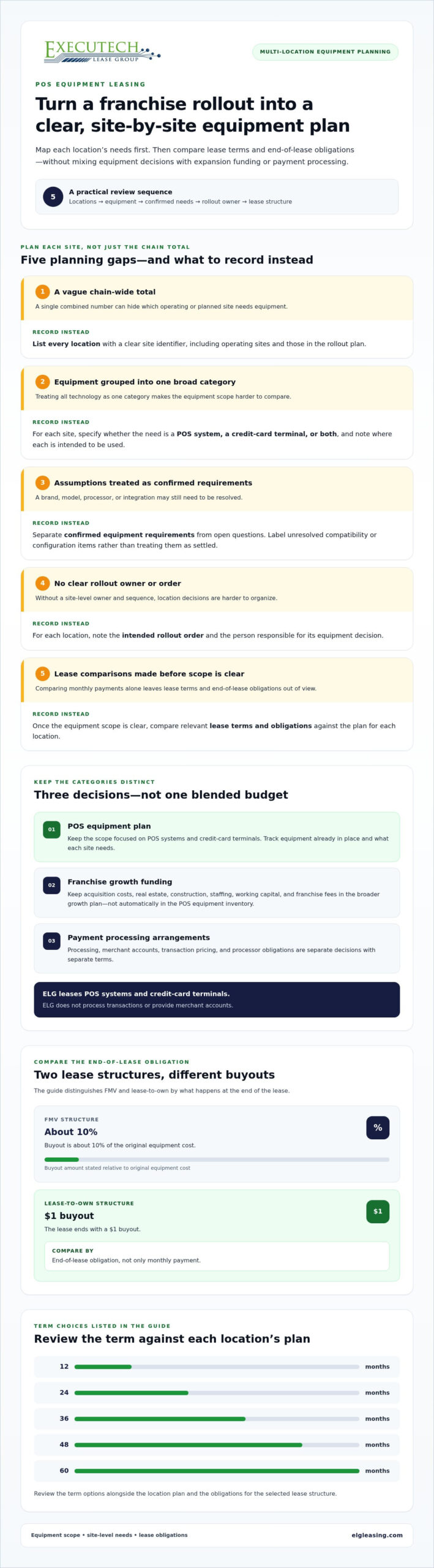
A clear inventory turns a multi-site technology plan into location-level decisions. A multi-location POS plan starts with an equipment inventory, because you can’t compare lease needs clearly until you know what each site requires. Make the record practical: identify the site, equipment category, decision owner, and rollout sequence. Separate confirmed requirements from open assumptions.
Build a location-by-location equipment inventory
List every planned location, including operating sites and those in the rollout plan. For each, record the POS system or credit-card terminal requirements, who owns the decision, and where the site sits in the sequence. Don’t assume one location’s configuration applies everywhere. Differences in operating format or transaction environment may affect the equipment scope.
Use this workflow to prepare the inventory for lease review:
- List the locations. Give each operating or planned site a clear identifier so equipment needs don’t disappear in a vague chain-wide total.
- Record equipment by site. Note whether the planned category is a POS system, a credit-card terminal, or both. Describe where each item is intended to be used.
- Mark what’s confirmed. Separate established equipment requirements from assumptions about a brand, model, processor, or integration. Label unresolved items rather than treating them as settled.
- Set the sequence and owner. Record the intended rollout order and the person responsible for each location’s equipment decision. This organizes planning without implying a delivery or installation schedule.
- Review the lease structure. Once the equipment scope is clear, compare relevant lease terms and obligations with the plan for each location.
Separate equipment scope from processing arrangements
Keep the equipment list distinct from payment-processing arrangements. ELG leases POS and payment-processing equipment. It doesn’t process payments, supply merchant accounts, set transaction pricing, or control processor obligations. Those arrangements have separate terms and decision-makers.
Record compatibility carefully instead of assuming it. A device or configuration used at one site doesn’t establish that every processor, model, or integration will work across the franchise. Track confirmed requirements separately from items still being evaluated by the relevant decision-makers. This keeps the lease scope focused on equipment and avoids implying that equipment leasing includes processing services.
For POS financing for multi-location franchise businesses, the inventory provides a shared reference for discussing equipment categories, sites, and lease structures without blending those decisions into processing terms. Vendors, ISOs, and MSPs coordinating equipment-leasing opportunities can use ELG’s vendor inquiry form. This form is for an inquiry, not a franchisee financing application or credit decision.
Compare POS Equipment Lease Structures Before Choosing
Once you’ve defined the equipment scope for each site, compare lease structures by their end-of-lease obligations, not just by the recurring payment. ELG offers equipment lease term choices of 12, 24, 36, 48, and 60 months. Compare the end-of-lease obligation with the equipment plan for each location.
| Lease structure | End-of-lease buyout | What to focus on |
|---|---|---|
| FMV equipment lease | About 10% of original equipment cost | Include the stated buyout in your end-of-term planning. |
| Lease-to-own equipment lease | $1 | Consider the stated buyout alongside the lease’s recurring obligations. |
These figures are end-of-lease buyouts, not monthly payments or total equipment prices. For a franchise group, compare each structure with the equipment assigned to each location and the lease term under consideration. A site-by-site record helps you determine whether one structure fits the plan across locations or whether equipment decisions need to be reviewed separately.
FMV equipment lease versus lease-to-own
An FMV equipment lease ends with a buyout of about 10% of original equipment cost. A lease-to-own equipment lease ends with a $1 buyout. Keep those outcomes distinct. Neither figure describes recurring payments or determines a location’s payment-processing terms.
Review the selected term and end-of-lease obligation together. The buyout figure alone doesn’t show the full financial commitment. Include the lease’s recurring obligations and end-of-term terms in your comparison.
What no-money-down does, and doesn’t, mean
No-money-down refers only to the down-payment requirement. It doesn’t mean the equipment is free or remove recurring lease payments and other obligations under the agreement. Keep those commitments visible in your multi-location plan, especially when comparing equipment decisions across sites.
Equipment leasing also doesn’t determine how a franchise accepts or processes payments. ELG leases payment-processing equipment, but doesn’t process payments, supply merchant accounts, set transaction pricing, or control processor obligations. Those are separate relationships. Don’t treat a lease structure as a processing arrangement or assume that choosing equipment establishes processor compatibility or terms.
For POS financing for multi-location franchise businesses, compare the equipment lease by its term, ongoing obligations, and distinct end-of-lease buyout. Review processing decisions separately.
Use This Decision Checklist for a Multi-Location POS Lease
A useful lease decision connects each location to its equipment and the people responsible for the decision. Then review the lease structure and obligations against that specific plan. This keeps the process practical without assuming every site has the same needs or that one structure is the cheapest or best fit for every operator.
Checklist summary: Inventory the locations, define the equipment, compare terms and end-of-lease obligations, separate support and processing responsibilities, then plan the appropriate inquiry.
- Inventory the sites. List operating and planned locations, identify each site’s rollout sequence, and name the decision-maker responsible for its equipment plan.
- Define the equipment scope. Record the POS system or credit-card terminal category for each location. Keep confirmed requirements distinct from assumptions about compatibility, brand, model, or processor.
- Compare lease terms. Review the available term choices against the equipment plan and how long you expect the arrangement to fit your location-level planning. Don’t select a term based only on a monthly payment.
- Review obligations. Check recurring lease obligations and confirm the agreement’s end-of-lease buyout description matches the selected FMV or lease-to-own structure.
- Plan inquiries. Gather the site and equipment record, identify the relevant decision-maker, and make clear whether the inquiry concerns payment equipment leasing or another business need.
Review term, buyout, and ongoing obligations
Compare the available 12, 24, 36, 48, and 60-month choices with your equipment planning needs. The appropriate structure depends on the equipment and your end-of-term priorities, not a universal cheapest option. Read recurring obligations alongside buyout terms. Don’t assume cancellation, renewal, upgrade, or early-termination rights that aren’t stated in the agreement.
Make the comparison visible across locations. A simple record can include the location, equipment category, selected term, lease structure, and decision-maker. If sites differ, document those differences instead of forcing one choice across the full group.
Keep equipment support and payment processing in separate lanes
Equipment warranties come only from the equipment manufacturer. ELG doesn’t provide maintenance, repairs, replacements, or support coverage. Keep those responsibilities distinct from the lease review so the equipment plan doesn’t imply services the lease doesn’t provide.
Payment processing is separate, too. ELG leases equipment, but doesn’t process payments, supply merchant accounts, set transaction pricing, or control processor obligations. Keep the equipment agreement and processing relationship in separate records, with the appropriate decision-maker for each.
For POS financing for multi-location franchise businesses, this checklist gives you a clear basis for reviewing equipment leasing without promising an approval or outcome. Vendors, ISOs, and MSPs can use the inquiry form to discuss equipment-leasing opportunities.
How Executech Lease Group (ELG) Fits a Franchise POS Equipment Plan
Executech Lease Group (ELG) is an equipment lease brokerage in the merchant-services and payments-technology ecosystem. For franchise operators, ELG’s role is focused on leasing payment equipment such as POS systems and credit-card terminals as one part of a location-level technology plan. Equipment planning can remain distinct from funding for franchise acquisition, build-out, or other growth needs.
What ELG’s equipment leasing role includes
ELG leases equipment. It doesn’t process payments, supply merchant accounts, set transaction pricing, or control a franchise’s processor obligations. An equipment lease and a payment-processing arrangement are separate relationships with separate terms and responsibilities. Keep them distinct as you plan each location’s hardware and payment setup.
ELG’s equipment lease options include FMV and lease-to-own structures, with term choices to compare against a franchise’s equipment plan. The appropriate scope depends on the needs documented for each location. Don’t assume that every brand, model, processor, or integration is supported, or that leasing equipment establishes compatibility with a processing arrangement.
Equipment responsibilities also have clear boundaries. Any equipment warranty comes from the manufacturer. ELG doesn’t provide maintenance, repairs, replacements, installation, training, or support coverage. Account for those responsibilities in the wider operating plan without treating them as part of the equipment lease.
Where to take the next step
Review the equipment lease program options alongside your location inventory and equipment scope. This gives you a practical basis for identifying which lease structure to evaluate while keeping equipment decisions separate from processor terms.
ELG’s credit-decision timing is a goal, not a promise of funding, equipment delivery, or installation. Our goal is to deliver credit decisions in under 2 business hours. The decision process remains separate from processor setup and the location rollout schedule.
For POS financing for multi-location franchise businesses, bring your location list, equipment categories, and decision priorities into the conversation. Vendors and ISOs can use ELG’s Become a Vendor inquiry form to discuss equipment-leasing opportunities. It’s an inquiry mechanism, not a franchisee financing application or a credit decision.
Turn Your Equipment Plan Into a Clear Next Step
A location-aware equipment plan helps your team make decisions in sequence rather than treating every site as one large project. Use the inventory to assign decision ownership, clarify which locations need action first, and keep equipment planning distinct from broader franchise funding and payment processing.
That structure provides a practical starting point for POS financing for multi-location franchise businesses: a defined equipment scope and a clear understanding of who needs to be involved. Vendors and ISOs coordinating payment-equipment leasing opportunities can use ELG’s Become a Vendor form to make an inquiry. The form is not a franchisee financing application or credit decision.
With responsibilities and next steps clearly assigned, you can move forward with a more organized plan for each location.
Frequently Asked Questions
How does POS financing differ from financing a franchise location?
POS equipment financing covers payment hardware acquired through a lease, while financing a franchise location may address broader business needs such as acquisition, build-out, or working capital. A terminal lease belongs in the equipment plan, while costs for preparing a new site belong in the broader growth plan. Keeping these budgets separate helps clarify the purpose of each arrangement and track its obligations.
Can a franchise operator lease POS equipment for multiple locations?
Yes. A franchise operator can plan equipment leasing across multiple locations by using a site-by-site record to define what each location needs. One site may require a POS system while another needs a credit-card terminal. A coordinated inventory organizes the equipment scope and rollout sequence without assuming every location needs the same setup or that one lease arrangement automatically covers every site.
What lease terms are available for POS equipment through ELG?
ELG offers POS equipment lease term choices of 12, 24, 36, 48, and 60 months. Compare the available terms with the equipment plan for each location and the obligations you’re prepared to manage. Recording the selected term alongside the location and equipment category helps decision-makers review the plan consistently without assuming every site needs the same term.
How do the FMV and lease-to-own equipment buyouts differ?
The FMV equipment lease ends with a buyout of about 10% of original equipment cost; the lease-to-own equipment lease ends with a $1 buyout. These are end-of-lease figures, not monthly payments or total equipment prices. Record which structure applies to each lease so the buyout isn’t mistakenly carried over to another location or lease type.
Does no-money-down POS equipment leasing mean there are no ongoing payments?
No. No-money-down refers to the down-payment requirement. Recurring lease payments and other obligations under the agreement still apply. When assessing equipment plans across several sites, include each lease’s ongoing obligations in your budget review rather than treating the absence of a down payment as the full cost picture. POS financing for multi-location franchise businesses still requires careful review of each agreement’s terms.
Does ELG process payments or provide equipment maintenance?
No. ELG leases payment-processing equipment but doesn’t process transactions, supply merchant accounts, or set transaction pricing. It also doesn’t provide maintenance, repairs, replacements, or support coverage. Any equipment warranty comes from the manufacturer. Keep these responsibilities distinct: the equipment lease addresses the leased hardware, while payment processing and equipment-related service responsibilities sit outside ELG’s leasing role.
How quickly does ELG make a credit decision?
Our goal is to deliver credit decisions in under 2 business hours. This applies to the credit-decision stage only. It doesn’t promise approval or establish when funding, equipment delivery, or installation will occur. For a franchise rollout, treat the credit decision as one separate step in the wider equipment plan, not as a schedule for putting hardware into operation at each location.

Article by
Robert Ensminger
Robert Ensminger is the founder and CEO of Executech Lease Group (ELG Leasing), which specializes in equipment leasing and financing solutions for the merchant-services, payments, POS, and FinTech industries. With more than 20 years of industry experience, Robert helps independent sales organizations, payment processors, POS providers, and software companies develop practical leasing, subscription, and SaaS-monetization programs. He founded ELG in 2010 and guided the company to recognition on the Inc. 5000. His work focuses on responsive service, transparent program structures, and helping ELG’s partners close more business while creating sustainable revenue.