Is your checkout line moving slower than it did three years ago? For many merchants, aging terminals and outdated operating systems aren’t just a nuisance; they’re a significant security liability. With the mandatory shift to PCI DSS 4.0 standards, sticking with “good enough” hardware is a gamble you simply cannot afford to take. You likely feel the frustration of watching a customer walk away because the terminal lagged, yet the thought of a massive upfront bill for new Clover Stations feels equally paralyzing.
Strategic POS hardware refresh programs turn this capital burden into a competitive advantage. You don’t have to choose between modern security and healthy cash flow. This guide shows you how to structure a cost-effective refresh that eliminates technical debt and streamlines your entire operation. We will explore how flexible 12 to 60 month lease models and FMV options provide predictable monthly costs while ensuring universal compliance across all terminals. It’s time to stop reacting to hardware failure and start managing your technology as a powerful, seamless asset.
Key Takeaways
- Identify the hidden costs of legacy tech, including security vulnerabilities and customer friction, to justify a proactive hardware update.
- Master a step-by-step audit process to inventory your fleet and map out critical “End of Life” dates for all terminals and peripherals.
- Compare FMV and Lease-to-Own models to determine which POS hardware refresh programs best align with your business’s cash flow and technology cycles.
- Execute a seamless two-phase rollout that uses pilot testing to eliminate friction points before a full-scale implementation.
- Leverage flexible 12–60 month lease terms to make modern hardware financially invisible while maintaining universal PCI compliance.
Why a POS Hardware Refresh is Critical in 2026
A POS hardware refresh is the systematic replacement of aging terminals, scanners, and printers across your entire business. It is a deliberate strategy to swap out failing legacy tech for modern, high-performance systems. In 2026, a 3-5 year hardware lifecycle is the new industry standard. Technology moves too fast for ten-year-old registers to remain viable. If you are still using the same terminals you bought in 2020, you are likely accumulating “Technology Debt.”
Technology Debt is the silent killer of merchant growth. It represents the future costs you incur by choosing a quick fix over a better long-term solution. Every time a terminal lags or a printer jams, you pay interest on that debt through lost labor hours and frustrated customers. POS hardware refresh programs help you retire this debt by providing a clear path to modern equipment without the massive upfront capital hit.
The Security and Compliance Mandate
Security is no longer a suggestion; it is a requirement. PCI DSS 4.0 standards now demand continuous compliance and advanced encryption that legacy hardware simply cannot support. Older devices often lack the processing power to handle modern phishing-resistant multi-factor authentication or the latest tokenization protocols. Running a Windows-based POS system past its end-of-life date leaves your business wide open to unpatched security vulnerabilities and potential data breaches. As you transition to cloud-based SaaS POS software, your hardware must meet higher performance specs to handle real-time data syncing and remote management features.
Enhancing the Customer Checkout Experience
Customer perception is tied directly to your hardware. Modern interfaces like the Clover Station project an image of efficiency and security. If your checkout process is slow, your brand feels dated. Today’s shoppers expect contactless and mobile payment options at every touchpoint. These features are no longer optional. A successful refresh streamlines your operations through:
- Faster Processors: Reduce transaction lag and eliminate checkout bottlenecks.
- High-Speed Thermal Printers: Cut down on paper jams and wait times.
- Universal Contactless Support: Accept every tap, dip, and swipe with ease.
Investing in a refresh program ensures your business remains a high-standard environment that values both security and speed. By adopting one of the many POS hardware refresh programs available, you can modernize your storefront while keeping your monthly costs predictable.
How to Audit Your Current Point-of-Sale Fleet
Successful POS hardware refresh programs don’t start with a purchase order. They start with data. You need a transparent view of every asset in your fleet to avoid wasting capital on unnecessary upgrades or missing critical failures. A blind approach leads to fragmented systems and unpredictable expenses. A structured audit ensures you only replace what’s necessary, when it’s necessary.
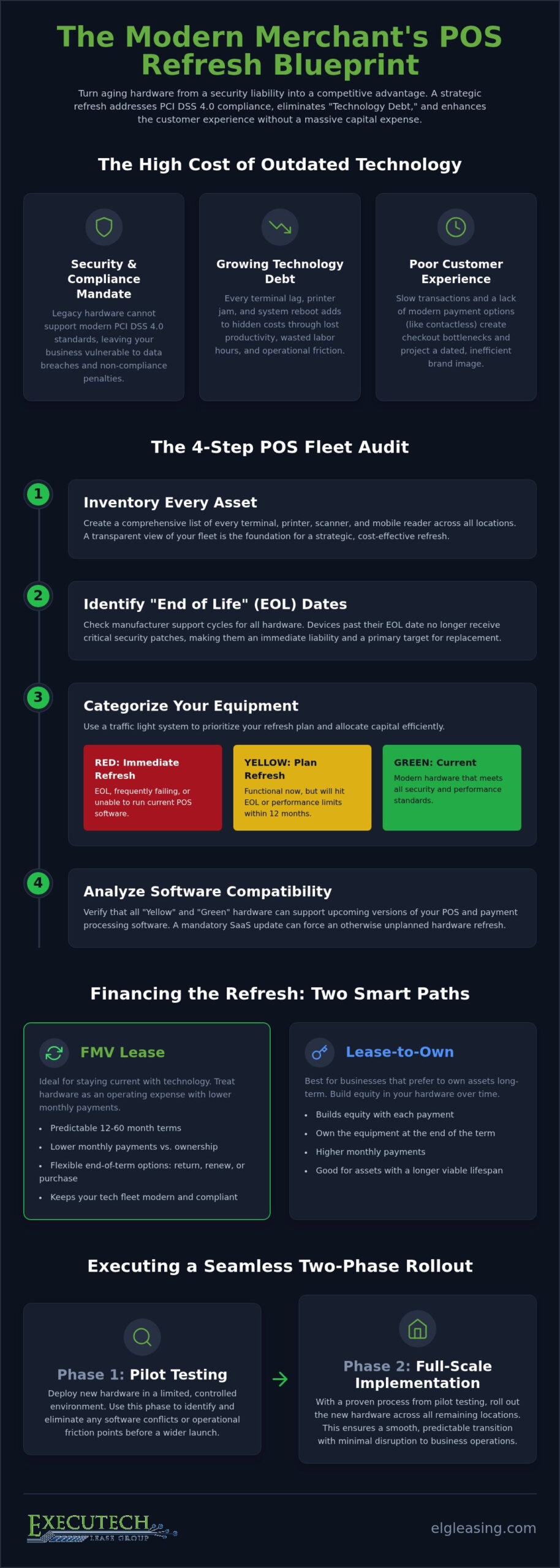
The audit process follows four decisive steps. First, inventory every terminal, printer, and scanner across all locations. Don’t skip back-office units or mobile readers. Second, identify the “End of Life” (EOL) dates for every model. Manufacturers eventually stop supporting older hardware with security patches and driver updates. If a device is past its EOL date, it is a liability. Third, categorize your equipment using a simple traffic light system:
- Red (Immediate Refresh): Units that are EOL, frequently failing, or unable to run current software.
- Yellow (Plan Refresh): Hardware that is currently functional but will hit EOL or performance limits within 12 months.
- Green (Current): Modern equipment that supports all required security and performance standards.
Finally, analyze software compatibility for upcoming SaaS updates. If your processor can’t handle the next version of your POS software, a hardware update is mandatory to avoid system crashes.
Identifying Performance Bottlenecks
Watch for the warning signs that indicate hardware fatigue. Frequent reboots and lagging transaction times are clear indicators. If your staff spends five minutes a day restarting a terminal, you’re losing hours of productivity every month. Assess the physical condition of touchscreens and card readers. Worn-out magnetic stripe readers or unresponsive screens frustrate customers and slow down the line. This is particularly important when evaluating Clover station leasing options, as high-volume environments demand hardware that can keep pace with peak hours without hesitation.
Software and SaaS Compatibility Check
Modern cloud based POS financing models often bundle software and hardware because the two are now inseparable. Legacy terminals lack the memory and processing speed required for real-time reporting and advanced inventory management. You must ensure your hardware supports upcoming features like AI-driven analytics or integrated omnichannel sales. Using a subscription-based lease keeps your hardware and software in sync, preventing the technical debt we discussed earlier. If you’re unsure where your fleet stands, auditing your equipment with a leasing expert can clarify your next steps.
Financing the Refresh: FMV vs. Lease-to-Own
A hardware audit reveals what you need. Financing determines how you get it without draining your cash reserves. Most merchants struggle with the upfront cost of a full fleet update. This is where strategic POS hardware refresh programs provide a financial bridge. You can choose between Fair Market Value (FMV) leases and Lease-to-Own programs. Each serves a specific operational goal. Your choice depends on how quickly you want to cycle through new technology.
The 12 to 60 month terms offered in these programs are designed to align with actual hardware lifecycles. A 36 month lease matches the rapid pace of payment terminal innovation. A 60 month lease might suit more durable peripherals. Beyond cash flow management, leasing offers significant tax advantages. For the 2026 tax year, the Section 179 deduction limit is $2,560,000. This allows many businesses to deduct the full cost of hardware and software in the year it’s placed in service. Always consult your tax professional to confirm how these deductions apply to your specific lease structure.
Fair Market Value (FMV) for Maximum Flexibility
FMV leases are the gold standard for rapid tech cycles. They offer the lowest monthly payments because you’re paying for the use of the equipment rather than the full purchase price. This model is perfect for Clover Mini leasing. It allows you to return and refresh your technology every three years. You avoid the burden of “zombie” hardware; these are devices that still turn on but lack the speed or security to handle modern transaction volumes. FMV leases keep your storefront modern, secure, and efficient without the risk of technology obsolescence.
Lease-to-Own for Long-Term Asset Retention
Some assets don’t need a refresh every three years. Heavy-duty cash drawers, rugged scanners, and certain kitchen display systems have longer operational lifespans. In these cases, Lease-to-Own makes sense. You pay a higher monthly amount than an FMV lease, but you own the hardware at the end of the term. This is a pragmatic choice for businesses that want to build equity in their equipment. It’s about balance. You can use POS hardware refresh programs to lease-to-own your durable peripherals while using FMV leases for your primary terminals. This hybrid approach ensures you own what lasts and refresh what evolves.
Executing a Seamless Hardware Rollout
Executing a hardware rollout is where strategy meets reality. Poor execution can erase the financial benefits of your refresh. You need a phased approach that keeps your doors open and your staff confident. High-standard POS hardware refresh programs succeed because they prioritize logistics as much as technology. It isn’t just about unboxing new gear; it’s about maintaining momentum.
Phase 1 starts with a pilot. Choose a single “control” location to identify friction points before a full-scale deployment. This reveals hidden issues with cabling or software configurations that could derail a multi-site rollout. Phase 2 involves establishing a rollout schedule. You must minimize downtime during peak business hours. Midnight installs or shift-change swaps are often necessary. In Phase 3, coordinate with your leasing partner. You want “just-in-time” equipment delivery to avoid storing expensive hardware in unsecure backrooms. Finally, Phase 4 focuses on staff training. Ensure your team is proficient with new interfaces like the Clover Station or Flex before they face a line of customers.
Minimizing Operational Downtime
Downtime is lost revenue. You can avoid it by “hot-swapping” terminals between shifts. This keeps at least one lane open at all times. Ensure your network and cabling are fully tested before the new hardware arrives. Outdated Cat5 cables can bottleneck a modern system. Many merchants utilize Clover Flex financing to provide mobile backup units during the transition. These handheld devices allow you to keep taking payments even if a countertop terminal is offline for configuration. It’s a simple way to ensure your business remains functional through every phase of the update.
Post-Rollout Support and Optimization
The work doesn’t end when the last box is unpacked. You must set up a feedback loop with your staff. They are the first to notice technical glitches or workflow bottlenecks. Monitor your transaction data closely. You should see a measurable increase in speed and a decrease in terminal reboots. This verifies the ROI of your new hardware. Finally, start planning the next refresh cycle the moment the current one ends. Technology won’t wait for your hardware to fail. Continuous improvement is the only way to stay ahead of the competition. If you’re ready to accelerate your business with modern equipment, explore our flexible POS leasing terms to find a plan that fits your rollout schedule.
Future-Proofing with ELG Leasing Refresh Programs
ELG Leasing removes the friction from technology updates. We specialize in making the “refresh” financially invisible through low monthly payments. By utilizing POS hardware refresh programs, you move away from the “buy and hold until failure” mentality that creates technical debt. We offer flexible 12 to 60 month terms that we tailor precisely to your specific hardware EOL dates. This ensures you don’t pay for equipment that has become a security liability. Our model isn’t limited to physical terminals. We streamline your entire technology stack by financing both the hard costs of devices and the soft costs of your cloud-based SaaS POS software. You gain immediate access to premium hardware like the Clover Station or Flex without the heavy upfront price tag that often stalls business growth.
Tailored Solutions for ISOs and Sales Agents
ISOs and sales agents find that modern POS hardware refresh programs are a primary driver for merchant retention. When you provide a clear, structured path to modern hardware, you secure your residuals for years to come. We offer white-labeled leasing experiences that allow you to strengthen your own brand identity while leveraging our financial expertise. You stop being a vendor and start being an “Efficient Expert” in fleet management. This approach makes it easier to monetize your merchant relationships. It protects your ecosystem from competitors who might use aging hardware as an entry point. By offering a seamless upgrade path, you provide the relief of simplicity that modern merchants demand.
Getting Started with Your Refresh Strategy
Your journey toward a future-proof storefront begins with a direct consultation. We work with you to map out a comprehensive 5-year equipment roadmap based on the audit categories we discussed earlier. Our application process is direct and transparent. We help you secure funding for your entire fleet quickly, allowing for “just-in-time” delivery that matches your rollout schedule. Many merchants hesitate because they believe leasing adds a layer of complexity to their books. The reality is that leasing simplifies your operations. It consolidates your technology expenses into one predictable, manageable monthly payment. You stop reacting to hardware failure. You start managing your technology as a powerful asset. Our goal is to get you what you need with minimal friction so you can focus on the results that matter.
Modernize Your Operations for 2026
Technical debt isn’t just a line item; it’s a direct barrier to your business growth. We’ve explored how auditing your fleet and choosing the right financial structure can eliminate security gaps and checkout friction. By leveraging POS hardware refresh programs, you ensure your terminals remain secure, compliant, and efficient. It’s about moving from reactive hardware fixes to a proactive, five-year technology roadmap that protects your margins and improves customer perception.
ELG Leasing provides the specialized expertise needed to transition your fleet without the capital strain. We offer 12 to 60 month flexible leases and comprehensive national B2B support to simplify even the most complex upgrades. As Clover specialist financing experts, we help you access premium hardware and SaaS software through a single, streamlined process. You don’t have to navigate these technical shifts alone or risk your cash flow on large upfront purchases.
Streamline your POS hardware refresh with ELG Leasing today. Take control of your technology cycle and give your business the modern edge it deserves. Your future-proof storefront is just one decision away.
Frequently Asked Questions
What is a POS hardware refresh program?
A POS hardware refresh program is a systematic strategy to replace aging point of sale equipment with modern terminals and peripherals. These programs ensure your business remains compliant with current security standards like PCI DSS 4.0. Instead of waiting for a total system failure, you proactively update your tech stack. This approach eliminates technical debt and keeps your checkout speed high. It transforms a capital burden into a predictable monthly operational expense.
How often should a business refresh its POS hardware?
Industry standards in 2026 suggest a 3 to 5 year lifecycle for primary terminals. While a cash drawer might last longer, the internal processors of a register become obsolete as software demands increase. By the three year mark, most hardware struggles to run the latest cloud based SaaS updates efficiently. A regular refresh cycle prevents the hidden costs of slow transactions and security vulnerabilities. It keeps your storefront aligned with modern consumer payment expectations.
Can I lease a Clover terminal for my hardware refresh?
You can access specialized leasing for the entire Clover ecosystem, including the Station, Mini, and Flex models. These POS hardware refresh programs allow you to deploy premium hardware without the significant upfront cost typically required for a full fleet update. Leasing provides the flexibility to choose between 12 and 60 month terms based on your specific operational needs. It is the most efficient way to maintain a modern, high standard checkout environment.
What happens to my old equipment during a refresh?
Old equipment is typically decommissioned and securely disposed of to protect sensitive cardholder data. If you utilize an FMV lease, you simply return the units to the leasing partner at the end of the term. This removes the logistical headache of storing or selling outdated “zombie” hardware. For businesses with owned equipment, you must ensure all data is wiped according to PCI standards before recycling. Modern refresh programs prioritize this streamlined transition.
Is it better to lease or buy during a hardware refresh?
Leasing is generally superior for businesses that want to preserve cash flow and stay current with technology. Buying requires a large capital outlay and leaves you responsible for disposing of obsolete equipment later. Leasing turns that cost into a fixed monthly payment and offers potential tax benefits under Section 179. For the 2026 tax year, the deduction limit is $2,560,000. This makes leasing a powerful financial tool for rapid technology cycles.
Can I include POS software in my hardware lease?
You can finance both the hard costs of terminals and the soft costs of cloud based SaaS POS software. This integrated approach ensures your entire technology stack stays in sync. Most modern POS hardware refresh programs are designed to bundle these costs into a single subscription based lease model. It simplifies your accounting and ensures you never run modern software on underpowered, aging hardware. It is the gold standard for streamlined fleet management.
How does an FMV lease help with technology updates?
A Fair Market Value (FMV) lease allows you to pay for the use of the equipment rather than the full ownership price. This results in lower monthly payments and gives you the option to return the hardware at the end of the term. It is the ideal structure for businesses that want to refresh their tech every 36 months. You avoid the trap of owning depreciating assets that can no longer support modern security protocols or phishing resistant authentication.
Will a hardware refresh disrupt my payment processing?
A well executed refresh minimizes disruption by using a phased rollout strategy. You can “hot swap” terminals during off peak hours or between shifts to keep your business running. If you utilize mobile backup units like the Clover Flex, you can continue taking payments even while countertop stations are being configured. Proper planning with an expert partner ensures your transition is seamless. You will see improved transaction speeds almost immediately after the update is complete.

Article by
Robert Ensminger
Robert Ensminger is the founder and CEO of Executech Lease Group (ELG Leasing), which specializes in equipment leasing and financing solutions for the merchant-services, payments, POS, and FinTech industries. With more than 20 years of industry experience, Robert helps independent sales organizations, payment processors, POS providers, and software companies develop practical leasing, subscription, and SaaS-monetization programs. He founded ELG in 2010 and guided the company to recognition on the Inc. 5000. His work focuses on responsive service, transparent program structures, and helping ELG’s partners close more business while creating sustainable revenue.