
A credit concern doesn’t tell the whole story of a POS equipment lease request. It can make the process feel uncertain, especially when you’re unsure what to prepare or whether a low score rules out leasing. Rather than assume the outcome, start by defining the equipment your business needs and the terms you want to understand.
Understanding POS equipment lease requirements means getting clear on the equipment, how it fits your business, and which lease structure you want to compare. This guide covers how to prepare a focused request, distinguish a credit decision from later funding or deployment, and compare lease-to-own and fair market value options. Our goal is to deliver credit decisions in under 2 business hours. That goal applies only to the decision stage, not funding or equipment deployment. No money down means no down payment, not no ongoing lease obligations.
Key Takeaways
- POS equipment lease requirements concern the request and credit review. A credit concern alone doesn’t predict the outcome.
- Prepare a clear request by defining your business need, identifying the equipment, checking your details, and listing questions about lease terms.
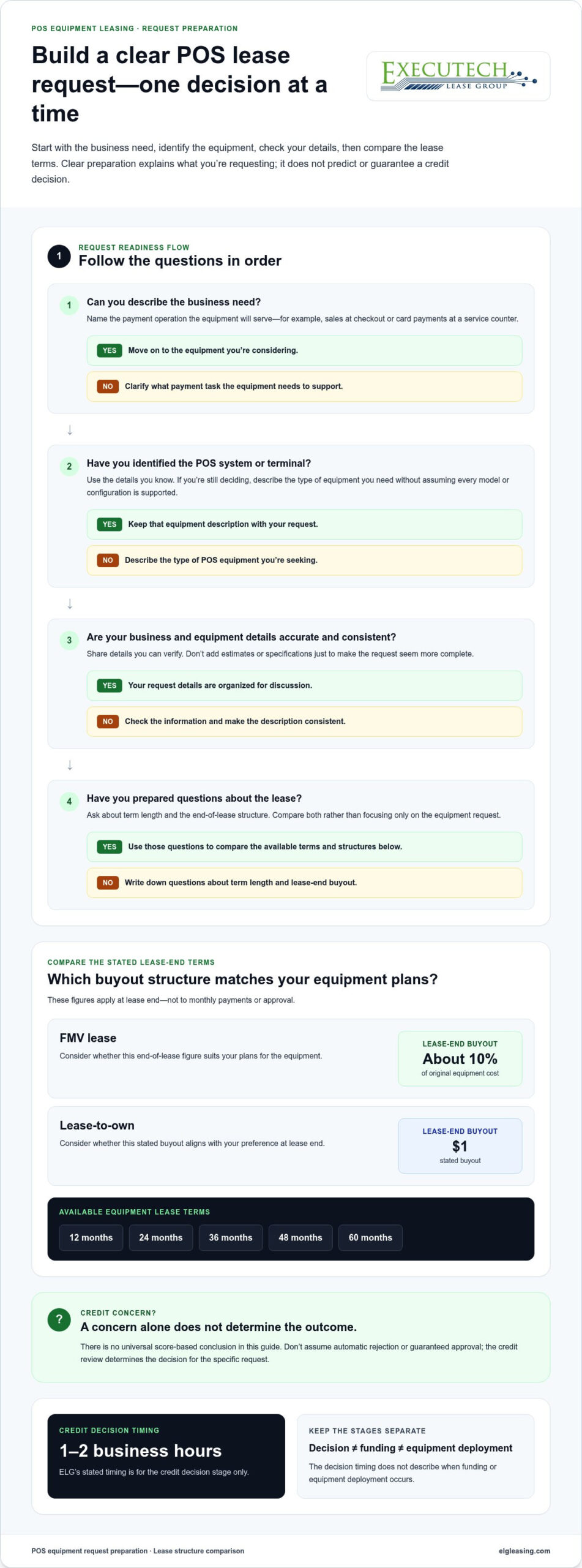
- Compare lease-end options: an FMV lease ends with a buyout of about 10% of the original equipment cost, while lease-to-own ends with a $1 buyout.
- ELG offers equipment lease terms of 12, 24, 36, 48, or 60 months. Our goal is to deliver credit decisions in under 2 business hours; funding and equipment deployment are separate steps.
POS equipment lease requirements: what merchants with bad credit should understand
Credit history can make an equipment request feel uncertain, but it doesn’t create a universal rule that every merchant with a particular score will be rejected or approved. A credit concern alone does not establish a specific approval outcome. ELG reviews the credit request, so broad claims about who qualifies can’t predict an individual decision.
Here, POS equipment lease requirements means the information and review involved in considering a lease request. It doesn’t mean there’s one public credit-score cutoff that predicts every result. A clear request identifies the equipment your business needs and gives the review a defined subject. It does not guarantee eligibility or approval.
Keep equipment leasing separate from payment processing. A lease concerns the POS equipment; payment processing concerns accepting and handling customers’ card transactions. A point-of-sale system can include equipment and software used to record and manage sales, but leasing equipment is not the same as obtaining payment-processing services. ELG leases payment-processing equipment and does not process payments.
What does a POS equipment lease review involve?
The review includes the equipment request and a credit decision. Prepare an accurate description of the equipment and its intended business use, but don’t treat any preparation checklist as a promise of qualification. There’s no need to assume that one credit detail settles the matter. The credit review determines the outcome for the specific request.
Does bad credit automatically prevent a POS equipment lease?
No. Don’t assume either automatic rejection or guaranteed approval. General claims such as “all credit types accepted” or a broad minimum-score statement can’t tell you how an individual request will be decided. A credit concern is a reason to approach the process with realistic expectations, not to conclude the outcome in advance.
Preparation and the credit review serve different purposes. Clear details explain what you’re requesting; the review determines the decision. A fast response or a general eligibility statement is not a promise of approval. Start by specifying the POS equipment your business is seeking, then consider the lease terms being discussed.
How to prepare a clear POS equipment lease request
A well-organized request starts with the business need, not a guess about what a lessor wants to see. POS equipment lease requirements involve a review of your request, but there isn’t a single document checklist here that applies to every merchant. Prepare accurate details you can explain clearly, then use the discussion to understand the available lease terms.
Describe the equipment and its business use
Start with the POS system or credit-card terminal you’re considering. Explain how it fits into your payment operations, such as handling sales at checkout or taking card payments at a service counter. Keep the description practical, and don’t assume that a particular brand, model, software setup, or processor will be compatible in every situation.
If you’re comparing structures, ELG’s POS equipment leasing options provide context for the choices to discuss. Identify the system or terminal you have in mind rather than relying on a broad label such as “new POS.”
Organize the information before discussing lease terms
Check that the business and equipment details you plan to share are accurate and consistent. This is a practical way to make your request easier to follow, not a prescribed list of required documents.
- Define the business need. Describe the payment operation the equipment will serve. For example, clarify whether you need a checkout system or a credit-card terminal for taking payments.
- Identify the equipment. Note the POS system or terminal you’re considering, using the details you know. If you’re still deciding, describe the type of equipment you need without assuming every model or configuration is supported.
- Check the details. Keep your business information and equipment description consistent. Don’t add estimates or specifications you can’t verify just to make the request seem more complete.
- Prepare lease questions. Ask about the term length and the end-of-lease structure. ELG’s equipment lease terms are 12, 24, 36, 48, or 60 months. Compare the term and buyout structure rather than focusing only on the initial equipment request.
This order keeps the conversation grounded: explain the business purpose, identify the equipment, check the details, and then discuss the contract structure. It also separates preparation from eligibility. Precise information clarifies what you’re requesting, but it doesn’t establish a credit decision or guarantee an outcome.
Vendors and channel partners discussing a merchant’s equipment needs can use ELG’s vendor inquiry form to start that conversation. The form is an inquiry route, not a merchant financing application or credit decision.
Compare POS lease structures without assuming bad credit determines the answer
A credit concern doesn’t tell you which lease structure fits your business. Compare the stated end-of-lease terms, then consider how each option aligns with your plans for the equipment. These buyout figures apply at lease end, not to monthly payments or approval.
| Lease structure | Confirmed end-of-lease buyout | What to consider |
|---|---|---|
| FMV lease | About 10% of the original equipment cost | Consider whether this end-of-lease figure suits your plans for the equipment. |
| Lease-to-own | $1 | Consider whether this stated buyout aligns with your preference at lease end. |
FMV lease: understand the confirmed end-of-term figure
ELG’s fair market value (FMV) equipment lease ends with a buyout of about 10% of the original equipment cost. This is an end-of-lease figure, not a monthly payment, the total equipment price, or the full amount paid over the lease term. Use it as one point of comparison without assuming an additional formula or end-of-term condition.
Lease-to-own: distinguish its $1 buyout
ELG’s lease-to-own equipment lease ends with a $1 buyout. That amount applies to this option only. It isn’t a monthly payment or a condition for every POS lease. The distinction is straightforward: the FMV option has an end-of-lease buyout of about 10% of the original equipment cost, while lease-to-own has a $1 end-of-lease buyout.
Neither figure alone tells you which structure is right for your business. Consider the equipment you’re requesting and what you want to take into account when the lease ends. Avoid choosing based on one number alone. The buyout is one part of the lease structure; your credit concern is a separate matter and doesn’t establish an approval outcome.
As you compare, focus on the named structure, its stated end-of-lease buyout, and the equipment request it relates to. If a term is unclear, get its meaning explained before making a decision. Don’t treat the FMV percentage as an estimate of monthly payments or apply the lease-to-own buyout to an FMV lease.
ELG’s equipment leasing programs outline the structures available for POS equipment. Use that context to frame your questions and compare the confirmed buyout terms against your business plans, without assuming that bad credit determines which option you can pursue.
What happens after a POS lease inquiry and credit decision?
A POS lease inquiry begins a review, not an instant path to an installed system. Keep each stage separate so you know what a credit decision does and doesn’t tell you. Our goal is to deliver credit decisions in under 2 business hours. That timeframe applies only to the decision stage, not funding, equipment delivery, installation, or deployment.
The sequence is easier to understand when you treat it as distinct steps:
- Inquiry or application: You provide the POS equipment request for review.
- Credit decision: The request receives a credit decision. This is not a funding or delivery date.
- Funding: Funding is a separate stage, and the decision timeframe doesn’t establish when it will occur.
- Equipment deployment: Equipment delivery and deployment are also separate from the credit decision.
Understanding the leasing sequence helps distinguish the credit review from the later steps needed to put equipment into use. A prompt decision can answer the credit-review question without resolving the timing of funding or deployment.
Separate the credit decision from funding and deployment
Decision timing does not establish an equipment-deployment date. Meeting that goal doesn’t promise funding, vendor payout, delivery, or installation within that period. Treat the credit decision as one milestone, and keep plans for system readiness flexible until the separate funding and deployment steps have taken place.
This distinction matters when coordinating a POS change with daily operations. Receiving a credit decision doesn’t tell you when a terminal will arrive or be ready to use. Don’t schedule a launch around the decision window alone; the credit review doesn’t guarantee the timing of later stages.
Know what equipment leasing does and doesn’t cover
Equipment leasing and payment processing are separate arrangements. ELG leases payment-processing equipment; it doesn’t process payments or provide merchant accounts. Your payment-processing relationship and any processor obligations are distinct from the lease. Equipment warranties come only from the equipment manufacturer, not ELG.
ELG also doesn’t provide installation, maintenance, repairs, replacements, or ongoing equipment support. Keep those responsibilities distinct from the lease request as you plan deployment. A lease decision doesn’t confirm that equipment is installed, supported, or ready to accept payments.
Use the credit decision to understand the review outcome, then treat funding and deployment as separate milestones. This sets practical expectations around POS equipment lease requirements without assuming a specific timeline or outcome.
Choose your next step for POS equipment leasing with ELG
A practical next step is to bring three things into focus: the POS equipment your business needs, accurate details about the request, and the lease-end structure you want to understand. That gives the leasing conversation a clear starting point. The POS equipment lease requirements discussed here are preparation guidance, not a prediction of approval.
Match the inquiry to the right equipment lease conversation
Keep the request centered on payment-processing equipment, such as a POS system or credit-card terminal. Explain what equipment the merchant is considering and how it relates to the business’s payment operations. A focused description frames the lease discussion without assuming every brand, model, or configuration will fit.
For vendors, ISOs, and MSPs, the Become a Vendor form is an inquiry route to discuss merchant equipment-leasing needs. It is not a financing application or a credit decision for a merchant. Use it to describe the channel inquiry clearly, not as a way to secure an individual merchant’s approval.
ELG offers no-money-down equipment leasing. This describes the down-payment requirement; the lease still carries ongoing obligations. Review the terms as a whole, including the payment commitment and end-of-lease structure. No money down does not mean there is no financial commitment.
Take a clear next step without assuming an outcome
A discussion can help establish whether a leasing program fits the equipment request and clarify what to consider next. It can’t guarantee a credit decision, funding, or deployment. A clear inquiry starts the conversation; it doesn’t predetermine the result.
Before submitting an inquiry, make sure the equipment description is accurate and the business need is understandable. If you’re comparing lease structures, be ready to discuss the end-of-lease options in relation to your plans. This keeps the conversation practical when credit history is a concern and avoids relying on generalized approval claims.
For channel partners, use the inquiry route to outline the merchant’s POS or terminal leasing needs. For merchants, focus on the equipment request and the terms you want to understand. In both cases, the purpose is to clarify program fit, not to promise approval or a deployment date.
Keep the decision framework simple: describe the equipment, share accurate details, and compare lease-end options with realistic expectations. An informed inquiry makes the next conversation more focused, whatever the credit decision may be.
Move forward with a focused equipment inquiry
A credit concern can make it tempting to wait until you feel certain about the outcome. A more useful next step is to decide what information you want clarified before making plans around new equipment. Treat your POS upgrade as a business decision with its own timeline, separate from assumptions about how a lease review will turn out.
Use the POS equipment lease requirements as a guide to prepare for an informed conversation, not as a checklist that predicts a decision. For vendors and channel partners, an inquiry can open a discussion about a merchant’s equipment-leasing needs. For merchants, it can put the equipment request before the review process. Neither replaces the decision itself, but a clear starting point makes the next step easier to approach.
When you’re ready to discuss an equipment request, use ELG’s vendor inquiry form to start the conversation. Clarity is within your control, even when the outcome isn’t.
Frequently Asked Questions
Can a merchant with bad credit get POS equipment leasing?
A merchant with bad credit can pursue a POS equipment lease, but approval isn’t guaranteed. POS equipment lease requirements involve a review of the specific request, so a credit concern alone doesn’t establish the result. Prepare a clear description of the terminal or POS system your business needs and submit it for consideration. General claims about credit or approval can’t predict your individual decision.
Does ELG require money down for equipment leasing?
ELG offers no-money-down equipment leasing. That does not mean the equipment is free or that there are no ongoing lease obligations. The lease still carries ongoing payments, so include the commitment in your equipment budget and review the lease terms before making plans.
How fast does ELG make a credit decision?
Our goal is to deliver credit decisions in under 2 business hours. Keep that separate from the funding and equipment-deployment stages. The decision timeframe doesn’t set a funding date or determine when equipment will be deployed. If you’re coordinating a POS change with a planned business launch, treat the decision as one milestone and keep later timing separate.
How do ELG’s FMV and lease-to-own buyouts differ?
ELG’s FMV option ends with about a 10% buyout. Its lease-to-own option ends with a $1 buyout. Those are end-of-lease figures, not monthly payments or the total equipment price. The $1 figure applies only to lease-to-own. Compare the stated end-of-lease structures against your plans for the POS equipment.
Does ELG process payments for merchants?
No. ELG does not process payments. Its equipment-leasing role is separate from payment processing. Leasing a credit-card terminal through ELG is distinct from arranging how your business accepts card payments. The lease does not establish payment-processing services or terms.
Does an ELG equipment lease include a warranty or repairs?
No. ELG doesn’t provide equipment warranties, maintenance, repairs, or replacements. Any warranty comes only from the equipment manufacturer. The lease itself does not provide repair or replacement coverage through ELG. Keep the manufacturer’s warranty separate from the equipment-leasing arrangement.

Article by
Robert Ensminger
Robert Ensminger is the founder and CEO of Executech Lease Group (ELG Leasing), which specializes in equipment leasing and financing solutions for the merchant-services, payments, POS, and FinTech industries. Robert helps ISOs, payment processors, POS providers, and software companies build practical equipment leasing programs. He founded ELG in 2010. His work focuses on responsive service, transparent program structures, SaaS-monetization programs, and helping ELG’s partners close more business while creating sustainable revenue.