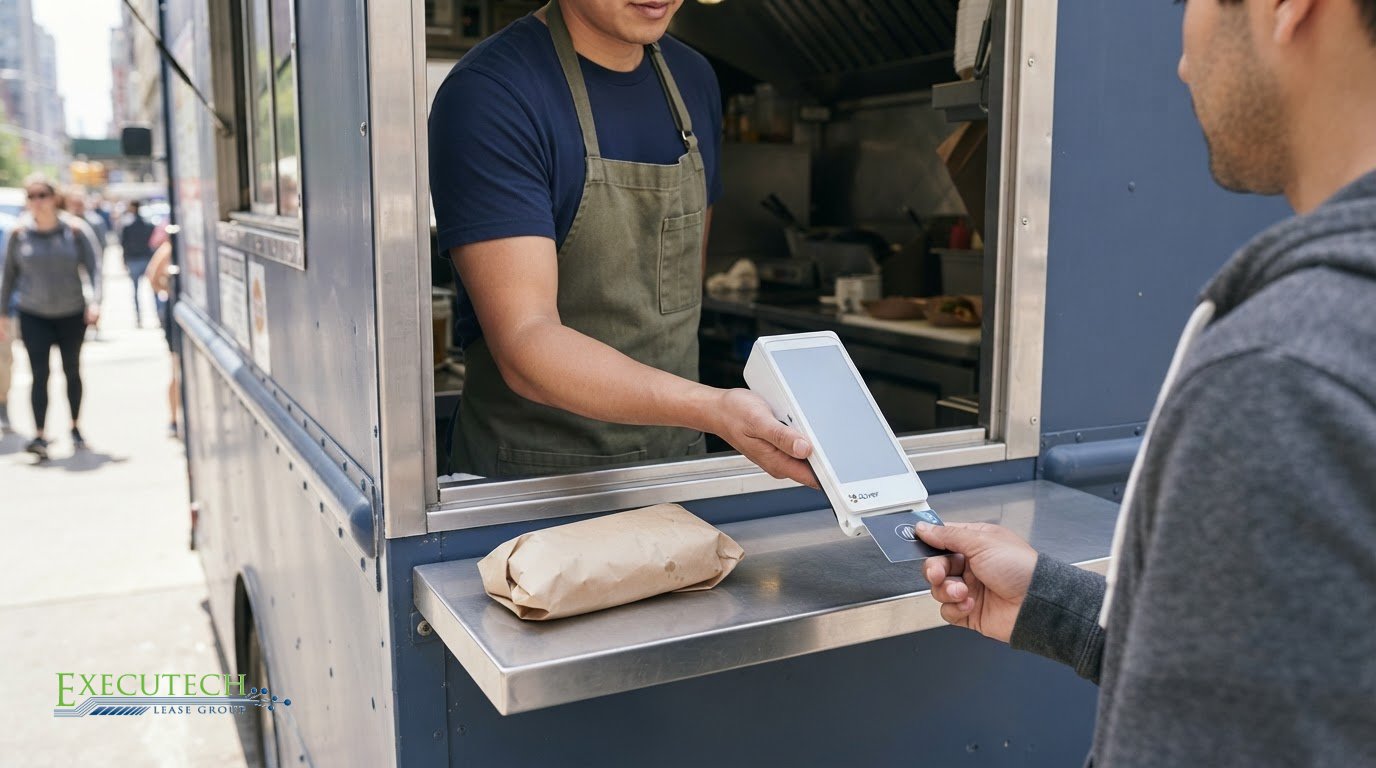
Choosing a food truck POS involves more than accepting payments. A mobile POS can combine order entry, card and mobile-wallet acceptance, sales tracking, and inventory tools on a device or tablet. POS leasing for food trucks and mobile businesses is one way to finance the equipment, alongside buying it outright or using a subscription model.
A mobile setup needs to fit service on the move, and connectivity is part of that decision. Offline capability may help when internet access drops, but available functions vary by system. The financing structure matters too: equipment lease payments and software subscriptions are separate costs to account for.
This guide covers food truck POS equipment and software, connectivity considerations, and the differences between buying, leasing, and subscribing. Use the steps to identify the hardware your workflow needs and compare the associated costs and terms.
Key Takeaways
- Separate equipment, software, and payment-processing costs to understand what a POS setup may involve.
- Assess offline capability and connectivity options before choosing a system for service on the move.
- Compare buying, subscriptions, and equipment leasing by how each affects upfront spending and ongoing costs.
- Review what a POS lease covers, and distinguish equipment financing from software or payment-processing services.
- Explore POS and card terminal lease options with terms from 12 to 60 months to find a structure suited to your operation.
Hardware and POS Subscription Costs
A food truck POS budget can include equipment, software, and payment-processing charges. List one-time costs separately from recurring payments before choosing how to fund the setup.
Upfront POS and Startup Costs
A POS lease spreads equipment payments across a scheduled term instead of requiring the full equipment cost upfront. That can reduce the initial cash needed for hardware, but payments remain an obligation. Compare the schedule and end-of-term terms with your opening budget and operating plan.
Mobile POS Hardware Choices
For mobile service, a compact POS terminal and wireless card reader can support order entry and card transactions. Add a thermal receipt printer if printed receipts fit your workflow, and verify that the POS system is compatible with it. Choose equipment based on counter space, order volume, and whether staff take orders at the window or in line.
Lease Agreement Inclusions
A POS equipment lease covers the equipment described in its agreement. Software and payment processing have separate terms and charges. Review the equipment list, payment schedule, lease term, and end-of-term option together. Also identify who provides software access and how processing charges are billed, even if a package presents these components together.
For tax and accounting, treatment depends on the lease structure. FMV lease payments may be deductible as an operating expense; consult your CPA about your situation.
Common sources of confusion include unclear payment obligations, equipment descriptions, and end-of-term terms. Read the complete agreement and attached schedules before signing, and make sure the written terms reflect the arrangement you intend to accept.
Software subscriptions generally charge recurring fees for access to POS features, while equipment financing covers hardware. Budget for each separately, and consider whether an internet-dependent service suits the places where you operate. Inventory tools may help with menu management, but prioritize features tied to your actual menu and service flow.
Offline Operation and Connectivity
A food truck can lose internet access at an event, in a crowded downtown area, or while moving between locations. An offline-capable point of sale system can keep sales moving during a connection outage, but its offline mode determines which payment actions remain available.
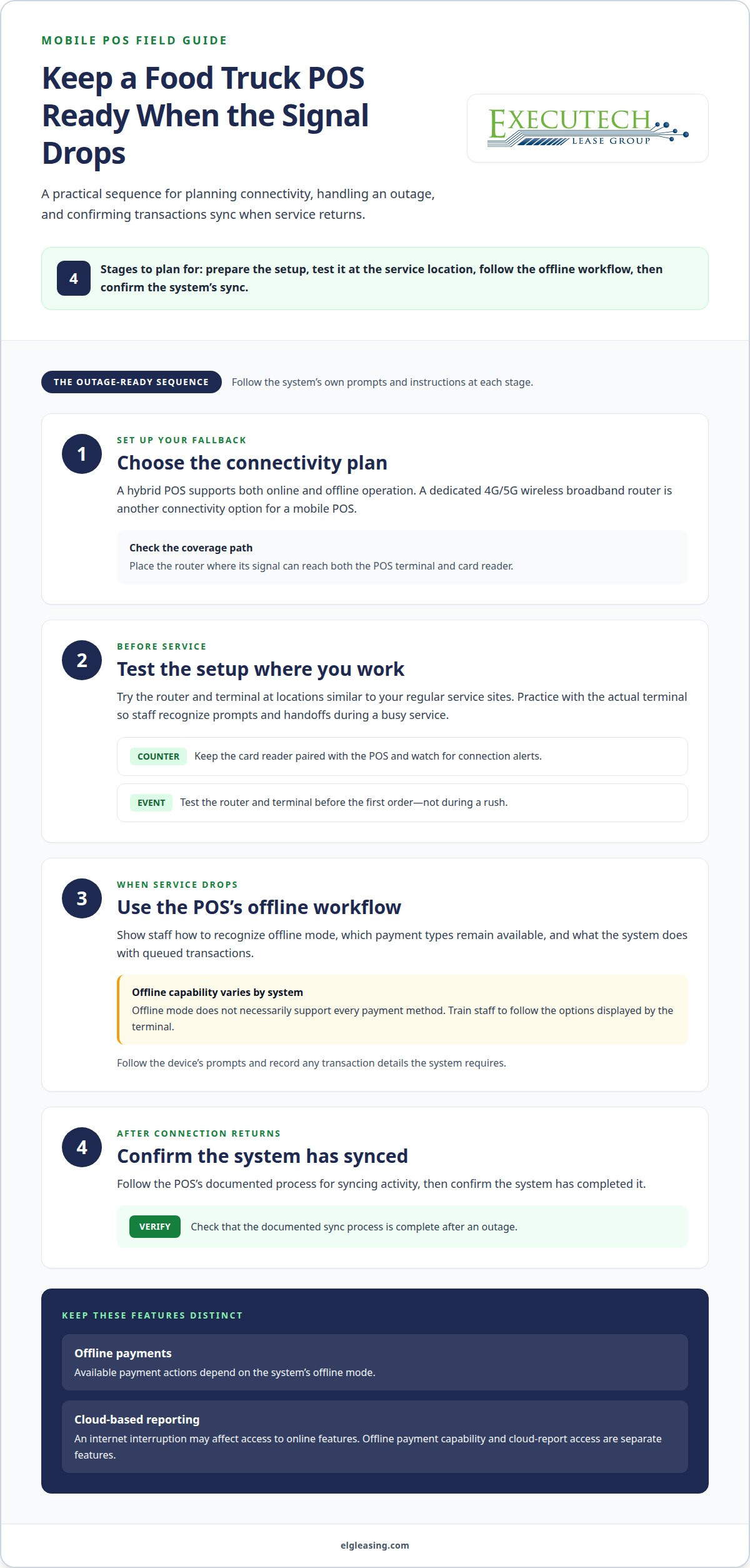
Before service, learn how the POS handles an outage. Show staff how to recognize offline mode, which payment types remain available, and what happens to queued transactions when the connection returns. Practice with the actual terminal so prompts and handoffs are familiar during a busy service.
Plan for Reliable Mobile Connectivity
A dedicated 4G/5G wireless broadband router is one connectivity option for a mobile POS. Place it where its signal can reach the POS terminal and card reader, then test the setup at locations similar to your regular service sites. A hybrid POS supports both online and offline operation, giving operators a fallback when internet service drops.
Build an outage routine into opening procedures. Check the POS connection status, follow the device’s offline prompts, and record any transaction details the system requires. When internet access returns, follow the system’s process for syncing activity. Offline access does not necessarily support every payment method, so train staff on the options displayed by the terminal.
- At the counter: Keep the card reader paired with the POS and watch for connection alerts.
- At an event: Test the router and terminal before the first order, not during a rush.
- After an outage: Confirm the POS has completed its documented sync process.
Cloud-based reporting can make sales data available across locations, but an internet interruption may affect access to online features. Consider where you need reports, such as at an event, commissary, or office, and test those workflows. Offline payment capability and cloud-report access are separate features.
Connectivity planning won’t prevent every interruption, but a tested offline workflow can clarify what staff should do next. If you’re arranging equipment financing for a mobile POS setup, you can start a POS equipment lease application as part of planning your system.
First-Year POS Cost Comparison
Compare costs across the first year, not just the device price. Include equipment purchase costs or lease payments, software subscriptions, payment-processing charges, installation, and recurring service fees where applicable. The total depends on the components your truck needs and how each agreement bills them.
Use your itemized costs as a comparison point, not as a quote for another setup. A single terminal differs from a package with a tablet, card reader, printer, and software. List each component before comparing purchase, lease, or subscription options.
Separate upfront expenses from costs that recur. Buying a device may require more cash at setup, while a lease spreads equipment payments across its term. Software access and payment processing can remain separate ongoing costs under either approach. Compare total scheduled obligations and payment timing, not only the first invoice.
- Equipment: List each terminal, reader, tablet, and printer included.
- Software: Identify recurring charges for POS access and features.
- Processing: Review how transaction charges are calculated and billed.
- Setup: Include installation or training if they’re part of the package.
For a truck serving lunch from a fixed location, fast order entry may help keep service moving. A festival operator may value inventory tools for managing popular items across changing menus. Include a loyalty feature only if it meets a real need, and account for any separate software cost. Match each feature to your operation.
When evaluating a POS setup, consider the equipment, software, processing charges, contract terms, and compatibility together. Check how transactions are billed and whether the device supports the way your truck takes and fulfills orders.
Build a first-year worksheet with a row for each cost category and a column for each payment approach. Mark every charge as upfront, recurring, or transaction-based. Then compare what each option includes, its scheduled payment obligation, and payment timing. This makes it easier to judge whether a lower initial outlay fits your expected business needs.
Food Truck Financing Options
Food truck operators can acquire POS equipment by buying it outright or using an equipment lease or lease-to-own program. When weighing POS leasing for food trucks and mobile businesses, compare upfront spending, scheduled payments, and the agreement’s end-of-term terms. The right structure depends on the equipment and how you plan to use it.
A purchase means paying for equipment upfront. That can suit a business with available cash and a preference for owning its hardware. Leasing spreads equipment payments across an agreed term instead. POS equipment leases may run from 12 to 60 months, giving operators a defined schedule for financing equipment.
A lease-to-own program sets out an ownership path in its agreement. A Fair Market Value (FMV) lease has a different end-of-term structure, so review the applicable options and obligations before signing. For POS leasing for food trucks and mobile businesses, compare the lease type and full payment schedule, not just the initial payment or the word “lease.”
Match the Funding to Your POS Setup
Start by identifying the equipment. A truck using one payment terminal has a different financing scope from a setup with a terminal, card reader, and printer. Keep hardware separate from software access and payment processing. For example, Apple Pay acceptance depends on the POS and payment setup, not on the equipment lease itself.
Match the funding structure to your operating plan. If equipment ownership matters, compare buying with lease-to-own terms. If limiting upfront spending is a priority, consider how scheduled lease payments fit alongside food, fuel, and event expenses. Leasing spreads equipment payments, but does not remove the obligation to make the payments.
Application and Credit Information
To discuss equipment financing, identify the POS equipment you need and provide the business information requested during the application process. Keep the description of your food truck and equipment consistent so the financing request clearly reflects your intended setup.
Before agreeing, review the payment schedule, lease term, equipment description, and end-of-term conditions together. Identify which items the agreement finances and which remain separate costs. This helps you track your obligations without treating every POS-related charge as one payment.
What Is Included in a POS Leasing Agreement: Hardware, Software, and Payment Processing?
A POS lease agreement identifies the equipment being financed and its payment terms. Software access, payment processing, installation, and support may involve separate arrangements. Treat each as a distinct part of the setup, even when a package presents them together.
Hardware Listed in the Agreement
Start with the equipment schedule. It should describe the POS terminal, tablet, wireless card reader, or receipt printer covered by the lease. For example, a food truck might finance a terminal and reader while obtaining a printer separately. Match each listed item to the equipment you intend to use, then review the term, payment schedule, and end-of-term terms.
Software and Reporting Access
Order management, inventory tracking, offline functions, and cloud reporting are software features, not necessarily financed hardware. POS software access may have separate charges and terms. Identify the software plan and recurring costs independently from the equipment lease. If your truck relies on cloud reports between events, determine how access is provided and billed.
Payment Processing Is a Separate Function
A POS device captures orders and supports payment acceptance, while transaction processing is a separate service. An equipment agreement does not establish processing rates or explain transaction charges. Review processing terms separately, including accepted methods such as contactless cards or Apple Pay. Keep equipment payments, software charges, and processing costs distinct in your records.
Installation, staff training, troubleshooting, maintenance, and technical support may be provided by a POS provider under separate terms. They aren’t automatically part of an equipment lease. If an ISO bundles installation or training with the equipment, those services may be included in the lease financing. Read the written scope carefully. Equipment warranties come from the manufacturer, not the equipment lessor.
- Equipment: Match every terminal, reader, and printer to the lease schedule.
- Software: Identify access, features, and recurring subscription charges.
- Processing: Review transaction terms separately from equipment payments.
- Services: Identify who provides installation, training, or technical support.
Separating these components clarifies what the lease finances and which costs remain separate.
Executech Lease Group (ELG Leasing)
Executech Lease Group (ELG) offers financing for POS and card terminal equipment, including equipment for mobile operations. For a food truck, leasing can finance hardware used at a service window or event. Identify the equipment needed and compare the lease structure and terms with your planned setup.
Available options include equipment leases, lease-to-own programs, and Fair Market Value (FMV) leases. Each structure has its own payment terms and end-of-term conditions. Consider which option fits your equipment plans and whether you want an ownership path defined in the agreement.
Financed equipment can include POS systems and card terminals, including Clover devices. A food truck operator can identify the terminals and other payment equipment needed for service, then review the proposed equipment schedule and lease structure together.
- POS equipment leases: Finance point-of-sale hardware for mobile operations.
- Card terminal leases: Finance terminals used to accept customer payments.
- Lease-to-own: Consider an agreement with an ownership path defined by its terms.
- FMV lease options: Review the agreement’s end-of-term conditions.
Keep your financing request focused on the equipment you need. Identify the hardware and how your team will use it, then review the written lease terms before proceeding. That makes the discussion specific to your food truck’s setup.
To discuss POS equipment leasing for your food truck, contact Executech Lease Group (ELG Leasing).
Set Up Your Next Move
Start with the way your truck takes orders, then map that workflow to the POS equipment you need. ELG offers equipment leasing, including FMV and lease-to-own options; software and payment processing remain separate decisions. That is a practical basis for evaluating POS leasing for food trucks and mobile businesses.
Before moving forward, define who will use the system, where transactions happen, and what your service workflow requires. These details give you a concrete basis for discussing equipment financing and comparing terms for your business plan. When your equipment needs are clear, use ELG’s leasing-program information to review the available structures.
A clear equipment plan helps you compare lease structures and identify the terms that fit your operation. Review ELG’s leasing programs to take the next step.
This article reflects the author’s opinion for general information only and isn’t tax, legal, or accounting advice. Consult your CPA or attorney about your specific situation.
Frequently Asked Questions
What Are Food Truck POS Systems?
A food truck POS system combines tools for taking orders and accepting customer payments. Depending on the setup, it may also track sales and inventory, such as ingredient use during a busy service period. A mobile device or tablet can serve as the point of sale, with a card reader handling payments. Features depend on the software and hardware selected for the truck.
What types of establishments use mobile POS?
Mobile POS systems suit businesses that take payments away from a fixed checkout counter. Food trucks, market stalls, pop-up vendors, and event sellers can use them to enter orders and accept payments at the service location. A mobile system can also suit a business that moves between venues. Choose a setup around your order flow, equipment needs, and internet access at each location.
What POS systems offer leasing or monthly payment plans for food trucks?
Executech Lease Group (ELG) leases POS and card terminal equipment, including Clover devices. Its options include FMV equipment leases and lease-to-own equipment leases. These agreements finance equipment, not payment processing. Software access and processing arrangements are separate, so identify the hardware you need and consider which lease structure fits your operating plan.
How much does it cost to lease a POS system for a food truck?
Lease payments depend on the equipment, selected term, and agreement. A terminal-only setup differs from one with multiple POS devices. Compare the scheduled payments and end-of-term option, then account separately for software and payment processing. This breakdown keeps the equipment obligation distinct from other POS-related expenses.
Is leasing a POS system cheaper than buying one for a mobile business?
Not always. Buying requires paying for the equipment upfront, while leasing spreads equipment payments across the agreement’s term. Compare the lease’s scheduled payments with the purchase cost, and include separate software or processing expenses in both scenarios. Also weigh the upfront cash required against the ownership outcome you want. The right fit depends on your budget and equipment plan.
Can food truck POS systems accept payments offline and sync transactions later?
Some food truck POS systems can continue operating offline and sync transaction data after internet access returns. Offline features vary, including which payment types the terminal can handle and how it stores transactions. A system may let staff enter orders during an outage while limiting payment functions. Train staff on the device’s offline prompts and follow its syncing process once connected.
What connectivity and power requirements should food trucks consider for POS equipment?
Plan for both a reliable network connection and a power source for each POS device. A dedicated 4G/5G wireless broadband router is one internet option for a mobile setup. Map where the terminal, card reader, and any printer will operate, then ensure the chosen power arrangement suits those devices. Test the complete setup at a service location before relying on it during a rush.
What are the lease terms, cancellation fees, and return requirements for POS systems?
Lease terms, cancellation charges, and equipment return or ownership requirements are set out in the signed agreement. Review the payment schedule, remaining obligations, end-of-term options, and equipment disposition instructions before signing. Do not assume cancellation rights or return procedures; the written terms define responsibilities for that lease. Understanding these clauses helps you plan for the agreement’s full term.
This article reflects the author’s opinion for general information only and isn’t tax, legal, or accounting advice. Consult your CPA or attorney about your specific situation.

Article by
Robert Ensminger
Robert Ensminger is the founder and CEO of Executech Lease Group (ELG Leasing), which specializes in equipment leasing and financing solutions for the merchant-services, payments, POS, and FinTech industries. With more than 20 years of industry experience, Robert helps ISOs, payment processors, POS providers, and software companies build practical equipment leasing programs. He founded ELG in 2010. His work focuses on responsive service, transparent program structures, subscription and SaaS-monetization programs, and helping ELG’s partners close more business while creating sustainable revenue.