
A POS lease is an equipment commitment, not a complete payment-services package. That distinction matters: POS system lease agreements can create recurring obligations for equipment while leaving payment processing, software, and equipment warranties under separate arrangements. Before signing, make sure you know what the lease covers, which obligations continue throughout the term, and what the agreement says about the end of the lease.
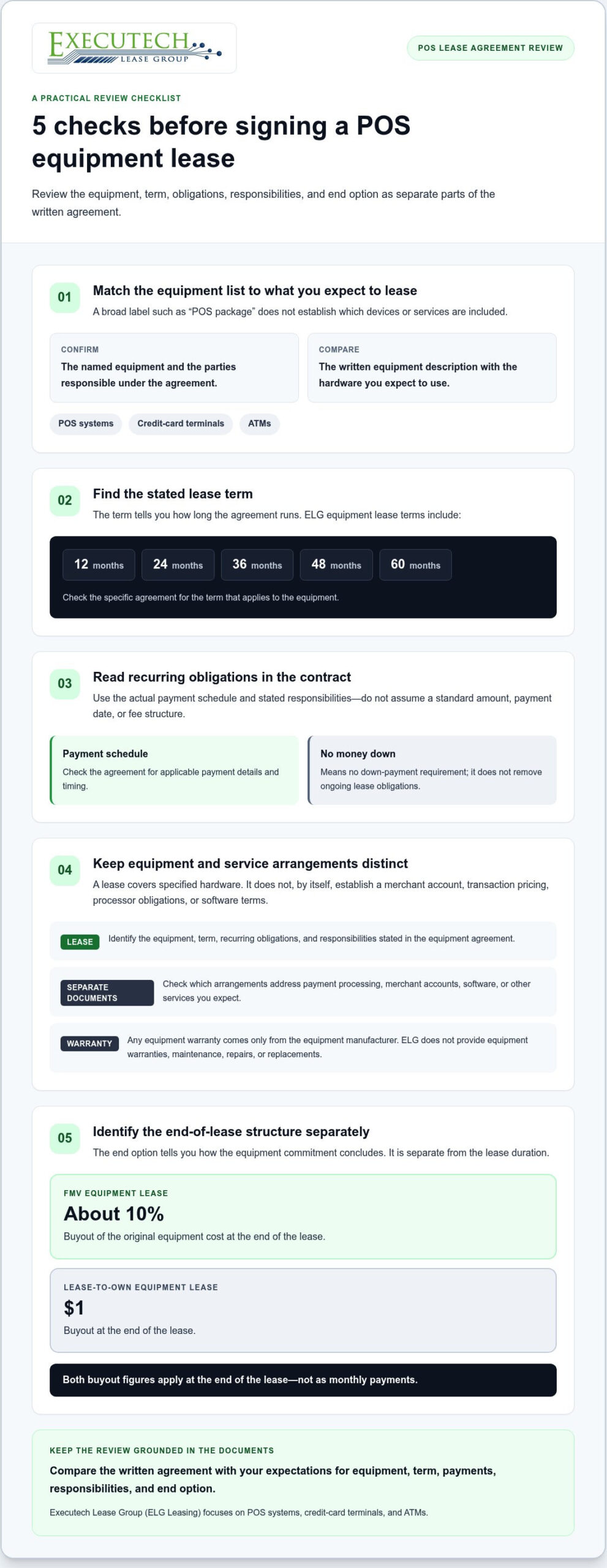
Look beyond the recurring payment and compare the equipment list, lease term, responsibilities, and end-of-lease structure. For example, an FMV equipment lease ends with a buyout of about 10% of the original equipment cost, while a lease-to-own equipment lease ends with a $1 buyout. Both figures apply at the end of the lease, not as monthly payments. This guide explains how to review those terms and keep the equipment agreement distinct from processing, software, and manufacturer warranty arrangements.
Key Takeaways
- Review POS system lease agreements as equipment commitments. Treat payment processing, merchant accounts, and software as separate arrangements unless the relevant documents say otherwise.
- Match the equipment description to the hardware you expect to lease, then check the stated term, recurring obligations, and responsibilities.
- Compare FMV and lease-to-own structures by their end-of-lease options. The buyout figures are not interchangeable.
- Use a line-by-line review to compare the written agreement with your expectations about equipment and related services.
- Executech Lease Group (ELG) is an equipment lease brokerage focused on POS systems, credit-card terminals, and ATMs.
What Does a POS System Lease Agreement Actually Cover?
A POS system lease agreement sets out the terms for leasing specified point-of-sale equipment. Check that it identifies the equipment and the parties, and spells out the obligations that apply under that contract. A POS setup may combine hardware, software, and payment services, but a broad label such as “POS package” does not establish that every component or service is included. Use the equipment description and the relevant agreements to determine what is covered.
Equipment leasing covers the specified hardware; payment processing governs how transactions are handled. A lease does not establish your merchant account, transaction pricing, processor obligations, or software terms. Those arrangements may have their own documents. Likewise, do not assume that a device listed in the lease automatically includes software, installation, maintenance, or processor support. Identify which document addresses each item you expect to use.
Lease obligations follow the written agreement. No money down means there is no down-payment requirement. It does not mean the equipment is free or that recurring obligations disappear. Check the contract for its payment schedule and other stated responsibilities rather than relying on assumptions about what a lease usually includes.
Which equipment and responsibilities should the agreement identify?
Look for an equipment description that distinguishes the items being leased, along with the parties responsible under the agreement. Executech Lease Group (ELG) focuses on POS systems, credit-card terminals, and ATMs. These are different equipment categories, so a generic reference to a “POS package” may not tell you which devices the contract covers.
Compare the written equipment list with the hardware you expect to use. Note any missing or differently described items, then separate equipment terms from processor arrangements. A lease does not set payment pricing or create a merchant account, and it does not determine processor obligations. Equipment warranties come only from the equipment manufacturer, not ELG. Do not treat a lease as a warranty or repair agreement.
Why is a POS equipment lease different from a rental?
This article covers equipment lease agreements, not short-term daily rentals. A lease creates obligations over the term stated in its contract, while a short-term rental is a different arrangement. Do not assume every lease has the same duration or end conditions. Check the written agreement for the term, payment obligations, and end-of-lease structure that apply to that equipment.
ELG equipment lease terms vary by program and include 12, 24, 36, 48, and 60 months. The agreement is the reference point for the specific equipment and payment schedule. For an overview of POS equipment leasing, read the POS equipment leasing guide. Use that general information for context, then rely on the terms in the agreement governing your equipment.
Which POS Lease Agreement Terms Should You Understand?
Review the agreement as a set of connected terms, not just a recurring payment. Confirm what equipment is covered, how long the lease runs, what obligations apply, which end-of-lease structure it uses, and what responsibilities the contract assigns. Each detail answers a different question: what you are using, for how long, what you owe, and how the equipment commitment concludes.
Use this checklist to keep your review focused:
- Equipment: Match the contract’s equipment description to the POS hardware you expect to lease. Check that the named items are clear.
- Term: Find the duration stated in the agreement. ELG equipment lease terms include 12, 24, 36, 48, and 60 months.
- Recurring obligations: Read the payment schedule and any other obligations in the actual contract. Do not assume a standard amount, payment date, or fee structure.
- End option: Identify the lease’s end-of-term structure separately from its duration.
- Responsibilities: Determine which documents cover equipment, processing, software, and any other service you expect.
The lease term tells you how long the agreement runs; the end option tells you how the equipment commitment concludes. Do not infer one from the other. Check both in the written agreement to assess whether the structure fits your plans.
How should you read the term and recurring obligations?
Read the stated term alongside the payment schedule. A 24-month term, for example, describes the agreement’s duration; the contract must provide the applicable payment details and other obligations. ELG’s no-money-down equipment leasing means no down payment is required. It does not remove ongoing lease obligations. The agreement remains the source for payment amounts, timing, and other contract-specific terms. Do not fill in missing details based on another lease or a general description.
What should you check about equipment condition and service?
Check whether the agreement states anything about equipment condition, and keep that separate from service expectations. ELG does not provide equipment warranties, maintenance, repairs, or replacements. Any equipment warranty comes only from the manufacturer. Do not assume lease payments include technical support, uninterrupted service, or replacement equipment. To understand who is responsible if equipment needs attention, distinguish the lease terms from any manufacturer warranty or separate service arrangement.
Vendors, ISOs, and MSPs exploring an equipment lease relationship can use ELG’s Apply Now page to make an inquiry through the “Become a Vendor” form. The form is an inquiry mechanism, not a merchant credit application. Merchants reviewing an agreement should focus on its written terms. Separating contractual obligations from expectations about equipment and related services helps keep the review specific.
FMV vs. Lease-to-Own: How Do POS Lease End Options Compare?
In POS system lease agreements, the end-of-lease structure is separate from the length of the term. Executech Lease Group (ELG) offers two distinct equipment lease structures: an FMV equipment lease with a buyout of about 10% of the original equipment cost, and a lease-to-own equipment lease with a $1 buyout. These are end-of-lease figures, not monthly payments or the equipment’s purchase price.
Compare the structures by what the agreement states about the end of the lease. Do not assume that the labels describe interchangeable arrangements.
| Structure | Confirmed end figure | Key distinction |
|---|---|---|
| FMV equipment lease | About 10% of original equipment cost as a buyout | The agreement identifies an FMV lease structure and its stated buyout. |
| Lease-to-own equipment lease | $1 buyout | The $1 figure applies to this lease-to-own structure only. |
What does the FMV equipment lease buyout mean?
ELG’s FMV equipment lease ends with a buyout of about 10% of the original equipment cost. This is an end-of-lease figure, not a monthly charge, a percentage range, or a calculation based on current market value. Do not infer an exact amount from the FMV label alone. Review the agreement for the specific equipment and the end-of-lease terms that apply.
The buyout figure does not, by itself, explain every step or option at lease end. Use the written agreement for any other applicable end terms. Do not assume a renewal arrangement, notice period, or other outcome unless the contract states it.
How does the lease-to-own equipment lease differ?
ELG’s lease-to-own equipment lease ends with a $1 buyout. That figure applies only to the lease-to-own structure. It is not a monthly payment or the total price of the equipment. The label distinguishes this structure from the FMV option, but the contract remains the reference for how the agreement concludes and which conditions apply.
To compare the two, start with the end-of-term arrangement you are considering, then match it to the structure and language in the agreement. Do not assume either option provides an early exit, guarantees ownership before the buyout, or includes additional services. Those details must come from the contract, not from a general description of the lease type.
Review the stated buyout alongside the equipment description and lease term, keeping each figure in context. The buyout is an end-of-lease amount; recurring payments and other obligations are governed by their own agreement terms. ELG’s equipment lease structures describe the available approaches, while the written agreement defines the terms that apply to your equipment.
How Can You Review a POS System Lease Agreement Before Committing?
A careful review turns broad expectations into specific questions about the written terms. Read each section against what you believe the agreement includes. If you expect software, installation, warranty coverage, or payment processing to come with the equipment, identify which document addresses that item. POS system lease agreements govern the equipment commitment; they do not automatically define every related business relationship.
Which agreement details should you compare line by line?
Work through the document in order and note the section that answers each point. If an assumption is not supported by the agreement or a separate document, do not treat it as a contract term.
- Identify the equipment. Compare the equipment description with the POS hardware you expect to lease. Note any difference between the listed items and your expectations.
- Confirm the term. Find the lease duration stated in the agreement. Do not infer it from a quote, conversation, or another contract.
- Review recurring obligations. Locate the payment schedule and other stated obligations. Avoid assuming amounts, dates, or fees that are not specified.
- Find the end option. Confirm which lease structure the document describes and which end-of-lease figure applies. Keep it separate from recurring payments.
- Map responsibilities. Identify which agreement addresses equipment, processing, software, warranties, installation, or other services you expect.
Flag language that appears to promise an upgrade, cancellation, replacement, or service coverage. Compare it with the specific written terms rather than relying on a general description or expectation. Do not add deadlines, formulas, or rights that the contract does not state.
How can you keep separate business relationships clear?
Separate the equipment lease from payment processing. ELG’s role is equipment leasing, not setting transaction terms or controlling processor obligations. Payment processing is a separate relationship. An equipment lease does not itself establish merchant account terms or promise that a POS device will work with every processor.
Keep warranty and service expectations distinct, too. ELG does not provide equipment warranties, installation, maintenance, repairs, or replacements. Any equipment warranty comes from the manufacturer. Do not infer that lease payments include support or uninterrupted service. Refer to the relevant written terms to determine which party is responsible for each arrangement.
For tax questions, consult a tax professional. For legal questions about an agreement, consult a qualified legal professional. They can address your circumstances without relying on general statements about how leases work.
ELG’s equipment lease process provides context for its leasing workflow. Keep that overview separate from your document review. The agreement is the reference for the specific equipment, obligations, and end option that apply to your lease.
How Does Executech Lease Group (ELG Leasing) Fit a POS Equipment Lease Agreement?
Executech Lease Group (ELG) is a U.S. equipment lease brokerage focused on the payments-technology ecosystem. Its equipment focus includes POS systems, credit-card terminals, and ATMs. For merchants reviewing POS system lease agreements, this defines the scope of ELG’s role: equipment leasing, not processing transactions or providing merchant accounts.
ELG offers no-money-down equipment leasing, meaning there is no down-payment requirement. It does not mean the equipment is free or remove recurring obligations under the lease. Review the agreement for the specific equipment, payment schedule, term, and end structure. Keep the hardware terms separate from payment processing, which is governed by a separate relationship.
What does ELG’s equipment leasing role include?
ELG arranges equipment leases. It does not set transaction pricing, process payments, supply merchant accounts, or control processor obligations. Those distinctions matter because a POS setup may involve separate arrangements for hardware, processing, and software. Do not treat an equipment lease as a bundled package of services unless the relevant written terms say so.
Keep equipment lease terms separate from software, subscription, or SaaS arrangements, which have their own scope and terms. ELG does not provide equipment installation, warranties, maintenance, repairs, or replacements. Any equipment warranty comes from its manufacturer.
What should a vendor or payments professional do next?
Vendors, ISOs, and MSPs can use the “Become a Vendor” form on the Apply Now page to make an inquiry about an equipment-leasing relationship. It is an inquiry route, not a financing application, and it does not produce a credit decision. Merchants reviewing a lease should focus on their own agreement; payments professionals exploring a vendor relationship can use the form for that purpose.
Our goal is to deliver credit decisions in under 2 business hours. That goal applies to the credit decision only. It is not a commitment about funding, equipment delivery, or deployment. Keep those stages separate when considering next steps.
Before making an inquiry, identify whether your question concerns equipment leasing or payment processing. ELG’s brokerage role concerns equipment, while merchant accounts, transaction pricing, and processor services belong to separate arrangements.
For vendors, ISOs, and MSPs exploring an equipment-leasing relationship, start with the designated inquiry route.
Make Your Next Equipment Decision With Clarity
A careful agreement review gives you a practical reference for future equipment decisions. Keep copies of the relevant documents and note which one governs each part of your setup. If your equipment needs or business relationships change, you can return to the written terms instead of relying on memory or assumptions.
Apply the same approach to future POS system lease agreements: distinguish the equipment commitment from the services around it, and make sure your expectations match the documents. That makes it easier to assess your next step, whether you are a merchant reviewing equipment terms or a payments professional exploring a vendor relationship.
ELG’s Apply Now page is an inquiry route for vendors, ISOs, and MSPs. Use it to start a vendor inquiry when you are ready to explore an equipment-leasing relationship.
With the right questions in hand, you can compare the written terms with your needs and keep equipment decisions grounded in clear responsibilities.
Frequently Asked Questions
Does ELG process payments?
No. ELG does not process payments. Its equipment-leasing role is separate from payment processing. Payment acceptance, merchant accounts, transaction pricing, and processor obligations belong to separate relationships, so an equipment lease does not itself establish those terms. For example, a lease may describe the POS hardware while another agreement addresses transaction services. Review the documents separately to see which relationship covers each part of your checkout setup.
How fast does ELG make a credit decision?
Our goal is to deliver credit decisions in under 2 business hours. Keep that separate from the funding and equipment-deployment stages. The decision timing does not mean approval is certain or set the timing for funding, vendor payout, equipment delivery, or installation. Treat each stage separately. A credit decision within that window does not establish when equipment will arrive or when another step will be completed.
Does ELG require money down for equipment leasing?
ELG offers no-money-down equipment leasing. That does not mean the equipment is free or that there are no ongoing lease obligations. No-money-down addresses the down-payment requirement only. It does not establish that there are no recurring payments or fees. Review the specific agreement’s payment schedule and other stated terms to understand the financial commitment.
Who provides the warranty for POS equipment leased through ELG?
ELG does not provide equipment warranties, maintenance, repairs, or replacements. Any warranty comes only from the equipment manufacturer. Keep the manufacturer’s warranty terms separate from the lease documents so you can see which agreement addresses equipment coverage. A lease through ELG does not include a protection plan, service coverage, replacement equipment, hot swaps, or uninterrupted service.
Does completing ELG’s Become a Vendor form submit a POS financing application?
No. The Become a Vendor form is an inquiry mechanism for vendors, ISOs, and MSPs. It is not a financing application and does not produce a credit decision. The form starts a business inquiry; any later financing or credit-decision stage is separate. Use it to express interest in an equipment-leasing relationship, not to request a merchant credit decision for a specific transaction.
Can an ISV discuss SaaS funding with ELG now?
Yes. ELG is actively staging ISVs for its SaaS funding program and invites a conversation about the software business and program fit. This is an invitation to discuss the opportunity, not a currently available funding source. The conversation can focus on the software business and whether the program may fit. The invitation does not establish a launch date, eligibility criteria, advance amount, or repayment terms.

Article by
Robert Ensminger
Robert Ensminger is the founder and CEO of Executech Lease Group (ELG Leasing), which specializes in equipment leasing and financing solutions for the merchant-services, payments, POS, and FinTech industries. Robert helps ISOs, payment processors, POS providers, and software companies build practical equipment leasing programs. He founded ELG in 2010. His work focuses on responsive service, transparent program structures, SaaS-monetization programs, and helping ELG’s partners close more business while creating sustainable revenue.