Buying a POS system may require a larger upfront payment, while leasing can spread equipment costs over time. Knowing how to explain POS leasing benefits to merchants starts with that cash-flow difference: lease terms can range from 12 to 60 months, giving businesses a way to plan payments over time instead of making one large equipment purchase.
Leasing is not automatically the better choice. Buying may suit a business with available capital and a long-term equipment plan, while leasing can spread payments and keep more capital available for other operating needs. Compare payment predictability, ownership, lease structure, and the full commitment.
This article explains how POS leasing compares with buying, how scheduled equipment payments may fit a business budget, and what merchants should understand about lease-to-own and fair market value (FMV) options. Use these points to explain the trade-offs clearly, so merchants can decide which approach fits their priorities.
Key Takeaways
- Compare the upfront cost of buying with scheduled lease payments to see which approach better fits your cash-flow priorities.
- Assess whether predictable equipment payments would leave more working capital available for everyday business needs.
- Understand how lease-to-own and fair market value options differ before weighing ownership and end-of-term decisions.
- Consider the full lease commitment, including its term and payment structure, rather than focusing only on the monthly amount.
- For a smaller POS setup, compare leasing with paying upfront; a formal lease may not be the most practical fit for every purchase.
Leasing as an alternative to traditional financing
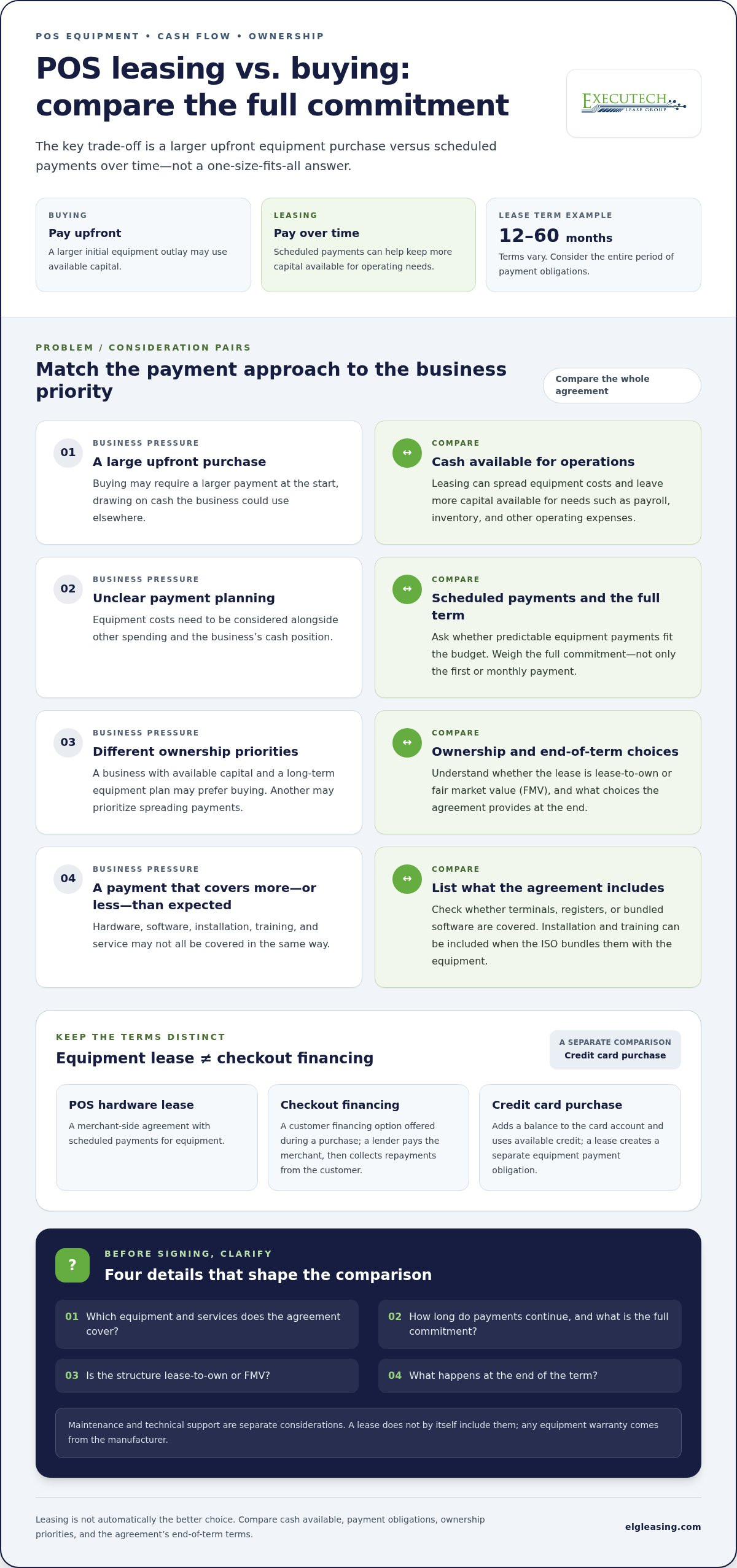
Leasing gives a merchant access to POS equipment through scheduled payments instead of financing a purchase through a conventional loan. It can preserve cash for payroll, inventory, and other operating needs. Traditional equipment financing may require a down payment of 10-20% of the POS system’s purchase price, while lease structures and payment terms vary. The useful comparison is not simply “lease or buy.” It’s how each option affects cash available, payment obligations, and ownership at the end of the agreement.
POS financing can also mean financing offered to a customer at checkout. In a typical third-party transaction, a lender pays the merchant, minus a fee, then collects repayments from the customer. In many such models, the lender assumes responsibility for missed customer payments. That differs from POS hardware leasing, where the merchant makes payments for equipment under a lease agreement. Keep these two meanings separate when explaining financing.
Credit cards offer another comparison. A card purchase adds a balance to the card account and uses available credit; a lease creates a separate equipment payment obligation. The fit depends on the business’s cash position, access to credit, and preference for ownership. Leasing is not automatically more economical, so compare the full commitment, not just the first payment.
Hardware and software can also have different payment arrangements. A lease may finance eligible POS equipment, while software may be billed through a separate subscription. Merchants should identify what the agreement covers, such as terminals, registers, or bundled software, and which costs remain separate. If an ISO bundles installation and training with equipment, lease financing can include those items. Listing each component helps a merchant understand what the scheduled payment actually relates to.
In-store POS financing for customers usually works through the checkout process. The customer selects a financing option, submits an application through the point-of-sale system, and receives a decision before completing the transaction. The merchant’s POS terminal or software must support that integration. By contrast, an equipment lease is a merchant-side arrangement, not a customer checkout offer. A clear explanation of cash-flow benefits helps distinguish these arrangements without blurring their purpose.
What questions should merchants ask before signing a POS lease? Ask what equipment and services the agreement covers, how long payments continue, and what happens at the end of the term. Also clarify whether the structure is lease-to-own or fair market value, since the end-of-term choices differ. A practical way to explain POS leasing benefits to merchants is to connect each answer to cash flow, credit use, and ownership, rather than presenting leasing as the right choice for every business.
What Is POS System Leasing?
A POS lease lets a business use payment equipment in return for scheduled payments over an agreed term. Its value depends on the equipment needed, operating plans, and the contract’s end-of-term options.
Access to Current POS Technology
Leasing can give a business access to newer point-of-sale equipment without paying the full purchase cost upfront. That matters when checkout operations rely on current hardware to support the business’s workflow. POS technology may lack needed features after two or three years, so merchants should consider how well a system fits both today’s tasks and anticipated operations. A newer system can help a business remain competitive, but leasing doesn’t guarantee that every new model will be available during an active term.
Technology Upgrades and Equipment Flexibility
Equipment flexibility means matching the leased system to current business needs and planning for the end of the term. A retailer with one checkout station, for example, has different requirements from a restaurant managing several payment points. Merchants should understand whether the agreement offers lease-to-own or FMV options. As the lease ends, they can assess whether to retain the equipment or consider a new lease for different technology.
Plan around the contract, not an assumed upgrade schedule. Identify the equipment included, the length of the commitment, and the choices available at the end. Adopting newer technology is a future decision tied to the agreement, not an automatic feature during the lease. Merchants can also plan for expected operational changes, such as adding a checkout station, before choosing equipment.
Maintenance and technical support are separate considerations. A lease does not by itself include these services, and any equipment warranty comes from the manufacturer. Merchants should distinguish equipment financing from service coverage and plan who will handle repairs or technical issues. Clear terms help prevent assumptions that scheduled equipment payments also cover ongoing service.
Consider a business whose current point of sale lacks a feature its operations require. If the lease is still active, it should follow the existing agreement rather than assume it can upgrade or swap equipment mid-term. Near the end of the term, the merchant can compare the system’s performance with current needs and decide whether to keep it or replace it through a new lease.
Before choosing equipment, list the functions that matter most, such as checkout workflow, payment acceptance, and the number of stations required. Then compare those needs with the equipment and end-of-term terms in the lease. This keeps the decision focused on business operations, rather than the appeal of newer technology alone. If leasing fits your equipment plan, you can begin the application process.
Preserving cash flow by spreading equipment costs over time
Leasing spreads POS equipment costs across a payment period instead of requiring the full purchase amount upfront. The trade-off is a continuing obligation that affects cash flow throughout the lease.
Lower Upfront Equipment Costs
Lower upfront cost means acquiring POS equipment without paying its entire purchase price at the start. This can leave more working capital available for inventory, payroll, and other operating needs. For example, a retailer preparing to open can preserve cash for initial stock while budgeting for scheduled equipment payments. The benefit is timing, not necessarily a lower total cost: compare all lease payments with the cost of ownership.
Compare the full period of use, not just the first payment. Buying gives the business ownership after purchase, while leasing spreads payments and may involve end-of-term choices. A lease can cost more over its full term than buying equipment outright. Account for the equipment included, payment schedule, contract length, and whether the merchant wants to own the system afterward.
Lease Payments and Tax Deductibility
Some POS lease payments, including FMV lease payments, may be deductible as an operating expense for U.S. businesses. Tax treatment depends on the lease structure, so merchants should consult a CPA before including a deduction in their financial plans. Don’t assume every lease receives the same treatment; the contract type and accounting approach matter.
What is the average monthly cost of leasing POS hardware in the United States? There is no single monthly amount for every lease; payments depend on the equipment, term, and agreement structure.
What fees, interest, or hidden costs can POS leases include? The agreement may specify fees, financing charges, or an end-of-term amount. Review the payment schedule and contract for every charge, along with any separately billed software or services.
What are the risks and disadvantages of leasing POS equipment? The total paid can exceed the purchase cost, payments continue through the agreed term, and ownership may not transfer automatically. Those commitments can constrain future cash flow, particularly if business needs change.
For a business with several locations, calculate the combined payment obligation across all POS stations. A lease may reduce the upfront cash needed to equip each location, but multiple agreements create recurring commitments that must fit the operating budget. Compare the total with staged purchases and projected inventory needs before deciding.
When explaining the trade-off, show the upfront cash preserved alongside the total commitment and ownership terms. Merchants considering equipment leasing can begin an application for POS equipment.
This article reflects the author’s opinion for general information only and isn’t tax, legal, or accounting advice. Consult your CPA or attorney about your specific situation.
Leasing instead of buying POS systems
Buying a POS system gives the business ownership after purchase, while leasing spreads equipment payments across an agreed term. The choice affects more than cash flow: it also determines who owns the equipment, how the business plans for the end of the agreement, and whether capital remains available for other priorities. A retailer opening another location, for example, may value preserving cash differently from an established store replacing a terminal.
Buying can suit a merchant with available funds who expects to use the same setup long term. Ownership gives the business control of the equipment after purchase, without ongoing lease payments. But the full purchase cost is due upfront, and the business decides when replacement makes sense. A restaurant expecting stable operations may prefer this ownership model over a continuing equipment commitment.
Leasing may fit a business that wants to spread payments and keep more working capital available for inventory, staffing, or a new location. The trade-off is scheduled payments and specific end-of-term terms. The total lease commitment may exceed the equipment’s purchase cost. Compare the full payment schedule with the purchase cost and expected period of use, not just the first payment.
End-of-term choices also shape the comparison. Lease-to-own arrangements are structured to provide an ownership path, while a fair market value lease has different end-of-term terms. A fair market value lease may have end-of-term buyout terms that differ from a lease-to-own arrangement. Merchants should understand which structure applies and what decision they’ll face when the agreement ends. That detail can change whether leasing matches their long-term equipment plans.
Consider a merchant planning a POS system for a new location. Buying means paying the full equipment cost before opening; leasing spreads payments across the lease term. Compare that schedule with projected operating cash needs, including inventory and payroll. This does not make leasing universally cheaper. It helps show whether retaining capital now is worth the total payment commitment and ownership terms later.
For a clear decision, compare the same equipment package under both approaches. Include terminals, registers, and other hardware in the proposed setup. Then assess total payments, ownership at the end, and how long the business expects to use the system. A merchant planning long-term use may favor buying; a business prioritizing cash allocation may prefer scheduled lease payments.
Neither choice removes the need to plan for equipment changes. A lease does not automatically provide the ability to upgrade during its active term. Merchants should base their decision on current operating requirements and the contract’s end-of-term options. This keeps the advantages of leasing distinct from those of buying and helps business owners consider the full commitment.
Cash-flow preservation and predictable monthly payments
Scheduled POS lease payments make equipment spending easier to include in an operating budget. The cash-flow benefit comes from spreading costs, not eliminating them.
Predictable Monthly Payments
Predictable payments are recurring equipment obligations set out in the lease agreement. A retail business can budget scheduled amounts alongside rent, payroll, and inventory. This can make cash requirements easier to anticipate than a single equipment purchase. Merchants should still review the payment schedule and contract, since these define the actual commitment.
For example, a retailer planning seasonal inventory can compare expected cash needs with the POS lease schedule. It can then see whether equipment payments fit alongside stock purchases for busy periods. This does not reduce the full-term cost. It helps the business understand when cash is due and plan around those obligations.
Communicating Leasing ROI and Cash-Flow Benefits
Explaining leasing ROI means showing how scheduled equipment payments fit the business’s operations, without promising a return. Merchants can describe the cash retained for inventory, staffing, or other priorities, then compare that benefit with the full lease commitment. Clarify that POS equipment leasing concerns the merchant’s equipment financing, not automatically a customer financing offer.
A practical explanation can cover three points: what equipment the lease covers, how payments fit the operating budget, and what the contract requires over its full term. A restaurant, for instance, might prioritize keeping cash available for food inventory instead of paying the entire equipment cost upfront. The merchant should also make clear that payments remain an obligation even if sales fluctuate.
To evaluate the business case, compare the equipment’s role with the costs and obligations attached to the lease. Identify the operational need, such as equipping a retail checkout, then assess whether the POS system supports it. Next, weigh the cash retained against total payments and end-of-term terms. This makes for a clearer ROI discussion than describing leasing as inherently cheaper.
Different lease structures can align with different financing preferences, but the agreement controls the details. Lease-to-own and FMV leases can lead to different end-of-term decisions. Include those outcomes in the comparison alongside the payment schedule. This way, the cash-flow case reflects both current budget needs and the eventual equipment decision.
Use the same approach when presenting the choice to a business owner or finance team. Show the purchase alternative, lease payment schedule, and ownership trade-offs. List software or services separately when they are not part of the equipment agreement. Clear categories help decision-makers see what each payment supports and avoid overstating the value.
Executech Lease Group (ELG Leasing): 12-60 Month Credit Card and POS Equipment Leases
Executech Lease Group (ELG) helps merchants access POS and credit-card equipment through equipment leases. If spreading equipment costs fits a merchant’s cash-flow priorities, the next step is to choose a lease structure that matches its equipment needs and ownership plans.
ELG offers lease-to-own and FMV equipment lease options, which have different end-of-lease buyouts. Comparing these structures helps merchants understand what an agreement means beyond scheduled payments. ELG also offers Clover leasing for merchants seeking to lease Clover equipment.
For merchant services providers, ISOs, and payment processors, these options offer a way to help merchants acquire POS and card-processing equipment. Review ELG’s leasing programs and consider which structure aligns with the merchant’s needs and plans.
Visit elgleasing.com to learn more about POS equipment leasing.
Make the Next Equipment Decision with Clarity
A useful next step is to turn the comparison into a decision framework for each merchant. Identify the business priority, equipment plan, and preferred end-of-term outcome. Then consider whether the payment structure aligns with those priorities. This keeps the conversation focused on fit rather than presenting leasing as the automatic answer.
A practical way to explain POS leasing benefits to merchants is to connect the agreement to their operating goals while making the commitment clear. Merchants can weigh the value of retaining capital against the full lease terms and decide which structure suits their plans.
ELG offers POS equipment leasing options to match merchants’ equipment needs and financing preferences. Review the leasing programs to compare lease structures, or begin an inquiry through the Become a Vendor form.
Clear terms support more confident business decisions. Choose a payment approach that makes sense for the operation.
This article reflects the author’s opinion for general information only and isn’t tax, legal, or accounting advice. Consult your CPA or attorney about your specific situation.
Frequently Asked Questions
Why Lease a POS System Instead of Buying?
Leasing lets a business use POS equipment while paying over an agreed term, rather than purchasing it outright. It can suit a merchant who wants to keep capital available for operating priorities or prefers scheduled equipment payments. Buying may suit a business that prioritizes ownership and can fund the purchase. Compare total payments, ownership plans, and end-of-term terms before choosing.
How Does POS Financing Work?
POS financing can describe financing offered to a customer during checkout. The customer selects an option, applies through the point-of-sale system, and receives a decision as part of the transaction. In a typical third-party model, a lender pays the merchant, minus a fee, then collects repayment from the customer. That differs from financing a merchant’s own POS hardware, which concerns equipment acquisition.
How Does Renting a POS System Compare to Buying One?
Renting provides access to equipment under an agreement, while buying transfers ownership through a purchase. A business with a temporary or changing equipment need may value rental flexibility; one planning long-term use may prefer ownership. Compare the full rental commitment with the purchase cost and consider who owns the equipment afterward. Rental terms and included services depend on the agreement.
Is It Cheaper to Lease or Buy a POS System and Hardware?
Neither option is always cheaper; the total depends on the equipment, payment schedule, and contract terms. Buying requires weighing the upfront purchase against expected years of use. Leasing requires comparing every scheduled payment and any end-of-term amount with that purchase cost. Compare equivalent equipment packages, rather than a basic terminal with a larger system offering different capabilities.
What Is Point-of-Sale (POS) Financing?
POS financing is a way to arrange payment for a purchase through the point-of-sale checkout process. It commonly refers to customer financing, where a buyer applies for credit while completing a transaction. The term can also describe financing a merchant’s POS equipment, a separate business decision. Identify whether the financing concerns the customer’s purchase or the merchant’s hardware before discussing terms.
What Are the Main Benefits of Leasing a POS System for Merchants?
Leasing can help merchants access POS equipment while spreading payments across an agreed term. This structure may preserve cash for operating needs, such as staffing or seasonal inventory. Scheduled payments can also make equipment budgeting more straightforward. A useful explanation connects the payment structure to a specific business priority without presenting leasing as universally preferable.
How Does POS Leasing Compare With Buying POS Equipment Outright?
Buying means the merchant pays for equipment and owns it; leasing means payments follow the agreement’s schedule, with ownership determined by its terms. The distinction matters when planning to use equipment beyond the current term. A merchant expecting to keep a system can weigh ownership against the lease’s full commitment. A merchant focused on preserving cash can assess whether scheduled payments fit current operations.
What Does a Typical POS Leasing Agreement Include?
A POS lease agreement generally identifies the equipment, payment schedule, lease term, and end-of-term provisions. It may also specify fees or other obligations, so review the full document rather than relying on a monthly payment alone. Check whether software, installation, or training appears in the agreement or is handled separately. Equipment warranty coverage comes from the manufacturer, not automatically from the lease provider.
This article reflects the author’s opinion for general information only and isn’t tax, legal, or accounting advice. Consult your CPA or attorney about your specific situation.

Article by
Robert Ensminger
Robert Ensminger is the founder and CEO of Executech Lease Group (ELG Leasing), which specializes in equipment leasing and financing solutions for the merchant-services, payments, POS, and FinTech industries. With more than 20 years of industry experience, Robert helps ISOs, payment processors, POS providers, and software companies build practical equipment leasing programs. He founded ELG in 2010. His work focuses on responsive service, transparent program structures, subscription and SaaS-monetization programs, and helping ELG’s partners close more business while creating sustainable revenue.