
A terminal lease’s monthly payment is only one part of its cost. The questions to ask before signing a terminal lease include how much you’ll pay in total, whether you’ll own the equipment, what happens if your software or processing agreement ends, and how renewal works. Compare the full lease cost with a purchase quote for equipment that meets the same needs.
A lower upfront commitment may seem straightforward, but the term, end-of-lease obligations, and cancellation language shape the real decision. Look beyond the monthly payment.
This guide explains how to compare leasing with buying, identify charges that affect the total, distinguish equipment terms from processing terms, and review renewal and exit provisions. You’ll be better equipped to decide whether an agreement fits your business before signing.
Key Takeaways
- Compare the lease’s total scheduled payments and required charges with a purchase quote for equipment that meets the same needs.
- Clarify whether the agreement is a lease, rental, financed purchase, or hardware bundled with another service, and understand who owns the terminal.
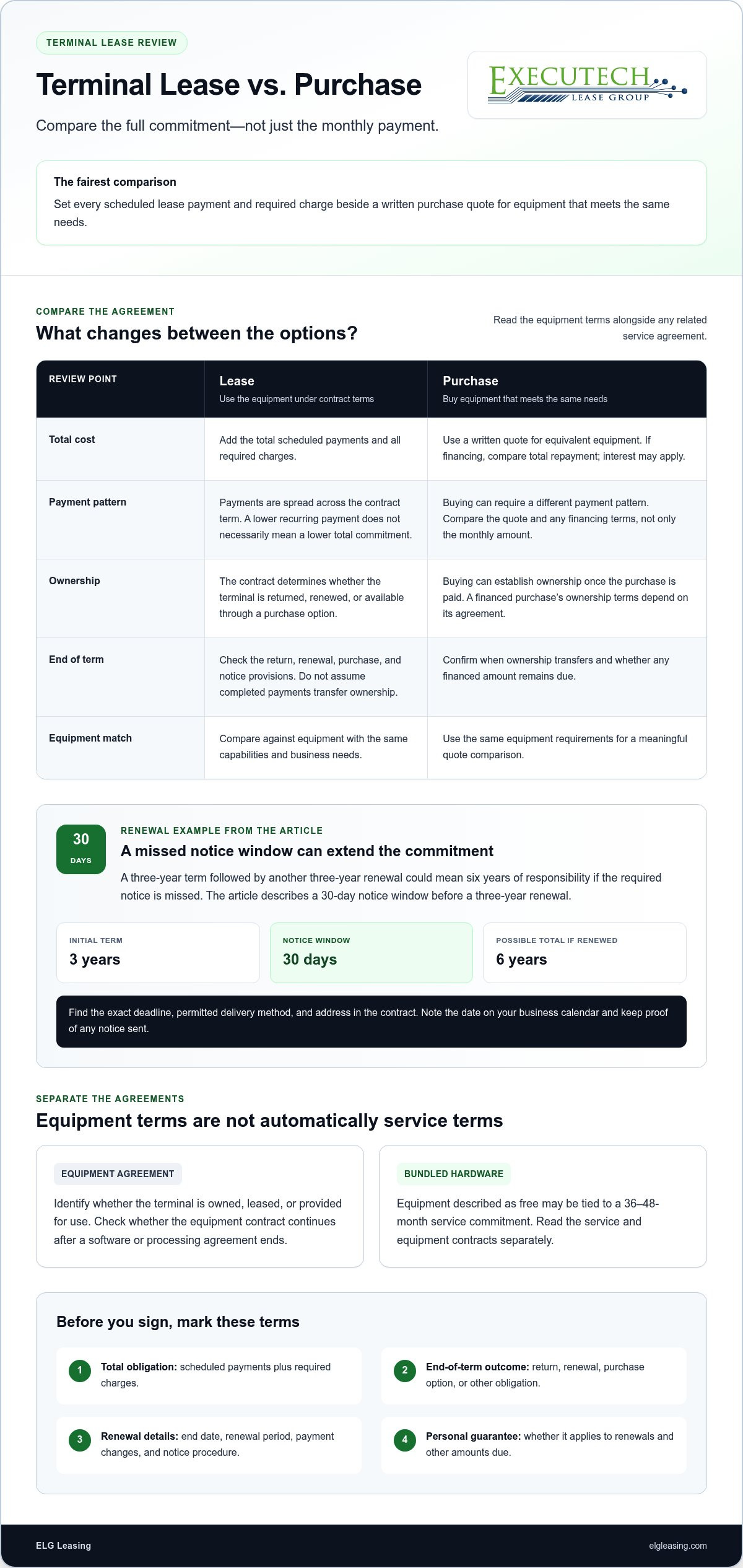
- Review renewal language and notice deadlines carefully. Missing a 30-day notice window before a three-year renewal can extend your commitment.
- Separate equipment obligations from processing terms, including what happens to the terminal lease if you change processors or end a software agreement.
- Compare lease and financing structures by their full costs, contract terms, and end-of-term obligations, not just the monthly payment.
Automatic renewal and notice deadlines
Automatic renewal can extend a terminal lease beyond its initial term if you miss the contract’s notice deadline. Review the renewal clause alongside the payment schedule, ownership terms, and any personal guarantee.
Lease Duration and Renewal Terms
The lease term sets how long the original payment obligation lasts. The automatic renewal clause explains what happens when that term ends. Terminal leases often run for several years, so renewal can add a substantial commitment. Note the end date, renewal period, and any change to the payment. For example, a three-year term followed by another three-year renewal could leave the merchant responsible for six years if notice is missed.
Notice Windows and Deadlines
A notice window is the period when you must send written notice to prevent or change a renewal. Missing the 30-day notice window before a three-year renewal can trigger another term and make the lease expensive to exit. Find the exact deadline, permitted delivery method, and address in the contract. Add the date to your business calendar well before the window closes, and keep proof of any notice you send.
Guarantees and Renewal Obligations
A personal guarantee may make an individual responsible for lease obligations if the business fails to pay. Check whether it covers only the initial term or also renewals, unpaid lease payments, and other amounts due. If the guarantee remains in force, renewal can extend that exposure. Identify who remains liable after the original end date and what conditions release that person.
Insurance, liability, and indemnity requirements depend on the agreement. Identify required coverage, who bears the risk of loss or damage, and which claims each party must cover. Review these terms alongside the guarantee and renewal clause.
Renewal and Termination Options
Renewal and termination options describe the contract’s routes at the end of the initial term or during it. The agreement may require renewal, allow a new term only by written agreement, or set a notice-based end date. Don’t assume you can cancel early or that returning the terminal ends every payment obligation. Before signing, compare each option’s deadline and financial effect.
In the United States, review the contract’s governing-law clause and the state rules that apply to the agreement. Renewal and notice terms can depend on the contract and jurisdiction, so identify the stated law and exact notice procedure before relying on a deadline.
Distinguishing a lease, rental, financed purchase, and bundled equipment
Contract labels matter because they affect who owns the terminal and which payments remain due. Compare the equipment agreement with any software or processing contract before signing.
Lease, Rental, and Financed Purchase Structures
A lease or rental generally gives your business the right to use equipment, while a financed purchase pays toward ownership. The agreement determines the actual ownership outcome, so read its end-of-term terms rather than relying on a sales description.
For a terminal lease, compare scheduled payments and required charges with a written purchase quote for equipment that meets the same needs. Ask whether the lease ends with a return, renewal, purchase option, or another obligation. A financed purchase may include interest, so compare its total repayment and ownership terms with the lease, not just its monthly payment.
Bundled hardware deserves separate attention. A processing agreement may describe equipment as free while tying it to a 36-48-month service commitment. Identify whether the terminal is owned, leased, or simply provided for use, and whether the equipment contract continues after the software or processing agreement ends.
Lease-Purchase Risks and Benefits
A lease-purchase agreement combines use of an asset with a possible path to ownership, but the contract sets the conditions. For a payment terminal, identify the specific purchase option, its cost, and when ownership transfers. Don’t assume that making all scheduled payments automatically makes the equipment yours.
Carrier lease-purchase agreements concern trucks, not payment terminals, and call for different questions. Ask whether you can change carriers, whether early payoff carries a penalty, and whether each payment is accurately reflected on the settlement. Also compare the full lease-purchase cost with financing a similarly specified truck over the same period.
No-money-down terms in carrier programs can involve higher periodic payments. That illustrates why the payment alone doesn’t show the total obligation. For any lease-purchase contract, read how missed payments, early payoff, and the final ownership step affect the amount remaining and your ability to complete the agreement.
Leasing Versus Buying Hardware
Leasing spreads equipment payments across the contract, while buying can establish ownership once the purchase is paid. The better fit depends on your cash-flow priorities, the agreement’s total cost, and what happens to the terminal at the end.
Compare equivalent equipment, not models with different capabilities. Set the purchase quote beside every scheduled lease payment and required charge, then review the lease’s renewal, return, and purchase terms. A lower recurring payment can still mean a higher total commitment if the term is longer or ownership requires an additional payment.
For a final review, separate the terminal agreement from software and processing terms, then mark which obligations continue under each contract. If leasing still fits, you can begin an equipment lease application.
Estimating total lease and purchase costs
Compare the full commitment, not just the monthly payment. For a credit card terminal, include scheduled payments, required charges, maintenance responsibilities, and any cost of ending the agreement early.
Maintenance Costs and Exclusions
Maintenance costs cover keeping a device working and may be separate from the lease payment. A terminal lease doesn’t automatically include repairs or replacement, so identify who handles each issue and what the equipment agreement excludes. Check the equipment agreement to understand what warranty coverage applies and who is responsible for repairs.
For a practical comparison, list the manufacturer’s warranty terms separately from the lease obligations. Then account for routine upkeep and possible service expenses as separate business costs. A lease without maintenance coverage may have a different total cost from a purchase with manufacturer coverage, even when the payment schedules look similar.
Costs of Leaving Early
Early-exit costs are the amounts due if you end a lease before its scheduled term. The contract may calculate them using remaining payments, a termination fee, or another stated formula. For example, with 30 months remaining, multiply the lease payment by 30, then add any applicable exit charge described in the agreement.
Ask for the calculation method in writing before signing. A dated payoff or termination quote can show the amount due at a specific point, but the contract explains how that amount is calculated. Include the exit cost in your comparison, even if you expect to keep the device for the full term.
Lease Versus Loan Costs
A lease and a loan allocate payments and ownership differently, so compare their total costs over the same period. For a 48-month term, add every scheduled lease payment and required charge; for a loan, total principal and interest, plus any equipment costs paid separately.
Use a written purchase quote for a device that meets the same needs. Compare the purchase amount and loan interest with the lease’s complete payment schedule and end-of-term obligations. This makes the cost of acquiring the terminal outright visible alongside the cost of using it through a lease.
Terminal Lease Costs
Total terminal lease cost means scheduled payments plus required charges and any end-of-term amount. A 48-month agreement, for example, should be assessed across all 48 payments, not by treating one month as the full cost. Include renewal terms separately so a possible additional term doesn’t disappear from your review.
Build a simple comparison with three columns: lease payments, additional contract charges, and purchase or loan costs. Keep software and processing charges separate from equipment costs. If installation or training appears in a bundled equipment quote, record it as a distinct item. This shows which costs belong to the device and which relate to other services.
Processing fees and separation from equipment leases
A terminal lease and a processing agreement can create separate obligations. Compare both contracts to see what continues if you change processors or end software service.
Processing Fees and Monthly Charges
Processing rates and monthly account fees are separate from equipment lease payments unless the agreement combines them. Compare the processing statement with the terminal contract, and record each charge by purpose. This distinction shows the cost of accepting payments versus the cost of using the device.
For example, a processor may offer hardware alongside a processing agreement. The equipment cost may be reflected elsewhere in the pricing structure, so review the rate schedule and recurring fees together. Ask how any hardware-related rate premium is calculated, whether it applies to all card volume, and when it can change.
Get the processing rate, monthly fees, and any rate-adjustment terms in writing. A verbal explanation may not show how a charge applies to different transactions. Compare the written terms with a recent processing statement, then identify which contract controls each amount. Keep the equipment payment separate in your cost comparison.
Identify which company receives each payment. A lessor may collect the equipment payment while a processor collects transaction fees and monthly service charges. If one agreement ends, the other may continue. Keep that distinction in mind before canceling software or processing service.
Terminal Use After Switching Processors
A terminal may remain subject to its equipment agreement after you switch processors. Ask whether the hardware is leased or purchased, whether the lease continues, and whether the device can work with another processor. The answer depends on the equipment and its programming, not simply on ending a processing agreement.
Processor-specific encryption or configuration can limit where a terminal works. Clover terminals cannot be reprogrammed to work with another processor. For other equipment, identify any processor restrictions in the agreement and determine whether the terminal is configured for that processor before treating a switch as a simple service change.
Consider a merchant who changes processors while lease payments remain. The equipment obligation may continue even if the old software or processing service ends. Review both agreements for separate cancellation terms, remaining payments, and any equipment return requirement. Get the lessor’s exit terms in writing instead of relying on a salesperson’s verbal explanation.
Before signing, compare processor charges, the monthly equipment payment, terminal ownership, switching restrictions, and what happens when either agreement ends. This makes it easier to see whether a lower processing rate changes the overall cost or leaves the equipment obligation untouched.
Total lease cost versus traditional financing
A lease and traditional financing can produce different ownership outcomes, even when both spread payments over time. Compare the same terminal, contract length, and included services. For example, model each option across 36, 48, or 60 months, then assess total cost and the balance or ownership position at the end.
For a lease, add every scheduled payment and required charge across the full term. Include any end-of-term purchase amount, return obligation, or renewal commitment stated in the agreement. For financing, total the loan payments, including interest, and account for separately paid charges. Use equivalent equipment and the same time period so the comparison reflects cost differences, not differences in hardware or term.
A monthly payment alone can distort the decision. A lease may have lower payments during the agreement but leave ownership dependent on a separate end-of-term option. A financed purchase includes interest, but payments reduce the loan balance and may lead to ownership once the obligation is satisfied. Read the ownership clause and calculate what you’ll owe at the end, not just what leaves your account each month.
Build a side-by-side worksheet with three categories: scheduled payments, additional charges, and end-of-term position. For a 48-month comparison, use 48 payments for both options. Add required fees under the correct agreement, and record whether the terminal is returned, retained, or subject to a purchase amount. Keep processing costs separate, because transaction pricing can change the business’s total expenses without changing the equipment cost.
Compare the commitment if your business needs to exit before the planned end date. A lease may calculate an early termination amount based on remaining payments or a stated fee. Financing has its own payoff balance, which changes as payments reduce principal and interest accrues. Use each option’s written calculation method rather than assuming either is easier or cheaper to exit.
The clearest takeaway: compare like with like, then weigh total payments against ownership and flexibility. A 36-month lease may look different from a 60-month loan because the terms differ. Recalculate each option over the same period, include every required charge, and note exactly what happens to the terminal when payments end.
Executech Lease Group (ELG Leasing): 12-60 Month Credit Card and POS Equipment Leases
Executech Lease Group (ELG Leasing) helps merchants acquire credit card terminals and POS equipment through lease options. If your comparison favors leasing over an outright purchase, its 12-60 Month Credit Card and POS Equipment Leases offer terms to consider alongside Lease-to-Own Programs and FMV Lease Options.
Review the payment schedule, ownership outcome, renewal terms, and end-of-term obligations before choosing a structure. These details determine how a lease fits your business needs and projected equipment use.
Visit elgleasing.com to discuss credit card terminal and POS equipment leasing with Executech Lease Group.
Make the Next Lease Decision Deliberate
Before signing, turn your comparison into a decision rule: the agreement should fit your equipment needs, cash-flow priorities, and plans for the terminal at the end of the term. Use the questions to ask before signing a terminal lease as a decision filter, not just a checklist. If an answer changes the total commitment or ownership outcome, make sure it’s clear in the written agreement.
Once you know which structure fits, bring your priorities and remaining questions to Executech Lease Group (ELG Leasing). A focused conversation can help you understand how its equipment leasing options relate to your business needs and the terms you’re weighing. Keep your cost comparison in view as you consider the next step.
A careful decision starts with clarity. Take the time to choose terms that support your business with confidence.
Frequently Asked Questions
What Is a Credit Card Terminal Lease?
A credit card terminal lease lets a business use payment equipment in exchange for scheduled payments. Ownership depends on the contract’s structure and end-of-term terms. One agreement, for example, might require the terminal to be returned, while another may offer a purchase option. Before treating the device as a business asset, identify who owns it during the term and what happens when payments end.
Are POS hardware leases ever worth it?
Leasing can suit a business that prioritizes spreading equipment costs over time rather than paying outright. The fit depends on the total commitment, ownership terms, and how long the POS system will meet operational needs. A business with multiple checkout stations, for example, may weigh scheduled payments against the cost of purchasing comparable equipment. Compare both options using the same equipment specifications and time period.
What should I check in the contract before accepting?
Read the equipment description, payment schedule, term, renewal language, ownership outcome, and end-of-term requirements. Check whether a personal guarantee applies and whether separate software or processing agreements create additional obligations. For example, note whether returning a terminal ends only equipment use or triggers another payment. Keep a copy of the complete agreement and any written terms describing what the lease includes.
What’s the catch with free POS systems?
“Free” may describe the upfront hardware offer, not the full cost of the arrangement. The equipment may be tied to processing rates, recurring service charges, or a required contract term. For example, a business could pay no separate terminal charge yet spend more under other agreement terms. Compare the complete pricing structure with an option that lists hardware and processing costs separately.
When is free placement genuinely a good deal?
Free placement may fit when the written terms make the total arrangement clear and the equipment meets the business’s needs. Review processing rates, recurring charges, contract length, equipment ownership, and what happens if service ends. For example, a merchant with steady card volume should assess how transaction pricing affects costs over the agreement, not just the initial hardware charge.
What should I check in a terminal lease before signing?
The questions to ask before signing a terminal lease should clarify the equipment, payment obligation, ownership, renewal, and exit terms. Also identify who handles equipment warranty claims, since coverage comes from the manufacturer. For example, compare the terminal model named in the paperwork with the device your business expects to receive. Keep verbal explanations distinct from the signed terms, and rely on the written agreement.
What fees and charges are included in a terminal lease?
Possible charges depend on the agreement, so review the payment schedule and every separately listed amount. Look for recurring lease payments, required fees, end-of-term purchase amounts, renewal charges, or early-exit calculations. Processing fees and software charges may appear in separate agreements rather than the equipment lease. Organize charges by contract and payment recipient to distinguish terminal costs from transaction-processing expenses.
How long are terminal lease terms, and what are the renewal options?
Credit card terminal leases commonly run three to five years, while renewal options depend on the agreement. The contract may describe an automatic extension, a written renewal, or an end date with return or purchase requirements. Note the initial term and any notice deadline in your calendar. For example, compare the renewal period with the time your business expects to keep using the terminal.
This article reflects the author’s opinion for general information only and isn’t tax, legal, or accounting advice. Consult your CPA or attorney about your specific situation.

Article by
Robert Ensminger
Robert Ensminger is the founder and CEO of Executech Lease Group (ELG Leasing), which specializes in equipment leasing and financing solutions for the merchant-services, payments, POS, and FinTech industries. With more than 20 years of industry experience, Robert helps independent sales organizations, payment processors, POS providers, and software companies develop practical leasing, subscription, and SaaS-monetization programs. He founded ELG in 2010 and guided the company to recognition on the Inc. 5000. His work focuses on responsive service, transparent program structures, and helping ELG’s partners close more business while creating sustainable revenue.