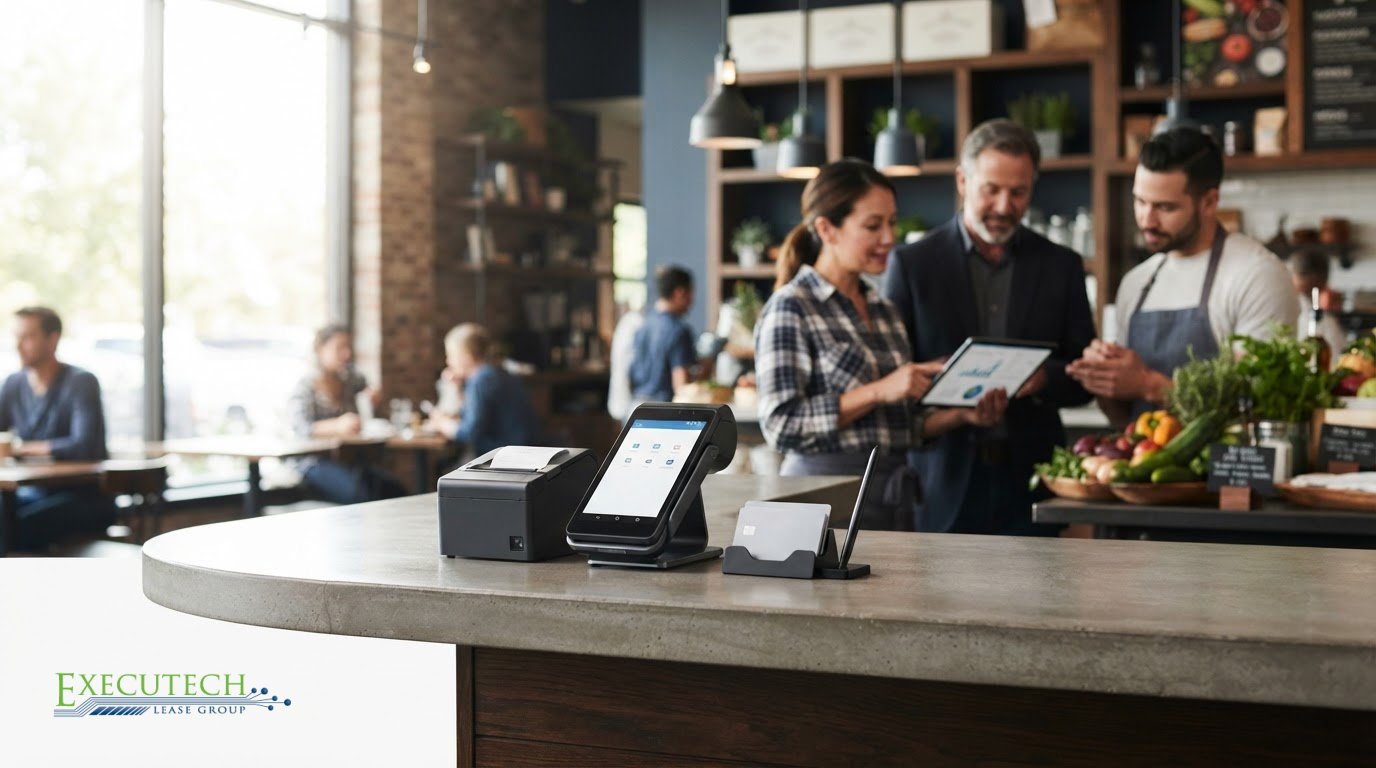
A payment terminal is an equipment decision, not a working-capital plan. Restaurant terminal financing can help you acquire payment hardware through an equipment-focused arrangement. ELG offers no-money-down equipment leasing, but no down payment does not mean the equipment is free or that there is no financial obligation.
Before committing, get clear on what the proposal covers and how the agreement ends. Executech Lease Group (ELG) arranges equipment leasing, including fair market value (FMV) and lease-to-own options with different end-of-term choices. ELG does not process payments or control your obligations to a payment processor.
This guide explains how restaurant terminal financing differs from general business funding, what to compare in an equipment proposal, and how lease terms and end options affect your decision. Use the checklist to assess the equipment scope, payment obligations, and relationship between hardware and processing before moving forward.
Key Takeaways
- Evaluate restaurant terminal financing as an equipment commitment, separately from funding for other restaurant expenses.
- Define the equipment scope first: a payment terminal and a broader point of sale (POS) system are not the same thing.
- Compare buying, equipment leasing, and general funding by purpose, cash-flow impact, and ownership considerations.
- Review the stated term, payment obligations, end-of-term option, and equipment requirements before choosing a program.
- ELG’s FMV terms are 12, 24, 36, 48, or 60 months and end with about a 10% buyout. Lease-to-own terms run from 12 to 60 months and end with a $1 buyout.
What Restaurant Terminal Financing Covers, and What It Does Not
Restaurant terminal financing is an equipment-focused arrangement for acquiring payment terminals or POS hardware through financing or leasing, rather than general-purpose funding for restaurant expenses. The equipment scope describes what the arrangement covers. It does not determine approval, payment terms, or the outcome of the agreement.
A payment terminal is the physical device used to accept card payments. A POS system is a broader setup that may combine payment hardware with software and other components used to manage sales. A proposal for a terminal may cover a narrower equipment scope than one for a complete POS system, so identify the items before comparing terms.
Which restaurant payment equipment can financing cover?
Equipment-focused programs can cover card terminals and POS systems. ELG also works with ATMs as an equipment category, though an ATM is not a standard requirement for every restaurant. Start with the physical equipment listed in the proposal rather than treating every part of a payment setup as one item.
- Card terminals: Payment hardware used at the point of transaction.
- POS systems: Broader point of sale equipment configurations.
- ATMs: A separate equipment category that may be relevant to some businesses.
Hardware is different from the services that let a business accept and process payments. A lease for equipment does not itself provide a merchant account or payment processing, and it does not set or manage obligations under a separate processor agreement. ELG focuses on equipment leasing, so keep the hardware arrangement and payment-services relationship distinct.
Equipment leasing lets a business use specified equipment under a lease arrangement rather than treating the transaction as general-purpose funding. ELG’s equipment leasing programs focus on payment technology and POS equipment.
How terminal financing differs from restaurant funding
General restaurant funding may address a wider range of business needs, depending on the arrangement. Terminal financing focuses on identified payment equipment. It is not a source for payroll, renovations, inventory, or other operating costs. That difference helps you compare an equipment proposal with the hardware requirement it is intended to meet.
Replacing a card terminal or planning a POS hardware setup is an equipment decision. Updating dining-room finishes or covering day-to-day expenses is a different funding need. As you review a proposal, ask what equipment it covers and which obligations relate to that equipment. Keep terminal leasing separate from general restaurant funding.
How Restaurant Terminal Leasing Works from Proposal to Term
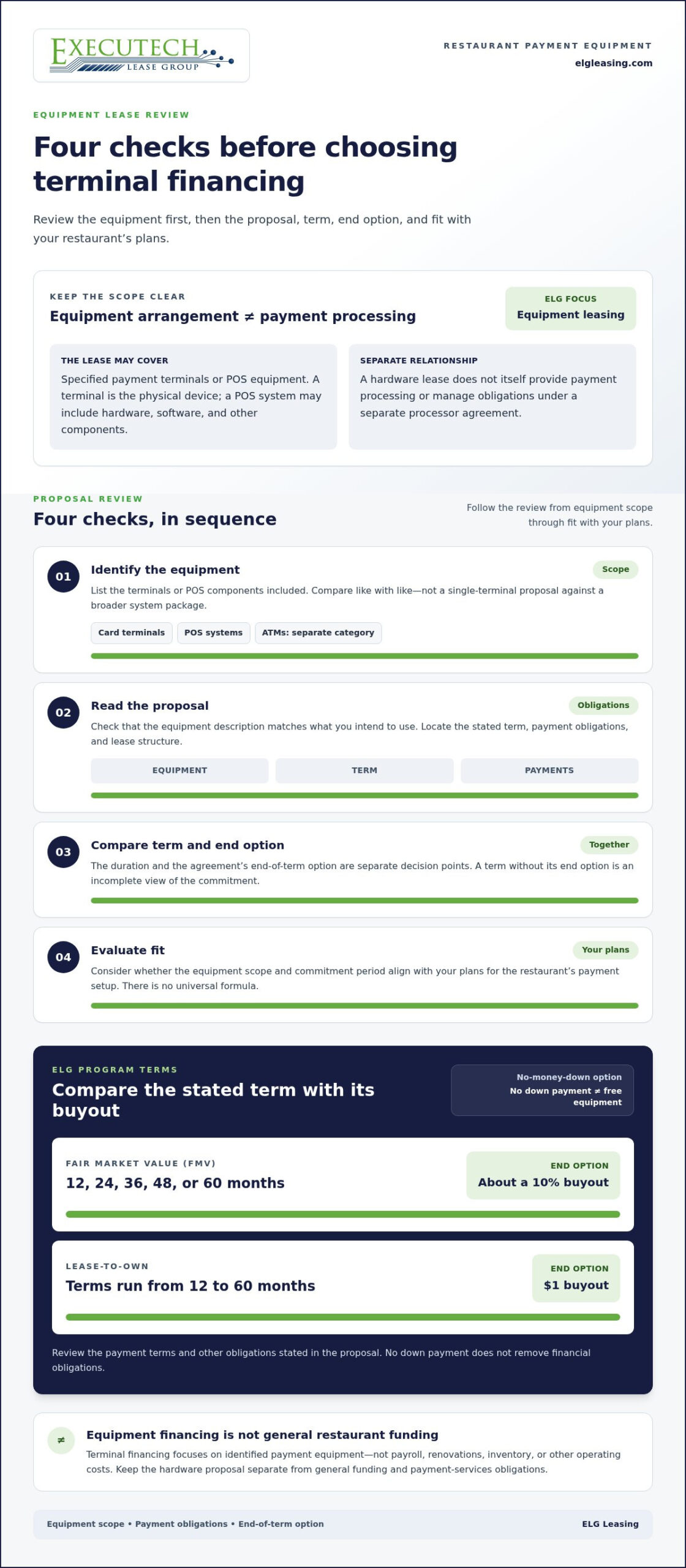
A useful review follows a clear sequence: identify the equipment, read the proposal, compare the term and end option, then assess whether the commitment fits your equipment plans. This keeps restaurant terminal financing focused on the hardware and agreement, rather than assumptions about processor services or unrelated expenses.
- Identify the equipment. List the terminals or POS components included. This lets you compare like with like, rather than weighing a single-terminal proposal against a broader system package.
- Review the proposal. Check the equipment description, stated term, payment obligations, and lease structure. Confirm that the listed items match the equipment you intend to use.
- Compare the term and end option. The length of the commitment and what the agreement specifies for its end are separate decision points. Review both.
- Evaluate fit. Consider whether the equipment scope and commitment period align with your plans for the restaurant’s payment setup. The comparison should reflect your needs, not a universal formula.
What to examine in a terminal lease proposal
Start with the equipment description. Check that it clearly identifies the terminal or POS equipment covered. Then locate the stated term and payment obligations. Finally, identify the lease structure and its end-of-term option. These details belong together: a term without its end option gives you an incomplete view of the commitment.
ELG offers no-money-down equipment leasing. A down payment is not required under this option, but that does not make the equipment free or remove financial obligations. Review the payment terms and other obligations stated in the proposal. For an overview of ELG’s equipment leasing programs, see the leasing programs page.
How to compare term length with operating needs
A term sets how long the agreement runs. Compare the proposed duration with your plans for the equipment and the applicable end-of-term option. Do not judge the duration on its own.
ELG’s FMV lease terms are 12, 24, 36, 48, or 60 months. Lease-to-own terms run from 12 to 60 months. The structures have different end options: ELG’s FMV leases end with about a 10% buyout, while lease-to-own ends with a $1 buyout. Compare the option attached to the term rather than treating the program names as interchangeable.
Keep the equipment lease separate from other financial products that may appear in a POS environment. Nation’s Restaurant News’ discussion of merchant cash advances and POS systems provides context on that distinction. ELG arranges equipment leasing; it does not process payments or control processor obligations.
Independent sales organizations (ISOs), vendors, and payment-services providers exploring a partnership can use ELG’s vendor inquiry page.
Restaurant Terminal Financing Compared with Buying or General Funding
Once the equipment scope is clear, compare how you will pay for it. Buying, leasing, and general-purpose funding serve different purposes. The relevant questions are whether you need specific payment hardware, how you want to structure the commitment for that equipment, or whether you need capital for broader business purposes.
| Option | Purpose | Commitment and considerations |
|---|---|---|
| Buy equipment | Acquire specified terminals or POS equipment directly. | Consider the upfront cash outlay and ownership implications of purchasing. |
| Lease equipment | Use specified equipment under an equipment-focused lease arrangement. | Review the term, payment obligations, and end-of-term option. The structure defines the commitment. |
| General-purpose funding | Address wider business funding needs, depending on the funding arrangement. | Review its own terms and purpose. It is not automatically a substitute for a lease tied to identified equipment. |
Buying and leasing involve different cash-flow and ownership considerations. A purchase centers on acquiring the equipment; a lease centers on the terms for using specified equipment and what the agreement says happens at its end. Neither is automatically preferable for every restaurant. Compare the full commitment, not just the amount due upfront or the headline term.
When the decision is specifically about payment equipment
Anchor the comparison to the equipment proposal. If you are considering a terminal or POS setup, identify the hardware covered, then weigh the payment obligations, term, and end option. General funding may serve wider business needs, but it does not automatically provide an equipment-specific arrangement. Use the same equipment scope for each option to make the comparison meaningful.
How lease-end choices change the comparison
The lease structure affects how you assess the end of the term, so do not compare options by monthly commitment alone. ELG’s fair market value (FMV) leases end with about a 10% buyout; lease-to-own agreements end with a $1 buyout. These are distinct options. Review the one that applies alongside the term, and do not assume an ownership outcome beyond what the agreement specifies.
For a practical comparison, put buying and leasing side by side using the same equipment scope. Note the upfront commitment for a purchase, then compare the lease’s payment obligations and end option. If you are also assessing broader capital needs, keep general-purpose funding separate. This avoids treating a restaurant loan or other funding arrangement as equivalent to an equipment lease when its purpose and commitment may differ. Restaurant terminal financing is an equipment decision, so evaluate it on those terms.
A Restaurant Checklist for Evaluating Terminal Financing
Review the same core details in every proposal: what equipment it covers, what commitment it creates, and where equipment financing ends. Use this checklist to compare restaurant terminal financing without making assumptions about processor services or hardware compatibility.
Questions to resolve before choosing an equipment arrangement
Start with the equipment and the job it needs to do. A card-terminal proposal differs in scope from one covering a broader POS setup. Match the proposed equipment to your intended use, then review the term, payment obligations, and end-of-term option together. No single detail tells the whole story.
- Equipment scope: Identify each terminal or POS component included. Check that the proposal reflects the equipment you intend to use.
- Business need: Connect each item to an operational need, such as taking payments at a service point or equipping a POS station.
- Stated term: Note the agreement length and compare the commitment period with your plans for that equipment.
- Payment obligations: Review the payments described in the proposal. No-money-down leasing still involves financial obligations.
- Lease-end option: Find the specific option stated for the end of the term. Do not assume every lease has the same outcome.
Keep equipment and processing decisions separate
Financing or leasing hardware does not provide payment processing or a merchant account. Those services and their terms sit outside the equipment arrangement. ELG arranges equipment leasing, but it does not process payments or control obligations in a separate processor agreement. Treat the equipment proposal as a document about the hardware arrangement, not as a summary of your processing terms.
Compatibility is another separate consideration. Do not assume every terminal works with every processor or merchant account, or infer compatibility from the fact that equipment appears in a lease proposal. Review the device and payment setup as separate parts of the decision. Equipment-financing terms describe the hardware arrangement; they do not establish universal compatibility, processor portability, or control over processor requirements.
Before choosing an arrangement, make sure you understand what equipment is included, the stated term, the payment obligations, and the end option in the agreement. Resolve any unclear details before comparing proposals. This keeps your decision focused on the equipment commitment rather than blending it with processing obligations.
Payment-services providers exploring a leasing relationship can submit an ELG vendor partnership inquiry.
How ELG’s Restaurant Terminal Leasing Programs Fit the Decision
Executech Lease Group (ELG) is a U.S. equipment lease brokerage serving the payments-technology ecosystem. For restaurants evaluating terminal equipment, ELG arranges equipment leasing. The restaurant can then assess the hardware scope, term, payment obligations, and lease-end option separately from payment processing and general business funding.
How ELG’s equipment lease options differ
ELG offers FMV and lease-to-own programs. Their term choices and stated buyouts differ, so compare the full structure rather than treating the names as interchangeable. The table summarizes the terms and end options.
| Program | Available terms | Stated end option |
|---|---|---|
| FMV lease | 12, 24, 36, 48, or 60 months | About a 10% buyout |
| Lease-to-own | 12-60 months | $1 buyout |
The buyout amounts differ, and neither should be treated as a general promise about what happens beyond the stated option. Assess the program type, term, payment obligations, and end point together. ELG’s leasing program overview describes its equipment lease structures.
ELG provides credit decisions in 1-2 business hours. This refers only to the timing of the credit decision, not delivery, installation, funding, or another step in the equipment process. Keep each stage distinct as you review an arrangement.
Where ELG fits in the payment relationship
ELG finances equipment. It does not process payments or supply merchant accounts. An equipment lease and a restaurant’s payment-processing relationship are separate arrangements with their own terms and obligations. ELG does not control obligations under a processor agreement, so read the equipment proposal as a document about the hardware arrangement, not payment services.
This distinction matters when comparing equipment options alongside an existing payment setup. Assess the lease according to the equipment and terms it covers. Review processor requirements and obligations separately, and do not assume the equipment arrangement changes them.
Vendors and payment-services providers interested in working with ELG can use the vendor inquiry for partnership discussions. It is not a merchant financing application.
Move Your Equipment Decision Forward
Turn your review into a clear equipment plan: define the setup you need, match the proposal to that scope, and keep the hardware commitment distinct from payment processing. A focused approach to restaurant terminal financing helps you compare the equipment and terms in front of you.
If you support merchants as a vendor or payment-services provider, discuss how equipment leasing may fit your work with ELG. The vendor inquiry is for partnership interest, not a merchant financing application.
For a vendor or payment-services provider, discuss becoming an ELG vendor.
Frequently Asked Questions
Is restaurant terminal financing the same as a restaurant business loan?
No. Restaurant terminal financing is tied to specified payment equipment, while a restaurant business loan is broader funding. Replacing a checkout terminal is an equipment need; a loan may be structured for other business purposes too. Compare what each agreement funds and the payment or lease obligations it states. Keep the equipment proposal separate from broader funding offers.
Can I finance a restaurant terminal without changing payment processors?
Financing a terminal does not itself require a processor change, but it also does not preserve, replace, or override an existing processor agreement. Compatibility depends on the equipment and payment setup, so do not assume a terminal works with every processor or merchant account. Review the hardware proposal alongside your current processor terms. ELG handles equipment leasing, not processing arrangements or obligations under them.
What happens at the end of an ELG FMV equipment lease?
ELG’s FMV option ends with about a 10% buyout. The figure is approximate, and it is not a formula or percentage base for calculating a separate amount without the agreement. Locate the FMV end-option language in the contract and use that wording as your reference. Do not infer renewal, cancellation, notice, or other choices that the agreement does not state.
Is the $1 buyout available on every ELG equipment lease?
No. The $1 buyout applies only to ELG’s lease-to-own equipment lease. The FMV option instead ends with about a 10% buyout, so the program label matters. Match the program name to the stated term and end option when comparing proposals.
How much does restaurant terminal financing cost?
There is no universal price for restaurant terminal financing. The financial commitment depends on the equipment and written program terms. Assess the payments across the full term and the lease-end option, not an upfront figure alone. ELG offers no-money-down equipment leasing, but no down payment does not make equipment free or remove payment obligations. Use the proposal’s figures and terms for the specific arrangement.
How quickly does ELG make a credit decision?
ELG provides credit decisions in 1-2 business hours. That timeframe applies to the credit decision only, not approval, funding, equipment delivery, installation, or vendor payout. Treat the decision as one step, not a schedule for the full equipment process. If you are planning a POS changeover, keep decision timing separate from planning for processor setup, delivery, and installation.
Does ELG process restaurant payments?
No. ELG does not process restaurant payments or supply merchant accounts. Its role is leasing equipment within the payments-technology ecosystem. A terminal lease does not establish the restaurant’s processing relationship or determine the processor’s terms. Keep transaction services and hardware obligations in separate documents, and use the processor agreement for questions about payment services.

Article by
Robert Ensminger
Robert Ensminger is the founder and CEO of Executech Lease Group (ELG Leasing), which specializes in equipment leasing and financing solutions for the merchant-services, payments, POS, and FinTech industries. With more than 20 years of industry experience, Robert helps independent sales organizations, payment processors, POS providers, and software companies develop practical leasing, subscription, and SaaS-monetization programs. He founded ELG in 2010 and guided the company to recognition on the Inc. 5000. His work focuses on responsive service, transparent program structures, and helping ELG’s partners close more business while creating sustainable revenue.