
A low monthly payment won’t fix an unclear equipment list. Retail point of sale leasing starts with defining what your checkout actually needs, from registers and payment terminals to scanners, receipt printers, and other supporting equipment. Scope the setup first, and you can compare lease options against the equipment your store plans to use.
It’s reasonable to question whether recurring payments fit your business. The answer depends on your budget, operating plans, and what you want to happen at the end of the term. This guide explains how to compare lease structures, including lease-to-own and fair market value options, by their end-of-term preferences and obligations, without assuming leasing is always cheaper than buying.
You’ll also learn where equipment leasing ends and payment processing begins. They’re separate arrangements: a lease covers equipment, while your processor governs payment acceptance and related processing terms. Executech Lease Group (ELG Leasing) focuses on equipment leasing for retail merchants and the merchant-services ecosystem. Use this guide to organize your scope, assess the structure, and plan a practical route to equipment leasing.
Key Takeaways
- Map checkout tasks, staff roles, and store locations before building an equipment list. A defined scope makes it easier to assess what the setup needs.
- Use retail point of sale leasing to align equipment needs with a lease structure, recurring obligations, and your end-of-term preference.
- Compare FMV leases, lease-to-own, and hardware subscriptions by their structure and obligations, not by an assumption that one option always costs less.
- Prepare a leasing request in sequence: document the scope and business needs, compare structures, then review the terms and separate credit decisions from later rollout stages.
- Keep equipment leasing distinct from payment processing. ELG leases equipment; your processor relationship governs payment acceptance and its obligations.
Why retail point of sale leasing starts with the checkout workflow
A retail POS setup should follow the work happening at the checkout, not a generic equipment bundle. Retail point of sale leasing means obtaining POS equipment through an agreement with recurring lease obligations over an agreed term. Before comparing those obligations, map how a sale moves through your store: where staff ring up purchases, how customers pay, and which tasks happen at the counter or away from it.
A POS system combines equipment and software used to complete transactions. The right scope depends on your retail workflow. A single staffed checkout, a service counter handling exchanges, and mobile selling on the shop floor may each need a different equipment setup. Start with those tasks, then identify the devices that support them.
Which retail checkout tasks shape the equipment scope?
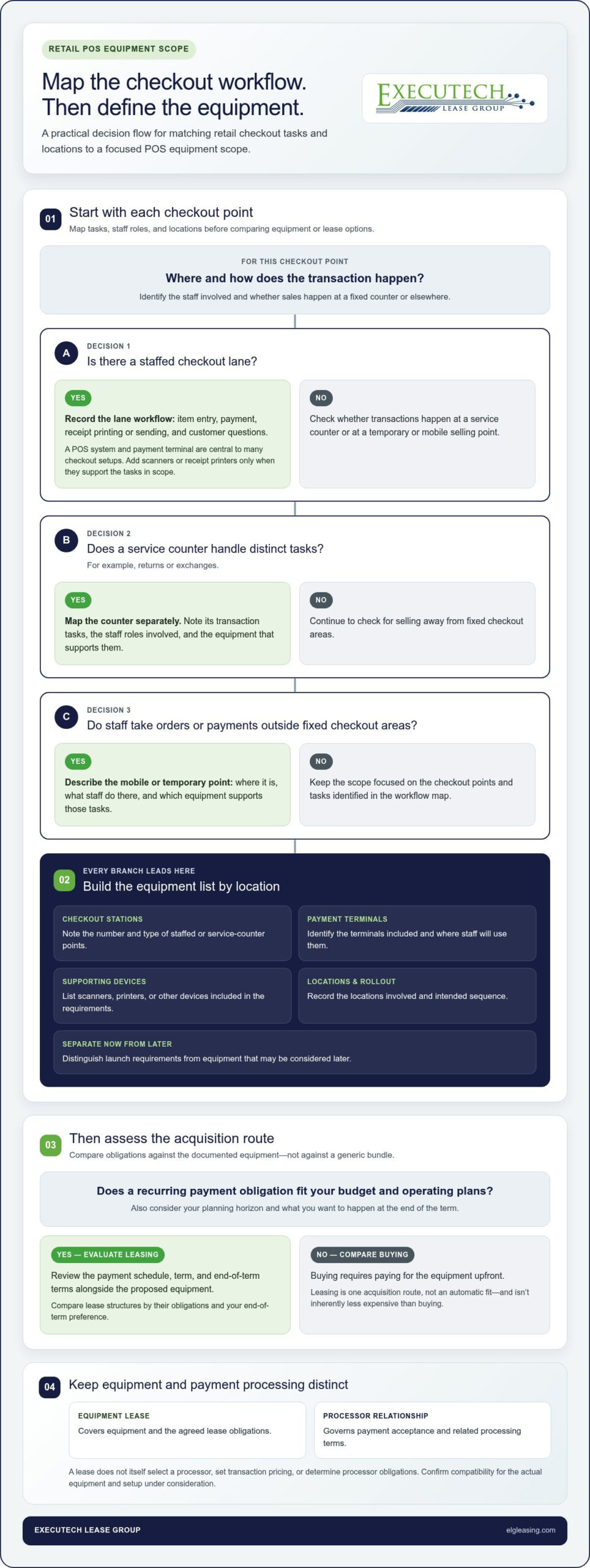
Map each checkout point separately. Note where staff scan or enter items, take payment, print or send receipts, and handle customer questions. Include the roles involved and whether transactions happen only at fixed counters or also at temporary or mobile selling points. This gives you a working equipment list tied to actual store operations.
Separate core equipment from supporting items. A POS system and payment terminal are central to many checkout setups. Other devices, such as barcode scanners or receipt printers, may support particular tasks, but they aren’t automatically needed at every station. Use your retailer-provided requirements and the equipment proposal to define what belongs in scope. Don’t assume that every device works with every POS platform, software configuration, or payment setup.
- Staffed lanes: Record the steps employees complete from item entry through payment.
- Service counters: Identify any distinct transaction tasks, such as handling returns or exchanges.
- Mobile selling points: Describe where staff take orders or payments outside fixed checkout areas.
This workflow map helps keep the scope focused. It also makes it easier to identify equipment that’s essential, optional, or tied to a specific location.
When does leasing enter the retail equipment decision?
Once you’ve defined the equipment scope, compare how you might acquire it. Buying requires paying for the equipment upfront. Leasing instead creates recurring obligations under an agreement, so assess the payment schedule, term, and end-of-term terms alongside the proposed equipment. Leasing is one acquisition route, not an automatic fit for every retailer, and it isn’t inherently less expensive than buying.
Keep the equipment decision separate from payment processing. A lease addresses the equipment and its agreed obligations. Your merchant account and processor relationship govern payment acceptance and related processing terms. Leasing equipment doesn’t itself select a processor, set transaction pricing, or determine processor obligations.
The practical sequence is clear: define the workflow, build the equipment scope, then evaluate lease terms against that scope. That way, the financing discussion starts with what your checkout needs, not with equipment selected before the operational requirements are understood.
What to evaluate before leasing retail POS equipment
A clear equipment scope gives you a stronger basis for comparing lease options. Put the proposed setup in writing, then assess it against the work each checkout point must support, the staff who use it, and the locations involved. This keeps retail POS equipment leasing focused on the actual operating plan rather than a generic device list.
Create a retail POS equipment checklist
Build the checklist by location and checkout station. Record what each point needs to do, which staff roles use it, and which equipment supports those tasks. Separate items needed for launch from possible later additions. That distinction helps you evaluate the initial scope without treating every useful device as essential.
- Checkout stations: Note the number and type of staffed or service-counter points in the proposed setup.
- Payment terminals: Identify the terminals included and where staff will use them.
- Supporting devices: List only the scanners, printers, or other devices included in the retailer’s requirements.
- Locations and rollout: Record how many locations are involved and the intended sequence, without assuming a deployment schedule.
- Later additions: Keep equipment that may be considered in the future separate from launch requirements.
Next, compare the proposed equipment with your operational requirements. Check that the scope reflects how each location handles transactions and staff tasks. Don’t assume that a device, POS platform, software configuration, or processor arrangement will work with another component simply because it appears on the same proposal. Keep compatibility questions tied to the actual equipment and setup under consideration.
Match lease evaluation to business requirements
Once the scope is documented, assess the recurring obligation against expected equipment use and your planning horizon. A lease term should make sense alongside how long you expect the equipment to serve the operation and any known business changes, such as a planned location expansion or checkout redesign. These are planning considerations, not a prediction that your needs will change.
Review the term, recurring payment obligation, and end-of-term preference as distinct factors. One option may align with a preference to own equipment at the end; another may suit a different equipment disposition plan. The exact obligations depend on the agreement, so assess the written terms rather than assuming that leasing costs less than purchasing.
Keep three decisions distinct: which equipment fits the retail operation, which lease structure fits the business plan, and which merchant account and processor arrangements support payment acceptance. A POS equipment lease doesn’t set transaction pricing or change processor obligations. For broader context on evaluating equipment lease terms, use this POS equipment leasing guide.
When the checklist and lease questions are ready, you can submit an equipment lease application based on the defined scope. A well-organized request makes it easier to discuss the equipment and obligations as one practical decision.
How to compare retail POS lease structures without assuming one is cheaper
A useful comparison starts with the obligations, not a promise of savings. For each option, review the recurring payment commitment, the term, and what the agreement says happens at the end. Then compare those details with your equipment plan and preference for the equipment when the lease ends. Retail point of sale leasing can be a practical acquisition route, but it isn’t automatically less expensive than buying.
The main distinction is what the structure says about the end of the agreement. The confirmed buyout figures below apply only to the specified equipment leases. They are end-of-lease figures, not monthly payments or total equipment prices.
Compare FMV and lease-to-own equipment leases
An FMV equipment lease ends with an about 10% buyout. A lease-to-own equipment lease ends with a $1 buyout. These figures describe different end-of-lease outcomes; don’t treat either as a recurring payment or as the full cost of the equipment. Review the written agreement for its specific obligations rather than inferring renewal or cancellation rules.
| Structure | What to compare | Confirmed end-of-term detail |
|---|---|---|
| FMV equipment lease | Recurring obligations, term, and the agreement’s end-of-term terms | About 10% buyout |
| Lease-to-own equipment lease | Recurring obligations, term, and your preference for the equipment at term end | $1 buyout |
| Hardware subscription | Recurring obligations, selected term, and the subscription agreement’s terms | No FMV or lease-to-own buyout figure applies here |
Use the table to narrow down what matters to your business, not to rank structures by price. The ELG leasing program options provide context for the available equipment-lease structures. For any option, read the agreement terms that apply to your scope and chosen structure.
Separate hardware subscriptions from equipment lease buyouts
Hardware subscriptions are a separate option to evaluate, not another name for an FMV or lease-to-own lease. Available term choices are 12, 24, 36, 48, or 60 months. Assess the recurring commitment and subscription terms on their own. Don’t apply either equipment-lease buyout figure to a subscription, or assume the arrangement includes free upgrades or unlimited cancellation.
Before choosing, write down your preferred term and end-of-term outcome, then compare each structure against those priorities. A clear comparison helps you see the commitment as well as the equipment arrangement. It also keeps assumptions out of the decision: the agreement, not a general description of leasing, sets the applicable terms.
If you’ve defined your POS equipment scope and are ready to submit it for consideration, use the equipment lease application.
How retailers can prepare a POS leasing request
A well-prepared request separates the equipment decision from the steps that follow. For retail point of sale leasing, work through the scope, business needs, lease structure, and agreement terms in order. This makes the request easier to review and helps keep expectations clear across the retailer, leasing process, and any merchant-services partners involved.
- Define the equipment scope. List the POS equipment and payment terminals under consideration, their quantities, and the locations where they’re intended to be used.
- Document business needs. Describe the checkout tasks, staff roles, operating requirements, and any planned changes that inform the equipment request.
- Compare lease structures. Consider the recurring obligations, term, and end-of-term preference for each option.
- Review the agreement. Read the terms for the selected structure and equipment scope before proceeding.
Organize equipment and rollout details
Make the request specific enough to distinguish locations and rollout stages. For example, note which equipment is planned for each store and whether the rollout is intended to happen in phases. Keep retailer requirements in their own list, separate from assumptions about equipment, software, or processor compatibility. The goal is a clear scope, not a claim that every proposed component will work with every setup.
Keep implementation responsibilities distinct, too. Installation, licensing, training, and ongoing support are separate from ELG’s equipment-leasing role. Document those needs independently so the lease discussion stays focused on the equipment and its obligations.
Review obligations and stages clearly
Before proceeding, review the recurring lease obligations and end-of-term structure together. Then keep each process stage distinct: a credit decision is not the same as funding, equipment delivery, or installation. ELG delivers credit decisions in 1-2 business hours. That timing applies only to the credit-decision stage, not to funding or deployment, and a decision doesn’t guarantee equipment delivery or installation.
This distinction matters for rollout planning. Avoid treating a credit decision as a confirmed deployment date. Keep processor arrangements separate as well: an equipment lease doesn’t establish a merchant account or determine transaction pricing or processor obligations.
For channel partners, a vendor inquiry about POS leasing can start a discussion about partnership fit. It isn’t a financing application or a credit-decision submission.
With the scope, requirements, and lease questions organized, you can move into the next stage with a clearer record of what the retailer needs and what the agreement covers.
How ELG supports retail POS equipment leasing through channel partners
Executech Lease Group (ELG Leasing) is an equipment lease brokerage focused on the U.S. merchant-services and payments-technology ecosystem. For retail point of sale leasing, that role is specific: ELG leases equipment. It doesn’t process payments, provide merchant accounts, set transaction pricing, or control the obligations a retailer has with its payment processor.
That separation helps retailers keep related decisions clear. The POS equipment scope and lease agreement address the equipment and its recurring obligations. The merchant’s processor and merchant-account arrangements address payment acceptance and related terms. A retailer can consider both as part of its checkout planning without treating them as the same service or agreement.
Who can use the channel-partner route?
Merchant-services ISOs, independent sales agents, MSPs, equipment vendors, resellers, and POS dealers can use the channel-partner route to make an inquiry about working with ELG. The Become a Vendor inquiry form is a contact mechanism for channel-partner inquiries. It isn’t a financing application or a submission for a credit decision.
For retailer-facing conversations, keep the focus practical. Help the merchant describe the checkout equipment under consideration, how it will be used, and the recurring lease obligations they’re evaluating. Clear information supports a focused equipment-leasing discussion without blurring it with processor selection or payment-processing terms.
- ISOs and sales agents: Keep equipment leasing distinct from the processing relationship you support.
- MSPs and POS dealers: Organize the equipment scope around the retailer’s stated needs.
- Vendors and resellers: Use the vendor inquiry route to discuss a channel relationship.
Set clear expectations about ELG’s role
ELG’s role is equipment leasing, not equipment support or deployment. ELG doesn’t provide installation, licensing, training, maintenance, repairs, or replacements. Any equipment warranty comes only from the equipment manufacturer. Keep those responsibilities separate in conversations about a retail POS setup so merchants understand what the lease covers and what it doesn’t.
No-money-down refers only to the down-payment requirement. It doesn’t remove the recurring lease payments or other obligations in the agreement. Merchants should evaluate those obligations and the lease terms alongside their equipment scope, rather than interpreting the down-payment arrangement as equipment without ongoing financial commitments.
For channel partners, a clear handoff starts with the retailer’s equipment requirements and a precise description of the leasing role. That makes it easier to keep leasing, processing, and rollout responsibilities distinct from the start.
ISOs, independent sales agents, MSPs, vendors, resellers, and POS dealers can submit a channel inquiry through the Become a Vendor form.
Turn your POS plan into a clear next step
Use your equipment scope as the starting point for a focused conversation. For merchants, that means keeping the checkout requirements and lease obligations clear as you plan the next stage of your retail point of sale leasing decision. For channel partners, it means making the equipment-leasing role clear within the broader merchant-services relationship.
Executech Lease Group (ELG Leasing) works with channel partners across the payments-technology ecosystem on equipment leasing. If you represent an ISO, MSP, reseller, vendor, or POS dealer, the vendor inquiry form is the right route to introduce your organization and explore a potential partnership. It’s an inquiry, not a financing application.
A clear plan makes the next conversation more productive. Take the next step with confidence.
Frequently Asked Questions
Does ELG require money down?
ELG offers no-money-down equipment leasing. “No-money-down” addresses the initial down-payment requirement, not the recurring payments or other obligations in the lease. For your review, keep the proposed equipment, payment schedule, and agreement terms together so you can assess the full commitment. The phrase doesn’t mean the equipment is free or that the agreement has no fees, taxes, or other financial obligations.
How fast does ELG make a decision?
ELG provides a credit decision during the timeframe stated earlier in this article. That timing applies to the credit-decision stage only. It doesn’t establish when funding, equipment delivery, installation, or vendor payment will occur. For rollout planning, track those as separate milestones and avoid treating a credit decision as a deployment date. This keeps the leasing review distinct from the operational schedule for putting equipment into use.
How do the two buyouts differ?
The FMV and lease-to-own options have different end-of-lease buyout amounts. The specific figures are outlined in the lease-structure comparison above; they apply only to their respective equipment lease types. Neither figure represents a monthly payment or the total equipment price. When comparing an agreement, focus on the applicable end-of-term language and recurring obligations rather than assuming one structure fits every retailer’s equipment plan.
Who provides the warranty on leased POS equipment?
The equipment manufacturer is the source of any warranty. Keep its warranty information with the records for the relevant POS devices, rather than treating it as part of the lease terms. That makes it easier to distinguish equipment documentation from the agreement governing lease obligations. ELG’s role is equipment leasing, not warranty coverage or equipment service.
Does an ELG equipment lease include installation, licensing, or training?
No. ELG’s equipment-leasing role doesn’t include installation, licensing, or training. Account for those activities separately in your rollout plan, alongside any internal preparation needed before staff use the POS setup. This helps avoid confusing a lease decision with implementation or operational readiness. Keep the equipment agreement focused on the equipment and its lease terms.
Does ELG process payments for a retailer using leased POS equipment?
No. ELG doesn’t process payments. The retailer’s payment-processing relationship is separate from its equipment lease. Keep the agreements and responsibilities distinct in your records: the lease concerns the equipment, while the processor relationship governs payment acceptance. Leasing through ELG doesn’t provide a merchant account, set transaction pricing, or change the retailer’s processor obligations.
Can a POS equipment lease guarantee compatibility with every payment processor?
No universal compatibility guarantee applies. Before proceeding, document the retailer’s specific equipment, software, and operating requirements so the proposed setup can be considered in context. A lease doesn’t promise processor access, transaction pricing, or uninterrupted processing. For retail point of sale leasing, keep those requirements separate from the lease’s financial terms, and don’t assume that every brand, model, integration, or processor is supported.

Article by
Robert Ensminger
Robert Ensminger is the founder and CEO of Executech Lease Group (ELG Leasing), which specializes in equipment leasing and financing solutions for the merchant-services, payments, POS, and FinTech industries. With more than 20 years of industry experience, Robert helps independent sales organizations, payment processors, POS providers, and software companies develop practical leasing, subscription, and SaaS-monetization programs. He founded ELG in 2010 and guided the company to recognition on the Inc. 5000. His work focuses on responsive service, transparent program structures, and helping ELG’s partners close more business while creating sustainable revenue.