What if you could update your checkout technology without making a large upfront equipment purchase? Financing for retail technology can spread equipment costs over time. Start by mapping your payment workflow: what customers need to do at checkout, and which devices or software support that process.
Upfront equipment spending can compete with other operating priorities, and FMV, lease-to-own, and subscription leases are not interchangeable. Before comparing them, identify what technology you need and what you expect to do with it at the end of the agreement.
This guide explains how financing can help you access payment technology, how common program structures differ, and what to review before discussing options. ELG Leasing focuses on credit card terminals, POS systems, Clover devices, and cloud-based SaaS POS software, rather than general retail equipment. Its equipment lease terms range from 12 to 60 months, with FMV, lease-to-own, and subscription-based options. First match the technology to your workflow, then compare the proposed terms with your business priorities.
Key Takeaways
- Map your checkout workflow to determine whether you need a payment terminal, a complete POS system, cloud-based POS software, or a combination.
- Compare FMV, lease-to-own, and subscription structures by your plans for the technology, then verify the terms in the agreement.
- Before discussing an application, identify the technology, term, software needs, agreement details, and business workflow you need to address.
- Financing for retail technology can help eligible merchants access supported payment equipment without a large upfront equipment purchase.
- ELG Leasing focuses on merchant payment hardware and POS software, with equipment lease terms of 12 to 60 months and multiple program structures.
What Does Financing for Retail Technology Cover?
Financing for retail technology means using a financing or leasing arrangement to access payment terminals, point-of-sale (POS) systems, or related POS software instead of paying the full equipment cost upfront. The scope matters: this is a focused category for merchant payment technology, not a catch-all for every device or system a retail business might use.
A POS system supports checkout by helping a business complete sales. Financing may help eligible merchants access supported technology without a large upfront equipment purchase. Because the equipment and software included depend on the program, check the scope before comparing options.
Inventory financing is separate from financing payment terminals or POS systems. This video covers inventory financing as a related business-financing concept:
Which retail payment technologies may be financed?
ELG Leasing’s supported categories include credit card terminals, POS systems, and Clover devices. Specialized programs may also include cloud-based SaaS POS software. This list is a starting point, not a guarantee that every model, platform, or vendor qualifies. Confirm that the specific technology you need is covered. You can review ELG’s equipment leasing programs for an overview of program structures.
For example, a business focused on accepting in-person card payments may need a terminal. A business looking for a broader checkout setup may need a POS system. If the need is hosted POS software, ask whether the software is included in the program being discussed. If you need both hardware and software, confirm how each component is addressed.
Who uses retail technology financing?
Merchants may explore financing to access payment technology for their business without a large upfront equipment purchase. Merchant-services providers, independent sales organizations (ISOs), and payment processors may also work with a specialized financing partner to help merchants access eligible equipment or POS software.
Keep the roles clear. ELG Leasing offers leasing and financing programs for supported payment technology. It does not provide direct payment processing, and it is not a general-purpose source for retail equipment or consumer electronics. Defining the technology you need first helps determine whether a financing discussion is relevant.
How Retail Technology Financing Programs Work
Start with the technology, not the contract type. Describe the checkout workflow, identify the equipment or software involved, and then compare structures that may fit. The Retail Industry Leaders Association’s innovation in retail technology work includes payments and financial technology, which is one reason to define the specific payment need before evaluating options.
ELG Leasing offers equipment leases for credit card and POS technology with terms ranging from 12 to 60 months. That range does not mean every term is available or suitable for every applicant. Cloud-based POS software may also fit specialized financing programs, but software and equipment can have different agreement details. Check what a proposal includes rather than assuming a hardware lease covers software, or the reverse.
What happens before choosing a financing program?
Prepare a concise description of your payment setup before discussing options. A clear outline helps keep the conversation focused on the actual business need without assuming any particular application or approval criteria.
- Map the payment workflow: Identify where customers pay and what the checkout process needs to support.
- List the devices: Note how many terminals or POS systems you are considering and how they will be used.
- Separate hardware from software: Decide whether you need a terminal, a complete POS system, cloud-based POS software, or a combination.
- Define the business need: Write down the operational requirements the technology must address before comparing program structures.
Then compare the available structure with your intended use. ELG’s financing process overview can help you understand the sequence. After clarifying the fit and reviewing the relevant information, you can review the application process as a possible next step.
What should you review before signing?
Read the proposed agreement carefully. Check the term, payment schedule, and equipment description. Confirm whether POS software is included or covered separately, and review the obligations stated in the contract. If the agreement describes end-of-term choices, verify which ones apply to your arrangement rather than relying on a general description of FMV, lease-to-own, or subscription programs.
The contract terms, not general assumptions, define your commitment. Ask for clarification before signing if a detail is unclear. A careful review helps you determine whether the agreement matches the technology and workflow you identified.
FMV, Lease-to-Own, or Subscription: How to Compare Options
A program name is a starting point, not a substitute for reading the agreement. To compare financing for retail technology, match the structure to your plans for the equipment or software. Then verify the payment details, responsibilities, and end-of-term terms in writing. ELG offers FMV, lease-to-own, and subscription-based options for supported payment technology.
| Structure | Business need to consider | Equipment or software fit | Questions to verify |
|---|---|---|---|
| FMV lease | You are comparing a lease option and want to understand its full term and obligations. | Ask which specific payment equipment or software the agreement covers. | What end-of-term options apply? Who is responsible for the equipment during and after the term? |
| Lease-to-own | You are considering a program structured around a potential ownership outcome. | Confirm the exact hardware or other technology named in the agreement. | What are the purchase or ownership terms? What obligations apply throughout the term? |
| Subscription-based lease | You are evaluating a subscription structure for the technology you plan to use. | Confirm whether the arrangement covers POS equipment, cloud-based POS software, or both. | What does the subscription include? What happens at the end of its term? |
When might an FMV lease fit a technology plan?
FMV is one program option ELG offers. Evaluate it by comparing the proposed agreement with your equipment plan, rather than assuming what an FMV contract allows. Check how the document defines end-of-term choices, equipment responsibilities, and any steps you must take. For a closer look at available structures, review the equipment leasing program options.
When might lease-to-own or subscription financing fit?
Lease-to-own is another available structure, but the name alone does not establish your specific purchase terms or outcome. Confirm those details in the agreement. Subscription-based leases may suit relevant POS equipment or software arrangements, but do not assume every technology or vendor qualifies. If you are considering a subscription structure, review the subscription program details and confirm what applies to your proposed arrangement.
Use the table to frame questions, not to predict contract terms. When comparing proposals, check the same details in each one: covered technology, payment schedule, responsibilities, and end-of-term provisions. The written agreement controls.
How to Evaluate Retail POS Financing for Your Business
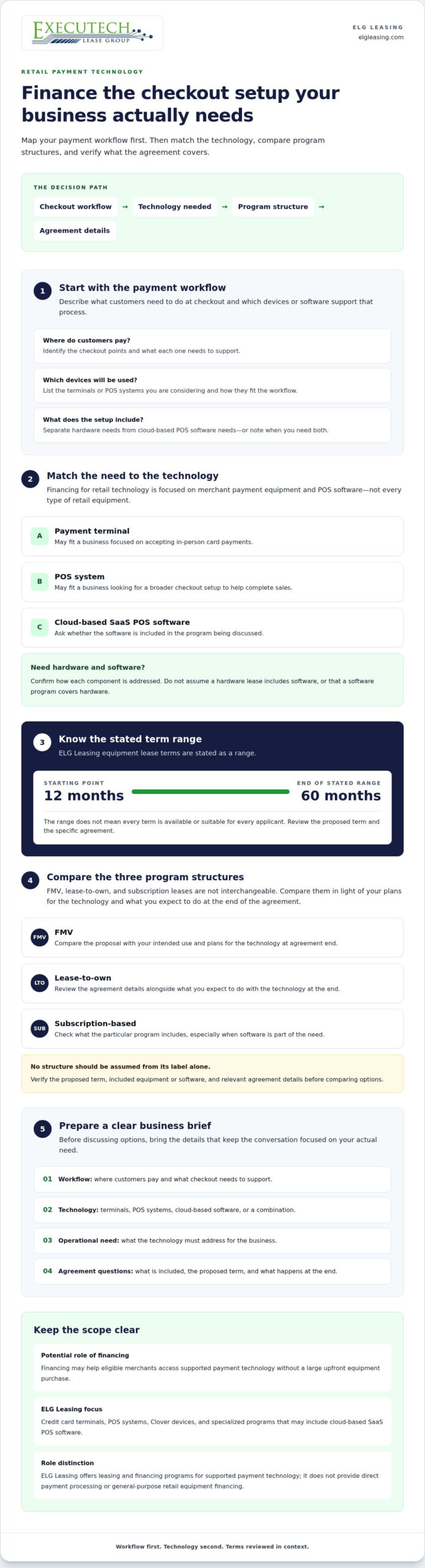
A financing proposal is useful only if it matches the way your business takes payments. Start with the checkout workflow, then check that the proposed technology and agreement fit your needs. This keeps the decision focused on what you are financing, not just the name of the payment structure.
Does the technology match your retail payment workflow?
Trace a typical transaction from customer checkout to payment completion. Note whether checkout happens at a fixed counter or in more than one location, and whether your need centers on payment acceptance, broader POS functions, or software. These distinctions can help you identify which category to discuss:
- Payment terminal: Consider this category if your need is focused on accepting card payments.
- Complete POS system: Consider this if you need a broader point-of-sale setup for your business workflow.
- Cloud-based SaaS POS software: Identify the software component separately and ask whether it is included in the proposed program.
- Clover devices: Clover is a supported leasing category. Verify that the specific device and arrangement you are considering are covered.
Do not assume every device or platform qualifies. Describe how and where you take payments, then ask whether the proposed technology fits that workflow. Confirm the equipment details directly rather than making assumptions about a model’s features.
Which contract questions deserve answers first?
Review the agreement alongside the proposed technology. Ask clear questions and locate the answers in the documents before committing:
- What equipment or software does the scheduled payment cover?
- Which agreement documents define the payment schedule and your obligations?
- What happens at the end of the term, and where are those options stated in writing?
- If the program includes SaaS POS services, how does the agreement address the software subscription, its payments, and its term?
- Does the proposed term align with how long you expect to use the equipment or software?
Check that the equipment description matches what you intend to use. If software appears in a separate document or schedule, review that document too. Contract terms vary, so do not assume a familiar program name answers questions about payments, responsibilities, or end-of-term choices.
Choose a financing structure only after checking both the technology and the contract. This helps you compare options by practical fit rather than labels alone.
Explore Retail Technology Financing with ELG Leasing
ELG Leasing focuses on financing and leasing merchant payment technology, not general retail equipment. Supported categories include credit card terminals, POS systems, Clover devices, and cloud-based SaaS POS software. ELG does not provide direct payment processing or operate as a general technology retailer. Its role is to help merchants and merchant-services partners explore financing for eligible technology.
ELG equipment leases have terms of 12 to 60 months. Available program structures include Fair Market Value (FMV) leases, lease-to-own options, and subscription-based leases. These structures are not interchangeable, and the agreement determines what applies to your specific equipment or software. Review the leasing program options to understand the categories before comparing them with your business needs.
What information should you have ready to discuss your needs?
Start with a clear description of the technology you are considering and how your business will use it. This keeps the discussion focused without assuming that every device or software platform fits a program.
- Technology category: Note whether you need a credit card terminal, a POS system, a Clover device, or cloud-based POS software.
- Business use case: Describe where and how the technology will support your payment workflow.
- Software needs: Clarify whether you are seeking hardware, software, or both, and ask how each component is addressed.
- Documents for review: Have relevant business and agreement documents available to discuss. Confirm which materials apply rather than assuming specific application requirements.
Where can you review program details and apply?
Use the program overview to compare FMV, lease-to-own, and subscription-based structures. Then review the proposed agreement: confirm the covered technology, payment schedule, term, documented obligations, and applicable end-of-term provisions. Do not infer approval, timing, or contract choices from a general description. Confirm the details that apply to your application and agreement.
If the technology fits ELG’s supported categories and you have reviewed the questions that matter to your business, you can submit an application for consideration.
Make Your Next POS Financing Decision with Clarity
The right financing for retail technology starts with a clear match between the payment workflow you need to support, the equipment or software involved, and the contract terms you understand. Compare FMV, lease-to-own, and subscription-based options against your business priorities, then confirm what the agreement actually covers.
ELG Leasing focuses on merchant payment technology, with 12 to 60 month credit card and POS equipment lease terms. Its program options include FMV, lease-to-own, and subscription-based arrangements. Financing options also include cloud-based SaaS POS software, so ask whether a specific software need fits the program under consideration.
If your technology needs align with these categories, reviewing an application is a practical next step. Read the agreement carefully, ask about any unclear obligations, and proceed only when the arrangement fits your operation.
A well-matched POS arrangement starts with a clear understanding of the technology, agreement, and commitments involved.
Frequently Asked Questions
What does financing for retail technology include?
Financing for retail technology can cover merchant payment equipment and related POS software through a leasing or financing program. ELG Leasing’s supported categories include credit card terminals, POS systems, Clover devices, and cloud-based SaaS POS software. It is not general retail equipment or consumer electronics financing. Whether a particular device, platform, or combination fits depends on the program and agreement, so confirm that the proposed technology is specifically included before proceeding.
Can I finance a POS system and credit card terminal together?
ELG offers leasing for both POS systems and credit card terminals, but confirm whether the specific equipment you need can be included together in one arrangement. Describe your checkout setup and identify each device. Then review the proposal and agreement to verify which items it covers, the applicable term, and the obligations tied to them. Do not assume that separate supported categories automatically qualify for a single combined agreement.
What is the difference between an FMV lease and a lease-to-own program?
FMV means Fair Market Value, while lease-to-own describes a different available program structure. The names alone do not establish your specific end-of-term rights or financial obligations. Compare the written agreements, paying attention to how each defines payments, equipment responsibilities, and end-of-term options. If ownership, purchase, renewal, or return matters to your plans, ask how that outcome is addressed in the specific contract before signing.
Can cloud-based POS software be included in a financing program?
Yes, ELG’s financing options include cloud-based SaaS POS software. Software may be addressed differently from payment hardware, so check exactly what the proposal covers. If your business needs both a POS system and software, ask whether each component appears in the agreement and how any software subscription is handled. Do not assume that financing for a device automatically includes its software or related subscription.
How long are ELG Leasing equipment lease terms?
ELG Leasing equipment lease terms range from 12 to 60 months for credit card and POS equipment. This describes the available term range, not a promise that every term will suit or be available to every applicant. Review the proposed term alongside its payment schedule and your intended equipment use. Confirm that the final agreement clearly states the applicable term and the obligations that continue throughout it.
Does ELG Leasing provide payment processing as well as equipment financing?
No. ELG Leasing provides leasing and financing programs for supported merchant payment technology, including credit card terminals, POS systems, Clover devices, and cloud-based SaaS POS software. It does not provide direct payment processing. If you are evaluating both equipment and processing, treat them as separate needs and confirm who provides each service. Review the equipment agreement on its own to understand what it covers and what it does not.
What should I review before applying for retail technology financing?
Before applying, identify the technology you need, how your business will use it, and whether you are seeking hardware, software, or both. Review the proposed term, payment schedule, equipment description, and contract obligations. Ask where the agreement explains any end-of-term options and how software subscriptions are addressed. Confirm the applicable process and information directly before submitting, rather than assuming application requirements or outcomes.

Article by
Robert Ensminger
Robert Ensminger is the founder and CEO of Executech Lease Group (ELG Leasing), which specializes in equipment leasing and financing solutions for the merchant-services, payments, POS, and FinTech industries. With more than 20 years of industry experience, Robert helps independent sales organizations, payment processors, POS providers, and software companies develop practical leasing, subscription, and SaaS-monetization programs. He founded ELG in 2010 and guided the company to recognition on the Inc. 5000. His work focuses on responsive service, transparent program structures, and helping ELG’s partners close more business while creating sustainable revenue.