
Stop treating your software stack as a drain on your liquid cash flow. Every modern merchant understands that staying competitive requires the latest technology, yet the initial implementation and training costs often stall necessary growth. SaaS subscription lease programs offer a streamlined alternative to the traditional cycle of high upfront expenses and fragmented billing. This isn’t for businesses content with the status quo. It’s a strategic shift that turns volatile soft costs into a predictable financial asset for those who value efficiency.
We know the pressure of managing multiple hardware leases alongside various software subscriptions while budget constraints prevent essential upgrades. It’s frustrating to see your working capital tied up in depreciating assets. This 2026 guide shows you exactly how to bundle your entire tech stack, including Clover hardware and cloud-based POS software, into a single, capital-efficient payment. We’ll explore the mechanics of modern software financing and explain how to access premium tools immediately without the usual friction of old-fashioned procurement methods.
Key Takeaways
- Discover how SaaS subscription lease programs transform intangible software costs into manageable, capital-efficient assets for your business.
- Learn to bundle Clover hardware, cloud software, and implementation costs into one streamlined monthly payment over 12 to 60 months.
- Contrast modern subscription financing with outdated perpetual license models to preserve your working capital while accessing premium technology.
- Identify critical transparency markers in lease agreements, including specific buyout options and insurance requirements.
- See why specialized leasing experts are the preferred facilitators for merchant services providers and ISOs in 2026.
The Evolution of SaaS and the Need for Subscription Financing
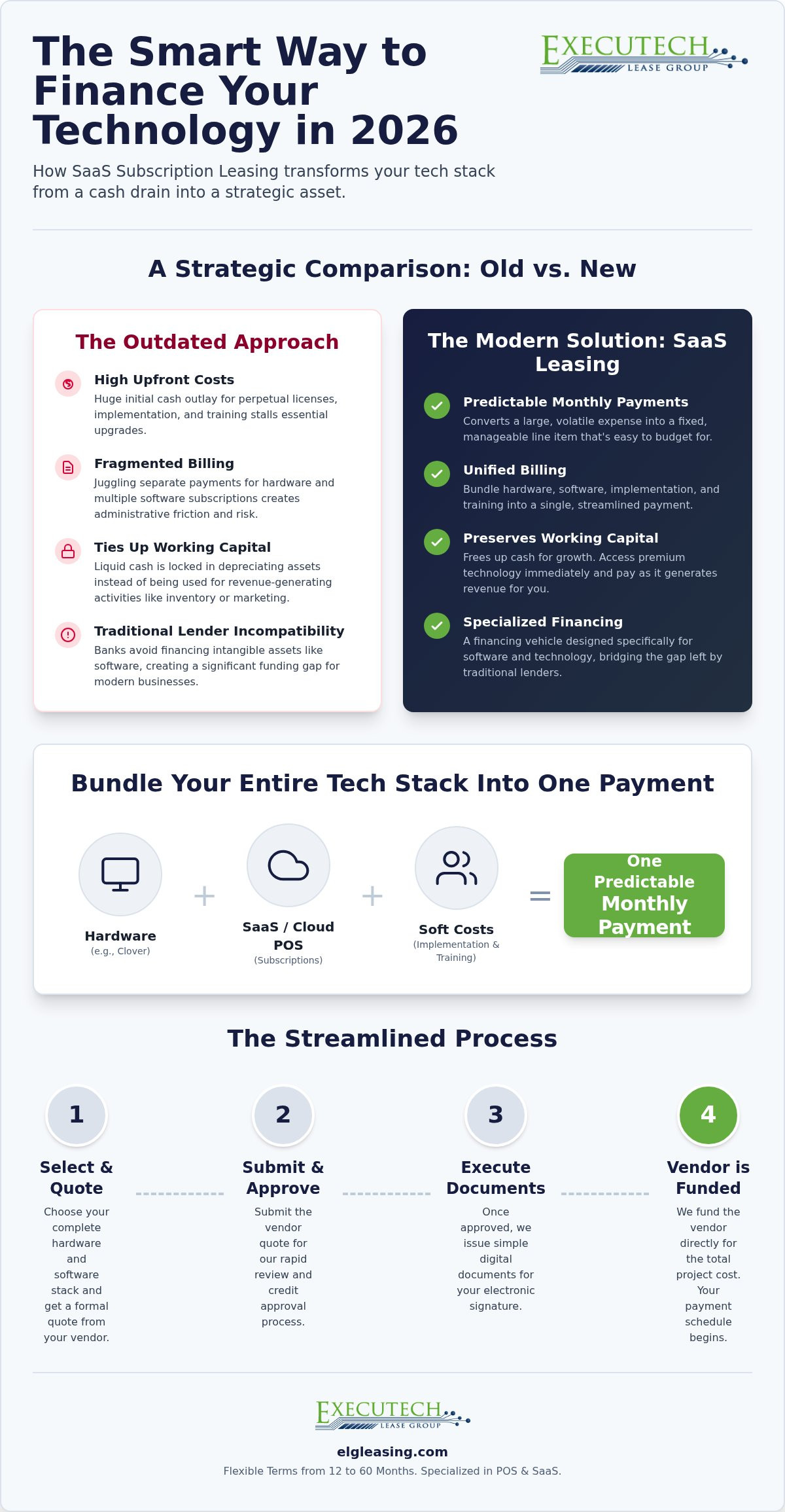
SaaS subscription lease programs serve as a specialized financing vehicle designed specifically for recurring software costs. Traditional banks often fail in this area. They demand physical collateral they can seize if a loan defaults. Software is intangible. It lacks traditional resale value. This creates a significant barrier for merchants needing high-end cloud solutions but lacking the liquid cash to pay for years of service upfront.
In 2026, the shift is absolute. Merchants have moved away from outdated perpetual licenses in favor of dynamic cloud-based ecosystems. This transition to the Software as a Service (SaaS) model ensures you always have the latest features without manual updates. However, it also introduces a capital gap. While the software itself is a monthly fee, the implementation, data migration, and staff training represent massive upfront expenses. These soft costs often stall projects before they even begin. Specialized leasing bridges this gap by financing the total cost of the transition.
Why Businesses Lease Software in 2026
Smart operators prioritize liquidity. Using SaaS subscription lease programs allows you to preserve working capital for revenue-generating activities like inventory and marketing. This approach transforms variable tech overhead into a fixed, predictable line item. From a tax perspective, businesses often treat these agreements as operating expenses. Some may even explore Section 179 benefits to accelerate deductions. Always consult your tax professional for current 2026 regulations to maximize these advantages.
The Problem with Standard Subscription Models
Standard subscriptions are often deceptive. Upfront professional service fees for complex POS systems can reach five to ten times the monthly subscription price. Relying on standard credit cards for these expenses is a mistake. High interest rates and restrictive credit limits erode your financial flexibility. Managing disparate billing cycles for hardware and software adds administrative friction you don’t need. You require a unified solution that bundles every component into one predictable agreement. Fragmented billing leads to missed payments and service interruptions, which are risks no growing business should take.
How SaaS Subscription Lease Programs Work
The operational logic of SaaS subscription lease programs relies on a tripartite relationship between the software vendor, the merchant, and the leasing partner. We act as the bridge that connects your need for advanced technology with the vendor’s requirement for upfront payment. This structure allows the vendor to receive their full contract value immediately while you preserve your cash reserves. You don’t have to wait for annual budget cycles to upgrade your systems. You can access the tools you need today and pay for them as they generate revenue for your business.
The process is built for speed and transparency. First, you select your software stack and obtain a formal quote from your vendor. Second, you submit that quote to us for review. Once approved, we issue digital documents for your signature. After execution, we fund the vendor directly for the total project cost. Your monthly payment schedule begins only after the funding is complete. This streamlined process flow eliminates the traditional friction associated with bank-led technology loans.
Standard terms in the POS industry typically range from 12 to 60 months. This flexibility allows you to align the lease duration with the expected lifecycle of the software. For growing enterprises, we utilize the “Master Lease” concept. This allows you to add new software modules or equip additional locations under a single overarching agreement. It simplifies your accounting and ensures your entire organization remains on a unified technology standard.
Bundling Hardware and Software into One Lease
Efficiency is the primary driver of modern business. We specialize in combining Clover terminals and other hardware with their native SaaS POS software into a single monthly payment. This centralization reduces administrative friction. You no longer have to track separate billing cycles for your equipment and your subscriptions. By consolidating your “Point of Sale” stack, you gain a clear, predictable view of your technology overhead. If you’re ready to simplify your operations, you can start your application now to see your available bundling options.
Financing the “Soft Costs”: Implementation and Training
Software is useless if your team doesn’t know how to use it. Many traditional lenders refuse to finance “soft costs” like implementation, data migration, and staff training. We don’t. We include 100% of these project costs in your lease. Financing these elements ensures you have the resources for a professional setup, which is critical for long-term ROI. You can structure your lease to cover the initial customization and the heavy lifting of moving data from your old system to the new cloud-based environment.
Subscription vs. Traditional Software Leasing: A Strategic Comparison
Traditional software leasing focused on perpetual licenses. You bought a specific version of a program, financed the one-time cost, and “owned” an asset that began depreciating immediately. In 2026, this model is obsolete. Modern SaaS subscription lease programs finance the ongoing service, not just a static file. You’re paying for continuous access, security patches, and feature updates. Software ownership is now a liability. It ties you to stagnant technology while your competitors use cloud-based tools that evolve daily.
Analyzing the total cost of technology over a 36-month period reveals the true advantage of the subscription model. With perpetual licenses, you often face unexpected maintenance fees and expensive version upgrades. SaaS leasing eliminates these variables. Your costs are fixed. You gain access to premium POS software and hardware without the volatility of “buy and hold” strategies. This approach ensures your business stays current with rapid update cycles. You don’t have to worry about your system becoming a legacy burden before the lease ends.
Capital Expenditure (CapEx) vs. Operating Expenditure (OpEx)
The shift to SaaS leasing changes how your technology stack appears on the balance sheet. Traditional purchases are Capital Expenditures (CapEx). They require large cash outlays and long depreciation schedules. Leasing transforms these into Operating Expenditures (OpEx). This model preserves your credit lines and improves your liquidity. In the 2026 financial environment, maintaining a lean balance sheet is critical for business valuation. By utilizing leasing benefits, you keep your debt-to-equity ratio healthy. This makes your business more attractive to investors and lenders alike. It’s also vital to verify current ASC 842 implications for your specific 2026 tax filing to ensure you’re maximizing the reporting advantages of these agreements.
Scalability and Flexibility
Growth shouldn’t require a total contract overhaul. SaaS subscription lease programs are built for scalability. If you need to add user licenses or new software modules, we can often integrate them into your existing agreement. This is far more efficient than managing dozens of individual subscriptions. We also offer FMV (Fair Market Value) leases. These are ideal for rapid tech refreshes. When the term ends, you can simply upgrade to the latest hardware and software versions without a massive capital hit. This flexibility allows you to pivot your technology strategy as the market changes. You aren’t locked into yesterday’s solutions when tomorrow’s opportunities arrive.
Evaluating SaaS Lease Agreements: A Merchant Checklist
Transparency is the foundation of a secure financial partnership. When you’re reviewing 12 to 60-month credit card and POS leases, you must look beyond the monthly payment. SaaS subscription lease programs require specific attention to detail because they involve intangible services rather than just physical hardware. You’re verifying that the financing covers the entire scope of work, not just the software access. This include the implementation and training fees that are often overlooked by traditional lenders.
- Documentation Fees: Confirm any one-time setup or processing costs before signing.
- Insurance Requirements: Software leases often have different liability standards than equipment-only agreements.
- Buyout Options: Understand your position at the end of the term, especially for bundled hardware like Clover terminals.
- Vendor Funding: Verify that the SaaS provider receives their full payment immediately to prevent service interruptions.
The “Early Termination” trap is a common risk in the broader market. Your business needs can change as you scale. You require a lease that offers a clear path for upgrades or adjustments without punitive penalties. We prioritize professional transparency so you can make informed decisions about your technology lifecycle. If the software doesn’t grow with you, the lease shouldn’t hold you back.
Key Contractual Clauses for Software Leases
Data ownership is non-negotiable. Your contract should explicitly state what happens to your business data if the lease ends or you switch providers. Additionally, you must examine how the software vendor’s Service Level Agreements (SLAs) interact with your lease. If the software is down, your payment obligations usually remain, so ensuring your vendor has robust uptime guarantees is essential. Watch for automatic renewal clauses. You should have the right to negotiate renewal terms well before the initial contract expires.
The Approval Process: What Lenders Look For
The approval process for SaaS financing is disciplined. We look for a consistent processing history and established business tenure. Credit requirements are generally higher for software-heavy leases because the asset is intangible. However, being a merchant-focused facilitator allows us to evaluate your business based on its operational health rather than just a balance sheet. You can streamline this process by using ELG’s online tools to submit your application and receive a decision quickly.
ELG Leasing: Tailored SaaS and Hardware Bundles
ELG Leasing operates as the high-standard gatekeeper for the merchant services industry. We don’t partner with everyone. This selectivity ensures a secure, high-quality ecosystem for our ISOs and agents. By focusing exclusively on the intersection of finance and technology, we’ve become the preferred facilitator for complex tech bundles. Our SaaS subscription lease programs allow you to offer a complete solution without the traditional friction of bank-led financing. We prioritize clarity and professional transparency in every agreement.
Consider a retail merchant who needs a Clover Station bundled with specialized retail software. The upfront implementation and equipment costs can easily stall the sale. We eliminate this objection. By wrapping the hardware, software, and soft costs into one agreement, you provide the merchant with a premium experience from day one. Our SaaS subscription lease programs turn these equipment hurdles into simple monthly line items. This approach increases merchant stickiness. It turns a one-time hardware sale into a long-term, monetized relationship that benefits everyone involved.
Empowering ISOs and Sales Agents
Closing large-scale POS deals requires more than just good software. It requires a financial strategy that removes barriers. Our ELG programs empower agents to move beyond small-ticket terminal sales. You can now approach enterprise-level clients with the confidence that their entire software stack is financeable. We offer white-label opportunities that strengthen your brand. By removing the “upfront cost” objection, you drive higher volume and accelerate your sales cycle. It’s a professional, transparent way to grow your portfolio without unnecessary complications.
Accessing Modern Payment Technology
The path to staying competitive in 2026 is clear. Merchants need cloud-based tools to survive, but they don’t always have the capital to buy them outright. We provide the “No-Nonsense” path to procurement. Our SaaS and Subscription Lease options are designed for the modern business environment. We skip the emotional storytelling and focus on the logistical advantages. You get the technology you need today. You pay for it using the revenue it helps you generate. It’s that simple.
The right technology is the engine of your business. We’re here to ensure you have the fuel to keep it running. It’s time to stop letting upfront costs dictate your growth potential and start accessing the premium tools your business deserves.
Frequently Asked Questions
What exactly are SaaS subscription lease programs?
SaaS subscription lease programs are specialized financial arrangements that allow businesses to finance the recurring costs of cloud-based software. Instead of paying for a multi-year contract upfront, you spread the cost over a fixed term. This model is specifically designed for the merchant services industry to handle intangible assets that traditional banks often reject. It transforms your software stack into a predictable monthly line item while preserving your liquid working capital for daily operations.
Can I include POS hardware like Clover terminals in my SaaS lease?
You can absolutely bundle POS hardware like Clover terminals into your agreement. We specialize in creating comprehensive technology packages that combine physical devices with their native cloud-based software. This centralization simplifies your administrative overhead by consolidating your equipment and subscription payments into one single monthly bill. It ensures your hardware and software lifecycles remain perfectly aligned. You get a unified solution that eliminates the need for managing multiple disparate contracts and billing cycles.
Do these lease programs cover software training and setup fees?
Yes, our programs cover 100% of the project costs, including software training, implementation, and data migration fees. These soft costs are often the biggest barrier to adopting new technology. We include them in the total lease value to ensure you have the resources for a professional installation. Financing these upfront expenses allows your team to achieve full software adoption and ROI without a massive initial cash outlay. It’s a strategic way to fund the entire transition.
How long are the typical lease terms for SaaS software?
Typical lease terms for SaaS software range from 12 to 60 months. This flexibility allows you to choose a duration that matches your business goals and the expected lifecycle of your technology. Shorter terms are often used for rapidly evolving tools, while 60-month terms provide the lowest monthly payment for established POS systems. You can select the timeframe that best balances your monthly cash flow requirements with your long-term technology roadmap.
Is SaaS leasing better for my taxes than a bank loan?
SaaS leasing often provides superior tax advantages because payments are typically treated as operating expenditures rather than capital debt. This allows you to deduct the full monthly payment as a business expense. In contrast, bank loans require you to manage complex depreciation schedules over several years. You should verify current 2026 ASC 842 implications with your tax professional to maximize these benefits. Our no-nonsense approach prioritizes your financial efficiency through these streamlined reporting structures.
What happens to my software access at the end of the lease term?
At the end of the term, you have several flexible options depending on your specific agreement. You can renew your subscription, upgrade to the latest software version, or exercise a buyout option if hardware is included. Since SaaS is cloud-based, you don’t own the code, but the lease ensures uninterrupted access throughout the contract. If you choose to end the agreement, you simply stop the service. This prevents you from being stuck with legacy technology that no longer serves your needs.
Can I add more software licenses to my lease later?
You can easily add more software licenses or new modules to your existing lease through our Master Lease structure. This feature is designed for growing businesses that need to scale their technology footprint across multiple locations. We add the new costs to your overarching agreement, which keeps your billing centralized and organized. It eliminates the administrative friction of managing dozens of individual subscription dates. You gain the scalability required to pivot your strategy as your market demands change.
Is a SaaS lease considered a liability on my business balance sheet?
Under 2026 accounting standards like ASC 842, most leases are recorded as right-of-use assets with corresponding liabilities. However, the impact on your credit availability is typically much lower than a traditional bank loan. SaaS subscription lease programs help you maintain a cleaner debt-to-equity ratio by avoiding large, lump-sum financing. This professional transparency makes your business more attractive to future investors. It positions your technology spend as a strategic operational asset rather than a burdensome capital debt.

Article by
Robert Ensminger
Robert Ensminger is the founder and CEO of Executech Lease Group (ELG Leasing), which specializes in equipment leasing and financing solutions for the merchant-services, payments, POS, and FinTech industries. With more than 20 years of industry experience, Robert helps independent sales organizations, payment processors, POS providers, and software companies develop practical leasing, subscription, and SaaS-monetization programs. He founded ELG in 2010 and guided the company to recognition on the Inc. 5000. His work focuses on responsive service, transparent program structures, and helping ELG’s partners close more business while creating sustainable revenue.