
Scalable POS leasing solutions can help you plan equipment decisions around each stage of business growth instead of treating every location as the same project. Before comparing lease structures, separate confirmed equipment needs from future projections, identify who owns each decision, and clarify what you want to happen at the end of the term. That approach makes it easier to plan equipment without assuming every future site will need the same setup.
This guide compares fair market value (FMV) leases, lease-to-own programs, and hardware subscriptions, including their terms, lease-end outcomes, and stated warranty coverage. It also offers a repeatable process for organizing equipment requests across locations and merchant accounts. Use the framework to compare each arrangement against a specific use case, rather than focusing on a payment figure in isolation.
Executech Lease Group (ELG) helps merchants and channel partners access equipment leasing options for Point of Sale (POS) systems, card terminals, and ATMs. ELG does not process payments or provide merchant accounts. Keeping the equipment decision separate from processor arrangements helps you plan each part of a rollout with clear responsibilities.
Key Takeaways
- Build a repeatable equipment-planning framework around each location’s use case, rollout timing, and decision owners.
- Compare Scalable POS leasing solutions by term, intended ownership, and what happens when the agreement ends.
- Separate equipment leasing decisions from processor setup, compatibility, delivery, and installation planning.
- Distinguish FMV leases, lease-to-own programs, and hardware subscriptions by their structure and applicable warranty terms.
- Understand how ELG supports POS equipment leasing without processing payments or supplying merchant accounts.
Why scalable POS leasing starts with a growth plan
A new location, a changed checkout workflow, or another merchant account can change the equipment a business needs. One site may use a countertop terminal, while another may need a different system for its workflow. Before comparing leases, list the equipment requirements for each use case. This makes it easier to align the equipment, timing, and intended lease-end outcome.
Scalable POS leasing is an equipment-planning approach that evaluates each decision against current needs and planned stages of growth; it does not guarantee that expansion will happen. Start with the actual workflow, then identify the equipment needed to support it. A POS system can include hardware and software used to support sales transactions, so consider the components separately when documenting the request. Leasing covers equipment arrangements. It is separate from payment processing: ELG does not process payments, provide merchant accounts, or control processor obligations.
Which business changes can trigger a new POS equipment decision?
Review equipment needs when adding a location, replacing devices, or onboarding a new merchant account. Treat each as a planning scenario, not an automatic purchase. Record the confirmed need, such as the device category and intended use, separately from projected demand that has not been established. This prevents a possible future rollout from being mistaken for a current equipment requirement.
Compatibility also needs a separate review. A device’s suitability depends on the specific equipment and relevant processor arrangements. Keep that review distinct from the lease decision, so the equipment plan does not imply that processor setup or compatibility is included in the leasing arrangement.
Why plan equipment in stages instead of choosing one structure for every need?
Different rollout stages may call for separate evaluations. Replacing a device at an existing location is not the same planning task as equipping a new site or onboarding a merchant account. The use, timing, and intended ownership may differ. Choosing one structure for every scenario can hide those differences, so assess each equipment need on its own terms.
Use a simple planning record for each stage:
- Timing: When is the equipment needed?
- Device category: What type of equipment supports the intended use?
- Need status: Is the requirement confirmed, or is it a projection?
- Lease-end outcome: What do you intend to do with the equipment at the end of the term?
Review the record as plans change. A consistent record helps you compare requests without treating projected demand as a commitment. For a starting point on available equipment lease structures, see ELG’s POS equipment leasing programs.
How to evaluate scalable POS leasing solutions
Start a comparison with the equipment need, not a monthly payment figure. Evaluate the structure, term, and end-of-term choice together. Comparing those elements on the same basis can clarify which arrangement fits a confirmed requirement and which assumptions still need to be resolved before a later expansion.
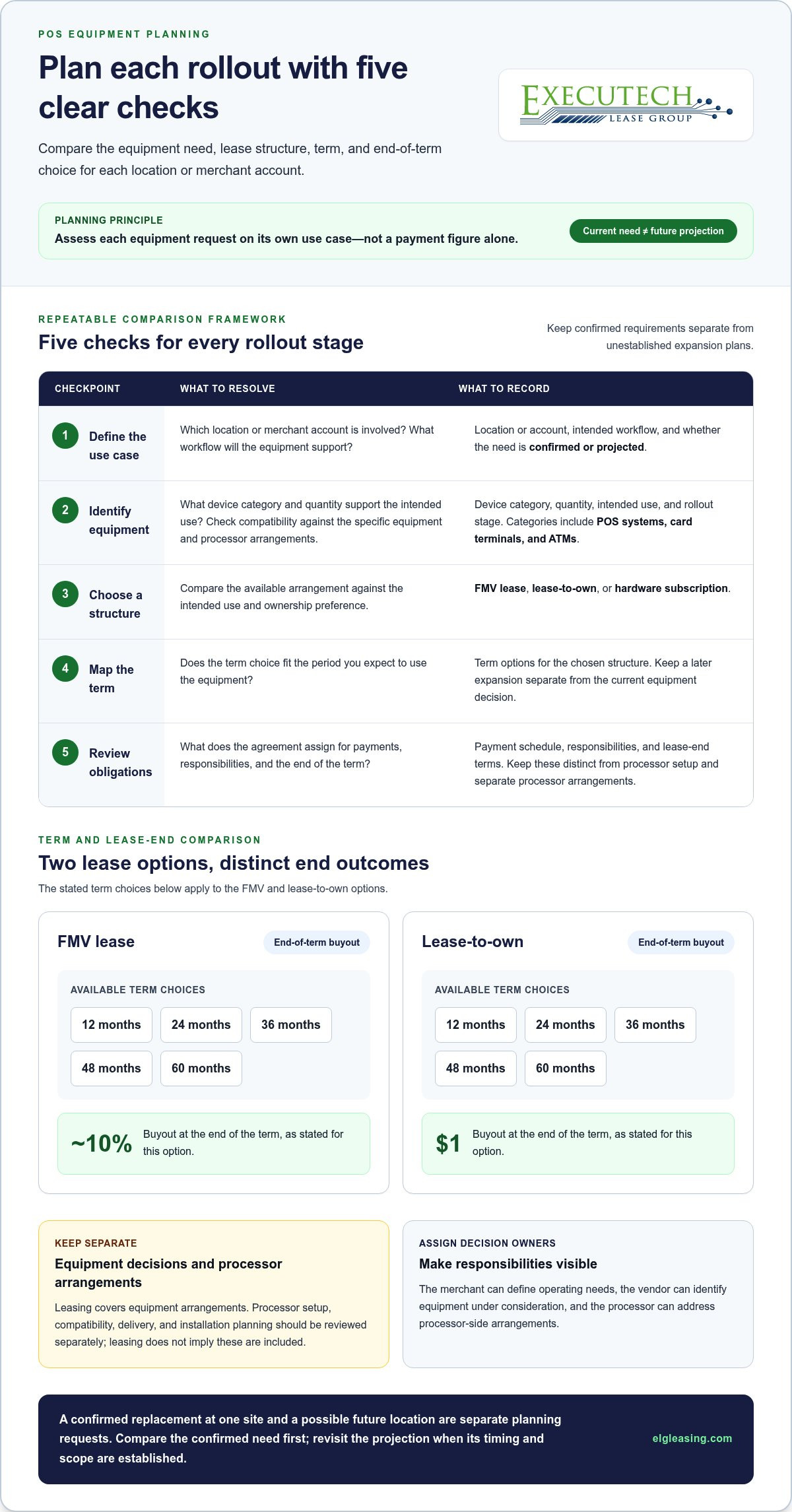
Use this five-step framework for each rollout stage:
- Define the use case. Identify the location or merchant account, the workflow the equipment will support, and whether the need is confirmed or projected.
- Identify the equipment. Record the device category, quantity, intended use, and rollout stage. Categories to evaluate include POS systems, card terminals, and ATMs. Review compatibility against the specific equipment and processor arrangements.
- Choose a structure. Compare an FMV lease, a lease-to-own arrangement, and a hardware subscription against the intended use and ownership preference. ELG’s equipment leasing programs outline these structures.
- Map the term. Compare the term choices for the structure with the period you expect to use the equipment. Do not assume that a later expansion belongs in the same equipment decision.
- Review obligations. Read the agreement for its payment schedule, responsibilities, and lease-end terms. Keep equipment obligations distinct from processor setup and separate processor arrangements.
What equipment and operating needs should the comparison include?
For each item, record its quantity, intended use, and timing. If several parties are involved, clarify who owns each decision. The merchant can define operating needs, the vendor can identify the equipment being considered, and the processor can address processor-side arrangements. Separating those roles helps surface dependencies without implying that equipment leasing includes payment processing or setup.
For example, a business may have a confirmed replacement need at one site and a possible new-location requirement later. Compare the confirmed equipment first. Keep the later request separate until its timing and scope are established. This keeps an estimate from being treated as a current commitment and makes it easier to revisit when the details are known.
How should you compare the term and lease-end preference?
ELG’s FMV and lease-to-own options each have 12, 24, 36, 48, and 60-month term choices. First decide what you want at the end of the term: ELG’s FMV option ends with about a 10% buyout, while its lease-to-own option ends with a $1 buyout. These are different lease-end outcomes, not interchangeable payment labels.
Compare the intended outcome, then review the term and payment presentation for that structure. Vendors organizing equipment-leasing opportunities can use ELG’s vendor inquiry page to discuss a vendor relationship. This is not a financing application.
FMV, lease-to-own, or hardware subscription: compare the structures
The practical difference between these structures is the lease-end outcome, along with the term and any stated warranty coverage. Compare those details before weighing payment presentations. Scalable POS leasing solutions are easier to evaluate when the structure fits the equipment plan and intended outcome, rather than assuming every device should follow the same arrangement.
| Structure | Confirmed terms | End-of-term outcome | Warranty information |
|---|---|---|---|
| FMV lease | 12, 24, 36, 48, or 60 months | About a 10% buyout | Not defined by the stated FMV terms |
| Lease-to-own | 12, 24, 36, 48, or 60 months | $1 buyout | Not defined by the stated lease-to-own terms |
| Hardware subscription | 12-60 months | No buyout outcome stated here | Hardware warranty for the subscription term |
When might an FMV lease fit the equipment plan?
Consider the FMV option when its lease-end outcome aligns with your equipment plan. ELG offers 12-, 24-, 36-, 48-, and 60-month choices, and the option ends with about a 10% buyout. Compare the available terms with the period you expect to use the equipment, then decide whether that buyout outcome matches your preference. Review the agreement for the applicable terms and obligations.
How does lease-to-own differ from a hardware subscription?
Lease-to-own offers the same term choices as FMV and ends with a $1 buyout. A hardware subscription instead runs for 12-60 months and includes a hardware warranty for the subscription term. That warranty applies during the subscription term; it does not establish upgrades, cancellation rights, or additional service commitments.
This difference matters when planning equipment for separate locations or rollout stages. If the buyout outcome is central to your decision, compare FMV and lease-to-own by their distinct end points. If the subscription-term warranty is important, evaluate the subscription on its own terms. Do not treat a warranty as a substitute for a preferred buyout outcome.
For further information about the subscription structure, ELG’s hardware subscription program describes that option. Use the comparison as a starting point, then review the agreement’s terms and obligations for the equipment in your plan. A clear view of the structure, term, and lease-end outcome helps you compare options against the actual rollout need.
Plan a POS rollout that can adapt as needs change
A rollout plan should show what is decided, what remains under consideration, and who owns each next step. That record helps you evaluate new equipment requests against established requirements instead of carrying early assumptions forward as if they were settled. Scalable POS leasing solutions depend on keeping the plan current as well as choosing an appropriate lease structure.
What belongs in a staged equipment plan?
Create a separate entry for each rollout phase. Make the plan specific enough to coordinate decisions, but do not turn an unconfirmed idea into a deployment schedule. Include:
- Phase and location or account: Identify the part of the rollout the request concerns.
- Equipment category and quantity: Record what is needed for that phase, distinguishing confirmed requirements from items still being planned.
- Decision owner: Name who is responsible for the equipment choice and who needs to contribute information.
- Target decision date: Track when the decision is needed, not an assumed delivery or installation date.
- Open dependencies: Note processor setup, equipment compatibility, delivery, or installation as separate workstreams with their own owners.
Keep equipment leasing discussions focused on the equipment arrangement. Processor setup and processing agreements remain separate, including obligations between the merchant and processor. Tracking these dependencies separately makes responsibilities clearer without suggesting that ELG controls processor arrangements or provides delivery and installation.
As each phase progresses, update the record with established details and label projections clearly. For example, a possible additional location can remain a planning assumption until its equipment category, quantity, and timing are known. Once those details are established, assess the request on its own requirements instead of automatically extending an earlier equipment decision.
How can channel partners support a repeatable process?
Independent sales organizations (ISOs) and agents can help coordinate equipment discussions by gathering the merchant’s intended use, known device needs, and rollout stage. A merchant services provider (MSP) may also be part of the merchant-services relationship. Keep partner responsibilities distinct from ELG’s role as an equipment lease brokerage. Payment processing and processor obligations remain separate.
A shared planning record gives the merchant, channel partner, and equipment-leasing discussion a consistent reference. It shows which details are confirmed, which remain assumptions, and who needs to resolve each open item. That clarity can help coordinate staged requests without assuming that one party owns every decision.
ELG’s equipment leasing process flow can help channel partners understand leasing as a distinct workstream within a broader rollout. Track processor setup, compatibility, delivery, and installation separately so each task has a clear owner.
How Executech Lease Group supports scalable POS leasing decisions
ELG is a U.S. equipment lease brokerage focused on the merchant-services and payments-technology ecosystem. ELG offers no-money-down equipment leasing, FMV leases, lease-to-own programs, and hardware subscriptions for equipment such as POS systems, card terminals, and ATMs. No-money-down describes the leasing arrangement; it does not mean the equipment is free or remove the financial obligations in an agreement.
ELG’s role is separate from payment processing. ELG does not process payments, provide merchant accounts, or control a merchant’s processor obligations. Merchants and channel partners can evaluate equipment terms alongside rollout plans and intended ownership, while keeping processing arrangements as a separate workstream.
Which ELG leasing option aligns with the planned outcome?
Start with your preferred lease-end outcome. ELG’s FMV option ends with about a 10% buyout, while its lease-to-own option ends with a $1 buyout. Both have 12, 24, 36, 48, and 60-month term choices. Hardware subscriptions have 12-60-month terms and include a hardware warranty for the subscription term. Evaluate that distinction without assuming additional upgrades or services.
Then match the structure to the equipment plan. Compare the FMV terms with the planned period of use if its buyout outcome suits your preference. Consider lease-to-own if its $1 buyout is the intended outcome. If the subscription-term warranty is relevant to the equipment decision, assess the subscription separately. Scalable POS leasing solutions are easier to compare when each option is matched to a stated need instead of being treated as interchangeable.
ELG provides credit decisions in 1-2 business hours. This refers only to the timing of a credit decision. It does not promise approval, funding, equipment delivery, or installation. Keep those steps distinct when coordinating the broader rollout.
What is the appropriate next step for a vendor or partner?
Vendors, ISOs, and MSPs considering a relationship with ELG can use the Apply Now page to make a vendor inquiry. It is for vendor inquiries, not financing applications, and submitting an inquiry does not produce a financing approval or credit decision. Keep partnership discussions separate from a merchant’s equipment request and its credit-decision process.
Before making a vendor inquiry, organize the equipment categories you work with and how leasing could fit into your merchant conversations. That context can help focus the relationship discussion on equipment leasing and the merchants you support. ELG’s role centers on equipment leasing, separate from processing services.
Make your next equipment decision easier to repeat
Build a review point into your rollout process. When a new equipment request comes forward, compare it with current requirements and the assumptions behind earlier plans. This gives your team a clearer basis for deciding whether the request belongs in an existing phase or should be evaluated separately.
Scalable POS leasing solutions support deliberate equipment decisions, not automatic expansion. Keep the plan current, share relevant details with the people involved, and match each discussion to the need at hand. A repeatable process makes it easier to explain decisions and coordinate the next stage.
Use the same practical framework for each request: define the equipment need, compare the structure and term, and confirm the intended lease-end outcome. Discuss becoming an ELG vendor.
Frequently Asked Questions
Does ELG process payments or provide merchant accounts?
No. ELG focuses on equipment leasing and does not process payments or provide merchant accounts. Treat the equipment arrangement and payment-processing relationship as separate workstreams. The processor or other relevant party handles processing arrangements, while ELG’s role is equipment leasing. A lease discussion does not change processor obligations.
How fast does ELG make a credit decision?
ELG provides credit decisions in 1-2 business hours. That timing refers only to the decision, not a promise of approval, funding, equipment delivery, or installation. Track the credit-decision step separately from equipment logistics and processor setup. A decision alone does not establish when a device will be ready for use.
Does no-money-down equipment leasing mean the equipment is free?
No. ELG offers no-money-down equipment leasing. No-money-down means no down payment is required for the equipment leasing arrangement, not that the equipment is free or that there is no financial obligation. Review the agreement for its payment schedule and applicable obligations when planning cash flow. Evaluate each equipment request against its own timing and terms.
Can I assume a POS device will work with every payment processor?
No. Do not assume a POS device works with every processor. Compatibility depends on the specific equipment and processor arrangements, so treat it as a project-specific coordination point, not a universal feature of leasing. Document the device under consideration and the processor setup for the merchant account before treating the equipment plan as ready. Scalable POS leasing solutions still require this separate compatibility review.
Is ELG’s Apply Now page a financing application?
No. ELG’s Apply Now page is for vendor inquiries, not financing applications, and submitting it does not create a credit decision. Use it for vendor, ISO, or MSP partnership discussions. A merchant’s equipment request and any credit decision are separate from a vendor relationship inquiry, so the page is not a way to apply for a particular merchant’s lease.
Can an independent software vendor discuss SaaS funding with ELG now?
Yes. Independent software vendors (ISVs) can engage with ELG now about its SaaS funding program. This is an invitation to discuss the program, not a statement that funding is available or that terms, eligibility, disbursement timing, or approval are established. Keep SaaS partnership questions separate from POS hardware lease terms. Equipment buyouts and credit-decision timing do not define SaaS program economics.
Does a 1-2 business-hour credit decision mean equipment will arrive in that time?
No. The 1-2 business-hour window applies only to a credit decision. Equipment readiness involves separate considerations, including delivery, installation, and processor setup, none of which is timed by that decision window. Track these activities independently in a rollout schedule, and do not use a credit-decision estimate as a shipment or go-live date. This keeps operating plans realistic and responsibilities clear.

Article by
Robert Ensminger
Robert Ensminger is the founder and CEO of Executech Lease Group (ELG Leasing), which specializes in equipment leasing and financing solutions for the merchant-services, payments, POS, and FinTech industries. With more than 20 years of industry experience, Robert helps independent sales organizations, payment processors, POS providers, and software companies develop practical leasing, subscription, and SaaS-monetization programs. He founded ELG in 2010 and guided the company to recognition on the Inc. 5000. His work focuses on responsive service, transparent program structures, and helping ELG’s partners close more business while creating sustainable revenue.