
Why would you tie up thousands in vital capital for hardware that will be obsolete in thirty-six months? It’s a strategic mistake many entrepreneurs make. You need the latest tools to stay competitive, but the upfront cost of modern systems often creates a massive barrier to entry. We agree that traditional ownership often leads to technology stagnation and depleted cash reserves. Researching small business POS leasing options shouldn’t be a chore; accessing premium technology should be a catalyst for growth, not a drain on your bank account.
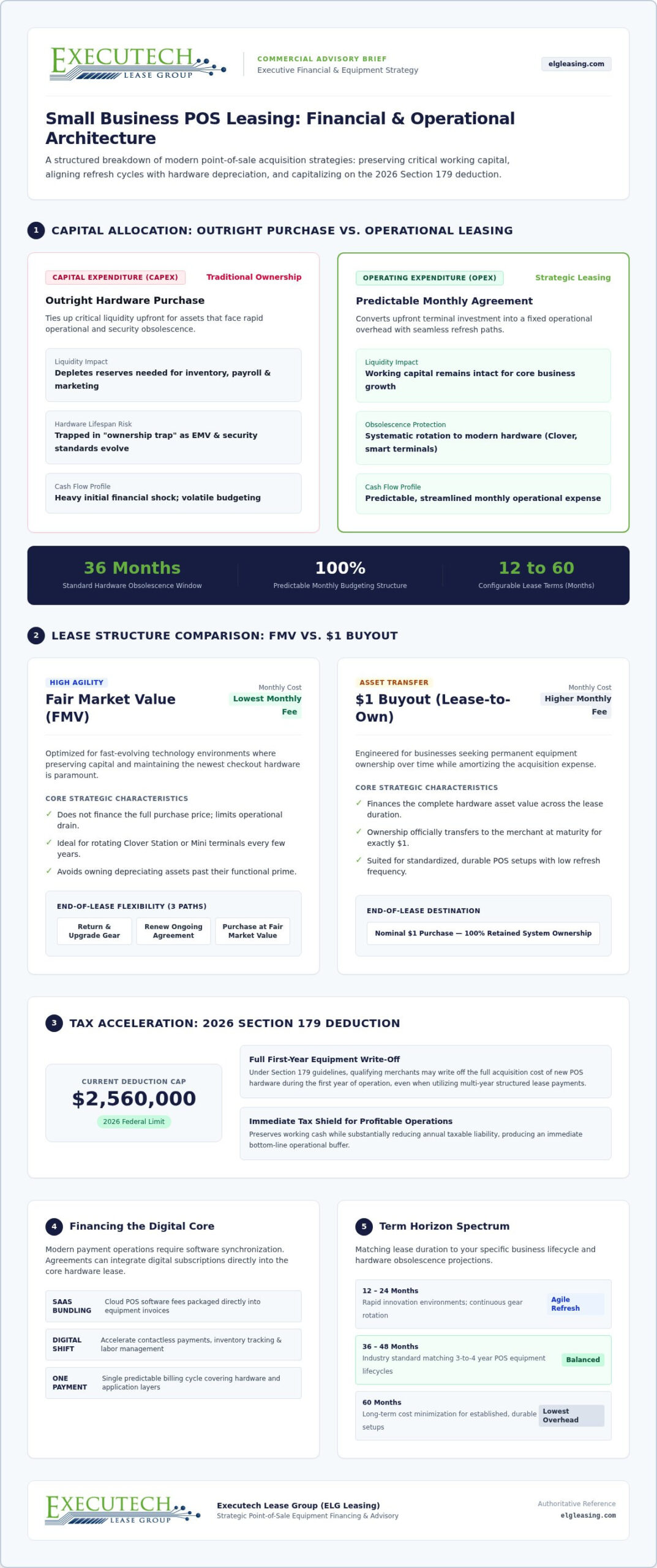
This guide identifies how to put elite hardware like Clover in your hands without the initial financial shock. You’ll discover how to leverage the 2026 Section 179 deduction, which currently features a $2,560,000 limit, to offset your acquisition costs immediately. We promise to cut through the financial jargon and show you how to acquire premium technology while maintaining liquidity. We’ll break down the structural differences between Fair Market Value (FMV) leases and lease-to-own programs, providing a clear path to a streamlined, tech-forward operation that prioritizes cash flow over depreciating assets.
Key Takeaways
- Preserve your working capital by converting high upfront hardware costs into predictable, streamlined monthly payments.
- Distinguish between Fair Market Value (FMV) models for rapid tech refreshes and $1 Buyout structures for long-term ownership.
- Accelerate your digital transition by bundling cloud-based SaaS software fees directly into your equipment lease agreement.
- Leverage the 2026 Section 179 deduction to potentially write off the full cost of your POS system in the first year.
- Compare flexible 12–60 month small business POS leasing options to find the ideal term for your specific business lifecycle.
The Fundamentals of POS Equipment Leasing for Small Businesses
POS leasing is a straightforward contractual agreement. You pay a fixed monthly fee to use essential hardware for a specific term. This structure keeps your capital intact for inventory, payroll, and marketing. Unlike traditional bank loans with rigid requirements or credit cards with predatory interest rates, leasing provides a dedicated path to acquiring modern point-of-sale hardware and software. It’s about efficiency. You get the tools you need without the upfront financial burden.
Smart operators prioritize liquidity. Buying equipment outright drains cash reserves that could be used for growth. By exploring small business POS leasing options, you convert a large, one-time expense into a predictable operational cost. This approach ensures you have the latest merchant-specific hardware, such as smart terminals and Clover systems, without the sticker shock of a full purchase.
To better understand the financial dynamics of equipment acquisition, watch this helpful video:
Modern commerce requires specialized tech. You need systems that handle contactless payments, manage inventory, and track employee hours. Standard consumer tablets often fail under the pressure of a high-volume retail environment. Dedicated POS hardware is built for durability and security, ensuring your business stays compliant with the latest payment standards.
Why Leasing Beats Buying for Rapidly Evolving Tech
Payment technology moves fast. Most hardware enters a cycle of obsolescence every three to four years as security protocols and EMV standards evolve. If you buy your equipment, you’re stuck with it. You fall into an “ownership trap” with outdated, insecure hardware that slows down your checkout line. Leasing prevents this. Specialized refresh programs allow you to rotate out aging gear for the latest models seamlessly. You stay current. You stay secure. You stay competitive.
The Financial Impact on Small Business Cash Flow
Leasing shifts your hardware acquisition from a Capital Expenditure (CapEx) to an Operating Expenditure (OpEx). This distinction is vital for financial forecasting. Predictable monthly budgeting allows for better cash flow management. You know exactly what’s leaving your account every month. Additionally, many businesses leverage the benefits of POS equipment leasing to take advantage of tax incentives. Under the 2026 Section 179 guidelines, you may be able to deduct the full value of the equipment in the first year, even if you’re paying for it over time. This creates an immediate tax shield for your profitable business.
Comparing POS Lease Structures: FMV vs. Lease-to-Own
Selecting the right structure for small business POS leasing options is a strategic decision that affects your balance sheet for years. You generally choose between two primary paths: Fair Market Value (FMV) and $1 Buyout, also known as Lease-to-Own. One is designed for technology agility. The other is a vehicle for asset acquisition. Your choice depends entirely on your long-term hardware strategy and how you manage cash flow.
Understanding these nuances is critical for maintaining a healthy bottom line. The SBA equipment leasing guidance highlights that the decision to lease versus buy should be grounded in how quickly the equipment depreciates. In the world of point-of-sale systems, depreciation happens fast. Choosing the wrong lease structure can leave you paying for “dead” technology long after it has lost its utility.
Fair Market Value (FMV) Leases: Maximum Flexibility
FMV leases are the gold standard for businesses that prioritize staying current. This structure offers the lowest monthly payments because you aren’t financing the entire purchase price of the equipment. It’s ideal for high-tech environments where you want to rotate into a new Clover Station or Mini every few years. When the lease concludes, you have three options. You can return the equipment and upgrade, renew the lease, or purchase the hardware at its current fair market value. From a tax perspective, FMV leases are typically treated as operating expenses, providing a straightforward deduction for your monthly payments.
$1 Buyout Leases: The Path to Ownership
$1 Buyout leases function much like a traditional equipment loan. Your monthly payments are higher because you’re paying off the full value of the hardware over the term. At the end of the contract, you own the equipment for a nominal $1 payment. This model is best for durable hardware with a long lifespan, such as basic credit card terminals or heavy-duty cash drawers. If you plan to keep your hardware for five years or more, this is the most cost-effective route. You can find detailed breakdowns of these specific structures within our leasing programs.
The decision comes down to your tech cycle. If you need a refresh every 24 to 36 months to maintain security and speed, choose FMV. If you prefer to own your tools and don’t mind using older models, the $1 Buyout is your solution. Regardless of the structure you choose, you can submit your application online to get a decision within hours.
Financing the Digital Core: SaaS and Software Lease Options
The era of the “dumb” terminal is over. Modern payment technology relies on sophisticated, cloud-integrated software to function. This digital core handles everything from inventory tracking to advanced customer analytics. When you evaluate small business POS leasing options, you must look beyond the physical metal and plastic. Software costs frequently exceed hardware costs over a five-year period. Managing these recurring fees is often the most complex part of your operational budget. We solve this through specialized SaaS lease programs designed specifically for cloud-based environments.
Many owners overlook the software component when reviewing commercial equipment lease structures. They focus on the machine while ignoring the engine that runs it. This is a strategic oversight. Bundling your software and hardware into a single agreement simplifies your operations. It eliminates the friction of managing multiple vendors and staggered billing cycles. You get one predictable payment for your entire system.
The Rise of Subscription-Based Equipment Models
Traditional leases focus solely on tangible assets. Subscription leases are different. They integrate the software license directly into the financial agreement. This protects your business from the volatility of “Software as a Service” (SaaS) price hikes. By utilizing SaaS POS software financing, you lock in your software costs for the duration of your term. It’s a modern solution for a tech-forward market. You gain access to premium digital tools without the burden of separate, high-cost monthly subscriptions that can drain your operating budget over time.
Managing Soft Costs in Your POS Lease
Soft costs are the hidden hurdles of technology adoption. These include installation fees, staff training, and initial software licensing. Most traditional lenders won’t touch these expenses. They want tangible collateral they can repossess. We take a different approach. We allow merchants to finance these essential soft costs alongside their physical small business POS leasing options. This ensures you don’t face a massive cash outlay just to get your system up and running.
SaaS leasing is the financing of recurring software licenses over a fixed 12-60 month term. This structure provides a level of financial control that standard subscription models can’t match. It transforms a variable, often unpredictable expense into a fixed, manageable line item. You focus on your customers while we handle the complexities of financing your digital infrastructure. It’s about total system utility, not just a box on a counter.
Strategic Selection: Matching Lease Terms to Your Business Lifecycle
Choosing the duration of your lease is a balancing act. You must align your term with your operational reality. Standard small business POS leasing options typically span 12, 24, 36, 48, and 60 months. Each serves a distinct financial purpose. Shorter terms, such as 12 or 24 months, prioritize agility. They allow for rapid hardware rotation. The trade-off is a higher monthly commitment. If your business model relies on having the absolute latest features to drive sales, these aggressive terms make sense.
Longer terms focus on stability. A 48 or 60-month agreement maximizes your monthly cash flow by spreading the cost over several years. This is ideal for established businesses with predictable growth. Be cautious, though. Technology moves fast. A terminal that feels cutting-edge today might struggle with the security protocols of 2030. If you opt for a long-term lease, ensure the hardware is robust enough to handle future software updates without slowing your checkout process.
Evaluate your projected growth before signing. Are you planning to scale? Will you need more stations? If you expect significant expansion, a shorter lease provides the flexibility to upsize your infrastructure sooner. Don’t trap a growing enterprise in a long-term contract for entry-level tools. Match the term to your roadmap.
The 36-Month Sweet Spot for Tech Refresh
Three years is the recognized industry standard for hardware relevance. It is the point where processing power and software demands usually cross paths. A 36-month term offers the perfect equilibrium. You get manageable monthly payments without the risk of long-term obsolescence. Our Clover terminal leasing solutions thrive in this window. It allows merchants to utilize premium hardware while maintaining a clear path to the next generation of devices. It is about staying current, not just staying afloat.
Evaluating the Total Cost of the Lease
Professionalism requires transparency. Look past the monthly payment. Calculate the total contract value to understand your full investment. We prioritize clarity over complexity. Our documentation is designed for the “Efficient Expert.” We strip away the financial jargon to show you exactly where your money goes. A clear contract is a secure contract. You should never feel like you’re navigating a maze to find your end-of-term obligations or total interest costs. We don’t hide behind fine print. We provide the facts so you can make an informed decision.
Navigating the Application Process with ELG Leasing
Our application process is a direct reflection of our brand: fast, transparent, and highly structured. We’ve moved away from the “old-fashioned” methods of general banks. Instead, we offer a digital-first experience that respects your time and prioritizes momentum. We operate as a selective partner. This means we focus our resources on merchants who demonstrate a commitment to quality and operational excellence. If you value efficiency, you’ll find our workflow fits your business model perfectly.
We don’t believe in the cumbersome paperwork of the past. We act as a disciplined gatekeeper to ensure the integrity of our leasing ecosystem. This approach allows us to move faster for the right partners. When you explore small business POS leasing options with us, you’re engaging with a team that values results over red tape. We’ve streamlined every touchpoint to get your technology in place without unnecessary friction.
What to Prepare for a Seamless Approval
Preparation is the key to a professional experience. While we’ve stripped away the impenetrable legalese, we still require precise documentation to maintain our high standards. You should have the following items ready before you begin:
- Your Business Tax ID (EIN).
- Recent bank statements to verify financial health.
- Specific equipment quotes for your hardware or cloud-based software.
Our process flow is designed to eliminate the back-and-forth communication that plagues general lenders. Qualified applicants typically receive a credit decision within 1 to 2 hours during standard business hours. Once you sign your contract, we execute funding via next-day ACH. It’s a well-oiled machine built for the modern merchant.
Why Specialized Leasing Outperforms General Lenders
General lenders treat a POS system like any other piece of office furniture. They don’t grasp the nuances of payment processing or the rapid cycle of technology obsolescence. We do. As a direct division of Executech, we draw on over a decade of industry-specific expertise. We understand how small business POS leasing options must integrate with your daily operations to be effective. This specialized focus allows us to offer more flexible structures and faster funding than traditional institutions. We aren’t just a lender; we’re a modern facilitator for your business’s growth.
Accelerate Your Business Growth with Modern POS Technology
Strategic financial decisions separate thriving businesses from those struggling with outdated tools. You’ve learned how to leverage small business POS leasing options to preserve your working capital while maintaining a cutting-edge checkout experience. Whether you choose the flexibility of an FMV lease or the clear path of a $1 Buyout, the goal remains the same: streamlined efficiency. By bundling SaaS software and hardware into a single, predictable payment, you eliminate operational friction and simplify your digital infrastructure.
Our specialized merchant services expertise ensures you aren’t just getting a loan; you’re gaining a partner that understands the payment industry’s deep roots. We offer flexible 12 to 60 month terms designed to match your specific growth cycle. You have the roadmap for 2026. Now it’s time to put that plan into motion. Stop letting high upfront costs stall your momentum. Access the premium technology your business deserves and start scaling today with confidence.
Your business deserves the best tools available. Take the next step toward a more efficient, tech-forward operation today.
Frequently Asked Questions
Is it better to lease or buy a POS system for a new small business?
Leasing is generally superior for new businesses because it preserves vital working capital for inventory and payroll. Buying outright requires a significant upfront cash outlay for hardware that depreciates quickly. Leasing allows you to access premium equipment like Clover systems with low monthly payments. This approach shifts the expense from a capital expenditure to an operating expenditure, providing better cash flow management during your critical early growth phases.
What is the average term length for a POS equipment lease?
The standard term length for a point of sale lease ranges from 12 to 60 months. Most merchants find the 36 month term to be the ideal window because it balances affordable monthly payments with a technology refresh cycle that keeps hardware current. Shorter terms offer faster upgrades but higher costs, while longer terms maximize immediate cash flow. We specialize in these flexible 12 to 60 month small business POS leasing options to fit your lifecycle.
Can I include POS software costs in my hardware lease?
You can bundle cloud-based SaaS POS software fees directly into your hardware lease agreement. This specialized financing covers the soft costs that general lenders often ignore, such as recurring software licenses, installation, and initial training. Bundling these costs into one fixed monthly payment simplifies your accounting and protects you from potential software price hikes during your term. It ensures your entire digital core is financed under a single, streamlined contract.
What happens at the end of a Fair Market Value (FMV) lease?
At the conclusion of an FMV lease, you have the flexibility to return the equipment, renew the agreement, or purchase the hardware at its current fair market value. This structure is ideal for businesses that want to rotate into the latest technology every few years without being stuck with obsolete gear. It prioritizes technology agility over long term ownership, allowing you to upgrade to new terminals seamlessly as security standards and payment protocols evolve.
Does POS leasing help with business taxes?
Leasing offers significant tax advantages through the Section 179 deduction. For the 2026 tax year, the deduction limit is $2,560,000, allowing many businesses to deduct the full purchase price of qualifying equipment in the first year it is placed in service. Even if you are paying for the equipment over a multi-year lease term, you may still be eligible to write off the entire value immediately. This creates a powerful tax shield for your profitable enterprise.
Can I lease a Clover terminal without a long-term processing contract?
Our leasing programs operate independently of your merchant payment processing contract. This decoupling prevents a single point of failure and ensures you aren’t locked into high processing fees just to access hardware. You can lease a Clover terminal or other POS hardware through us while maintaining the freedom to choose or switch your payment processor as needed. We provide the financial structure for the equipment, not the direct payment processing services.
What credit score is needed for small business POS leasing?
We act as a selective partner and look for established businesses with stable financial histories. While we don’t publish a single minimum score, our credit decisions consider bank statements and the overall health of your operations alongside traditional credit metrics. We focus on working with merchants who value quality and efficiency. Our small business POS leasing options are designed for professional operators who need premium hardware and software solutions without the red tape of traditional banking.
How quickly can I get approved for a POS lease?
You can receive a credit decision in as little as 1 to 2 hours during standard business hours. Our digital-first application process is built for speed and transparency, removing the friction found with general lenders. Once you sign the contract, we execute funding via next-day ACH. This rapid timeline ensures you can acquire and deploy your new payment technology quickly, keeping your business momentum strong without waiting weeks for a bank’s approval.

Article by
Robert Ensminger
Robert Ensminger is the founder and CEO of Executech Lease Group (ELG Leasing), which specializes in equipment leasing and financing solutions for the merchant-services, payments, POS, and FinTech industries. With more than 20 years of industry experience, Robert helps independent sales organizations, payment processors, POS providers, and software companies develop practical leasing, subscription, and SaaS-monetization programs. He founded ELG in 2010 and guided the company to recognition on the Inc. 5000. His work focuses on responsive service, transparent program structures, and helping ELG’s partners close more business while creating sustainable revenue.