A smart terminal can streamline checkout, but the wrong lease can leave you paying for equipment that doesn’t fit your workflow. Smart terminal leasing for merchants is about more than avoiding a large upfront purchase. You need the right capabilities, a clear agreement, and an end-of-term option that matches your plans.
If you’re unsure whether you need a mobile terminal, a countertop device, or a broader POS setup, you’re not alone. Lease terms can be just as difficult to compare, especially when monthly payments don’t explain what happens when the agreement ends.
This guide will help you assess terminal fit, understand the differences between fair market value, lease-to-own, and subscription-based structures, and identify the details to confirm with a leasing provider before you commit. You’ll also see how to review the equipment and agreement through your merchant services provider, so you can choose a payment setup that supports the way your business actually operates.
Key Takeaways
- Smart terminal leasing for merchants covers equipment arrangements, not payment processing. Know which service and provider you’re evaluating.
- Start with your checkout environment, staff workflow, and software needs to narrow down the right terminal or POS setup.
- Look beyond the monthly payment: check the full payment schedule, total commitment, and what happens at the end of the agreement.
- Before applying, organize your equipment and software requirements and confirm what information your provider needs.
- Compare leasing partners on program fit, clear documentation, equipment scope, and coordination through your merchant services relationship.
What smart terminal leasing means for merchants, and when it fits
Smart terminal leasing is an equipment financing arrangement that lets a merchant use eligible payment or point-of-sale equipment under a lease agreement, separate from the service that processes card transactions. Leasing concerns the equipment and its agreement. Payment processing concerns how transactions are handled through a provider. They may be presented together, but they are not the same service.
A lease may cover credit card terminals, POS systems, Clover devices, and, where eligible, cloud-based SaaS POS software. The right setup depends on what your business needs the equipment to do and what the provider includes in the proposed agreement.
Buying usually means paying for equipment upfront; leasing spreads payments over a contractual term. That can help you manage the timing of equipment spending, but it doesn’t guarantee a lower total cost. Review the full commitment, including what the agreement says about use and end-of-term choices, before deciding. Confirm lease terms, equipment scope, and applicable options with the provider.
Which merchant needs may make leasing worth evaluating?
Leasing may be worth exploring if you’re modernizing checkout, equipping a new location, or changing how staff take payments. A countertop terminal may suit a fixed checkout, while mobile equipment or a broader POS system may better align with a different workflow. These are starting points, not device recommendations.
Spreading equipment payments may matter if you’d rather avoid a large upfront purchase. The trade-off is a contractual commitment that needs to fit your business plans. Consider how long you expect to use the setup, whether your workflow may change, and what the agreement requires if your needs shift. Suitability depends on those details, not just the payment schedule.
Does leasing a terminal require a particular payment processor?
Not automatically. An equipment lease and a payment-processing agreement serve different purposes, but that doesn’t establish that every terminal works with every provider or that a lease is independent of processing arrangements. Ask your merchant services provider and leasing provider to confirm device compatibility, software requirements, any provider-specific conditions, and whether the agreements affect one another.
Executech Lease Group operates as a leasing resource within the merchant services ecosystem, working through merchant services providers, ISOs, and payment processors. It does not provide direct payment processing. For broader context on equipment arrangements, see The Comprehensive Guide to POS Equipment Leasing in 2026, then confirm the specific equipment and agreement available through your provider.
Match terminal capabilities and lease structure to your operation
Choose the setup around the work it needs to do, not a feature list. Map your checkout environment, transaction flow, staff use, and software requirements first. Then compare equipment and lease options against that list. Smart terminal leasing for merchants works best as a fit exercise: the device, software, and agreement should align with how your business operates.
Which terminal setup matches your checkout workflow?
A fixed checkout point may call for a countertop terminal. If staff take payments in different parts of your location, ask about mobile equipment. If you need more than payment acceptance, compare a broader POS system. Clover leasing is an available category, but confirm which equipment is currently offered and whether it fits your setup.
List the software, peripherals, and integrations your workflow depends on. Ask your provider to confirm compatibility rather than assuming a terminal will connect to your existing tools. Mark each requirement as confirmed, unsupported, or still to be checked.
How do FMV, lease-to-own, and subscription options differ?
Fair market value (FMV), lease-to-own, and subscription-based leasing are distinct program types. Don’t infer what happens at the end of a term from the program name alone. Ask for the written agreement and confirm the payment schedule, included equipment or software, and end-of-term choices. Subscription terms may differ in what they include, so verify the specific arrangement.
ELG offers these program categories, subject to current availability and applicable terms. Review its lease program options with your provider. Compare the written terms for each option, including what the agreement covers and what responsibilities continue through the end of the term.
| Decision | Starting point | Questions to verify |
|---|---|---|
| Equipment setup | Countertop, mobile, or broader POS | Does it suit staff workflow? Are required software, peripherals, and integrations compatible? |
| FMV lease | Compare the FMV program against your equipment plan | What are the documented end-of-term choices and obligations? |
| Lease-to-own | Consider if eventual equipment ownership is part of your plan | When and how does ownership transfer under this agreement? |
| Subscription-based lease | Review as a separate program structure | What equipment, software, or other items are included, and what is billed separately? |
Once your equipment needs and agreement questions are clear, you can begin an equipment lease application through the appropriate provider relationship.
Compare the agreement, not just the monthly payment
A manageable payment can still sit inside an agreement that doesn’t fit your plans. Before signing, read the full payment schedule and understand the total contractual commitment, including any separately billed equipment, software, or services identified in the documents. Smart terminal leasing for merchants calls for a clear view of the obligations across the term, not just the amount due each month.
Compare the obligations and end-of-term terms, not the payment amount alone. The agreement controls what you’re responsible for, what the lease includes, and what steps you must take when the term ends. Don’t assume a return, renewal, purchase option, or cancellation right exists unless the contract states it.
What should merchants verify before accepting a terminal lease?
Read the contract and related documents together. Confirm the equipment covered, lease duration, payment schedule, and the identity of each contracting party. Check that the listed equipment matches what you expect to receive. If software or services appear in a separate document, clarify how that document relates to the lease.
Use this checklist before accepting:
- Equipment: Is every terminal, POS component, or other leased item identified clearly?
- Term and payments: Do the duration and complete payment schedule match the proposal?
- Included items: Which software, support, or maintenance services are covered, and which are billed separately?
- Changes and return: What does the agreement say about cancellation, replacement, return responsibilities, and end-of-term choices?
Get unclear answers in writing and compare them with the contract. A verbal explanation is not a substitute for understanding the signed terms.
How can merchants avoid confusion between equipment and processing agreements?
Review equipment leasing documents separately from payment-processing documents. They address different arrangements, even if the same provider presents them together. Ask whether either agreement refers to or depends on the other, and request a written explanation of any linked obligations. For example, confirm what the equipment contract requires if your processing relationship changes, rather than assuming the answer.
Don’t rely on a headline or a summary page to explain the full commitment. If a term remains unclear after the provider explains it, pause before signing and consider asking a qualified professional to review it. That extra review can help you understand what you’re agreeing to before the equipment becomes part of your day-to-day operation.
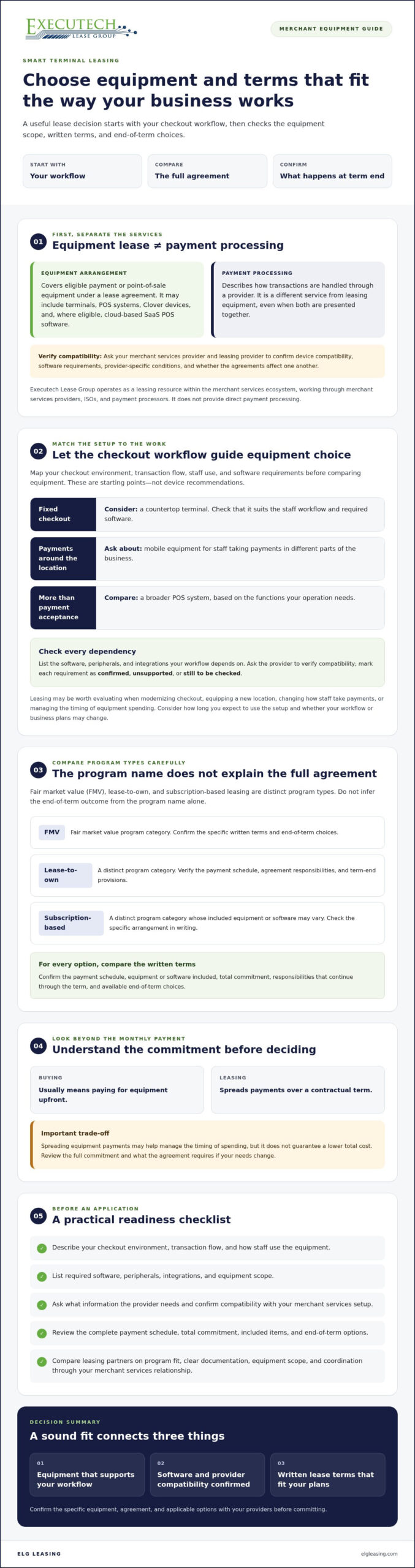
Pre-Application Checklist for Smart Terminal Leases
A prepared application starts with a clear equipment plan and a direct conversation with the provider coordinating the lease. Smart terminal leasing for merchants can involve different equipment and program arrangements, so confirm current availability, requirements, and applicable terms rather than assuming they’re standard.
What information should you have ready?
Write down how you’ll use the equipment before you start. A concise brief helps your provider connect the application to your actual checkout needs and identify what details are still missing.
- Business use case: Note whether the equipment is for an existing checkout, a new location, or a workflow change.
- Equipment category: Identify whether you’re considering a credit card terminal, a broader POS system, Clover equipment, or another eligible setup. Confirm the specific equipment’s availability.
- Software and integrations: List the POS software you need, the tools it must work with, and any peripherals involved. Ask the provider to verify compatibility.
- Operating setup: Describe where transactions happen, who uses the equipment, and whether checkout is fixed or needs mobility.
- Business and equipment details: Gather the information you already have, then ask the provider or sales representative which application documents they require.
Requirements can vary. Don’t assume you’ll qualify, that a particular document is sufficient, or that an application follows a specific timeline. Ask the provider to confirm eligibility, required documentation, expected timing, and the terms currently available for your situation.
Which questions should you ask your provider?
Clarify who will coordinate equipment selection, application steps, and questions about the lease agreement. Confirm which party handles each part, especially if your merchant services provider, sales representative, and leasing provider are different organizations. Ask whether the equipment depends on specific processing or software arrangements, and request clear answers before proceeding.
- Is the equipment and program you’re considering currently available for my business?
- What documents and business details should I provide?
- Are there software, processor, or integration requirements to confirm?
- Who should I contact if an application or agreement question comes up?
Review the application process details for an overview, then confirm the steps and applicable terms with your provider. Once your equipment needs and questions are organized, you’ll be better prepared to decide whether to proceed.
Choose a leasing partner and move forward with a clear application
The right leasing partner should make the arrangement easier to understand, not harder to compare. Assess the fit across four points: the program matches your equipment plan, the documents explain obligations clearly, the equipment scope reflects what you need, and the provider coordinates questions and next steps consistently. Smart terminal leasing for merchants is a business decision, so clarity matters from the first discussion through the application.
Why work with a merchant-services-focused leasing group?
Executech Lease Group is a leasing and financial services division serving the merchant services ecosystem through merchant services providers, ISOs, and payment processors. Its leasing categories include credit card terminals, POS systems, and Clover devices. It also offers financing for cloud-based SaaS POS software. ELG provides leasing solutions, not direct payment processing or daily equipment rentals.
Confirmed program categories include 12-60 month terms, fair market value (FMV) leases, lease-to-own programs, subscription leases, and SaaS financing. The right structure depends on your requirements and the applicable terms. If a subscription arrangement may suit your needs, review the subscription leasing programs and confirm current availability and what the specific agreement includes.
Use the same practical standards with any prospective partner. Can they explain which equipment is covered? Do the documents align with the proposal? Is it clear who coordinates with your merchant services provider and who can answer agreement questions? A strong fit means you can get clear answers before you commit, not just a proposal that appears to match your workflow.
What is the next step if a program appears to fit?
Before applying, confirm the equipment, program availability, and agreement details with your provider. Make sure you understand the obligations, included items, and end-of-term provisions. If you’re considering Clover equipment, verify which options are currently available and compatible with your provider’s setup. Don’t rely on a category name alone to establish equipment availability or compatibility.
Once those details are clear, prepare the business and equipment information your provider requests. The application is the next step in evaluating the arrangement, not a substitute for confirming fit and terms. ELG’s programs are designed to work through the merchant services ecosystem, so coordinate with the relevant provider as you move forward.
Make Your Next Equipment Decision With Confidence
Smart terminal leasing for merchants starts with fit: choose equipment and software that support your checkout workflow, then compare the full agreement rather than relying on the monthly payment alone. Confirm what’s included, how the lease works, and what your responsibilities are at the end of the term.
Executech Lease Group offers credit card and POS equipment lease terms of 12-60 months, with FMV, lease-to-own, and subscription-based options. Cloud-based SaaS POS software financing is also available. Program availability and applicable terms depend on the specific arrangement, so review them with your merchant services provider before applying.
With your equipment needs clear and your agreement questions answered, you can take the next step with a more informed plan.
Choose the setup that fits your operation, and move forward when the terms are clear.
Frequently Asked Questions
What is smart terminal leasing for merchants?
Smart terminal leasing for merchants is an equipment arrangement that lets a business use payment or point-of-sale equipment under a lease agreement. It covers the equipment, not the processing of card transactions. Eligible arrangements may include credit card terminals, POS systems, Clover devices, and cloud-based SaaS POS software. Review the proposed agreement to confirm exactly what it covers, how payments work, and which terms apply to your business.
Can I lease a payment terminal without changing payment processors?
Possibly, but don’t assume a leased terminal will work with your current processor or that the lease is separate from processing obligations. Equipment financing and payment processing are distinct arrangements, yet compatibility requirements or linked terms may apply. Ask your merchant services provider and leasing provider to confirm device and software compatibility, any processor dependencies, and whether changing a processing relationship affects your equipment agreement. Get important explanations in writing before committing.
How much does it cost to lease a smart terminal?
The cost depends on the equipment, lease structure, term, and specific agreement. ELG’s confirmed equipment lease terms range from 12 to 60 months, but that range doesn’t establish a price or monthly payment. Request the complete payment schedule and total contractual commitment from the provider. Also confirm whether software, support, maintenance, or other items are included or billed separately. Compare the full obligations, not just the monthly amount.
What is the difference between an FMV lease and lease-to-own?
FMV, or fair market value, and lease-to-own are different program structures. The program label alone doesn’t establish your end-of-term rights or responsibilities. Review the agreement to see what it says about payments, equipment, and end-of-term choices. Ask the provider to explain any terms you don’t understand and confirm them in writing. ELG offers both types of programs, subject to current availability and the terms applicable to your arrangement.
Can a merchant lease Clover devices?
Yes, Clover leasing is among the equipment categories ELG offers. That doesn’t confirm that every Clover device or configuration is available for every merchant. Before applying, ask your provider which equipment is currently offered and verify that it works with your processing setup, software, and workflow. Review the lease agreement for the exact equipment included, payment schedule, and applicable terms. Don’t rely on the category name as confirmation of a specific device.
What should I check before signing a terminal lease?
Confirm the equipment covered, lease duration, full payment schedule, and contracting parties. Check which software or services are included, what may be billed separately, and what the agreement says about cancellation, replacement, returns, and end-of-term responsibilities. Review equipment leasing and payment-processing documents separately, then ask whether either agreement creates linked obligations. If a provision remains unclear after the provider explains it, consider getting qualified advice before signing.
Does terminal leasing include POS software?
Not necessarily. Whether software is included depends on the specific program and agreement. ELG offers financing for cloud-based SaaS POS software, but that doesn’t mean software comes with every equipment lease. Ask the provider to identify the software covered, any separate agreements or charges, and whether the software works with the equipment and processing setup. Confirm the details in writing so you know what the lease includes and what requires a separate arrangement.

Article by
Robert Ensminger
Robert Ensminger is the founder and CEO of Executech Lease Group (ELG Leasing), which specializes in equipment leasing and financing solutions for the merchant-services, payments, POS, and FinTech industries. With more than 20 years of industry experience, Robert helps independent sales organizations, payment processors, POS providers, and software companies develop practical leasing, subscription, and SaaS-monetization programs. He founded ELG in 2010 and guided the company to recognition on the Inc. 5000. His work focuses on responsive service, transparent program structures, and helping ELG’s partners close more business while creating sustainable revenue.