
A recurring POS software bill can look like financing, but the two are not the same commitment. Subscription software financing for merchants raises a practical question: who provides the software, who bills for it, and who carries any financing obligation? When those roles blur, it becomes harder to understand what you’re agreeing to.
Look beyond the monthly amount. A software agreement may define access, billing, renewal, and cancellation terms, while financing, equipment leasing, and payment processing involve separate arrangements and parties. This guide explains the differences and what to examine before considering a software-related financing option.
You’ll learn how software costs relate to POS needs without confusing them with hardware leases or processing services, which contract details deserve close review, and how merchants, independent software vendors (ISVs), and channel partners can assess next steps. Executech Lease Group (ELG) focuses on payment-processing equipment leasing and invites ISVs to discuss fit for its SaaS funding program. That invitation is for ISVs, not an available merchant software-financing offer. Understand the roles first, then ask focused questions.
Key Takeaways
- Subscription software financing for merchants is distinct from a vendor’s recurring SaaS bill. Compare what each agreement covers before assessing the overall commitment.
- Map the merchant, software vendor, financing intermediary, and payment processor as separate parties so responsibilities and terms stay clear.
- Compare billing structure, contract scope, ongoing obligations, and what each arrangement does not establish across software billing and equipment models.
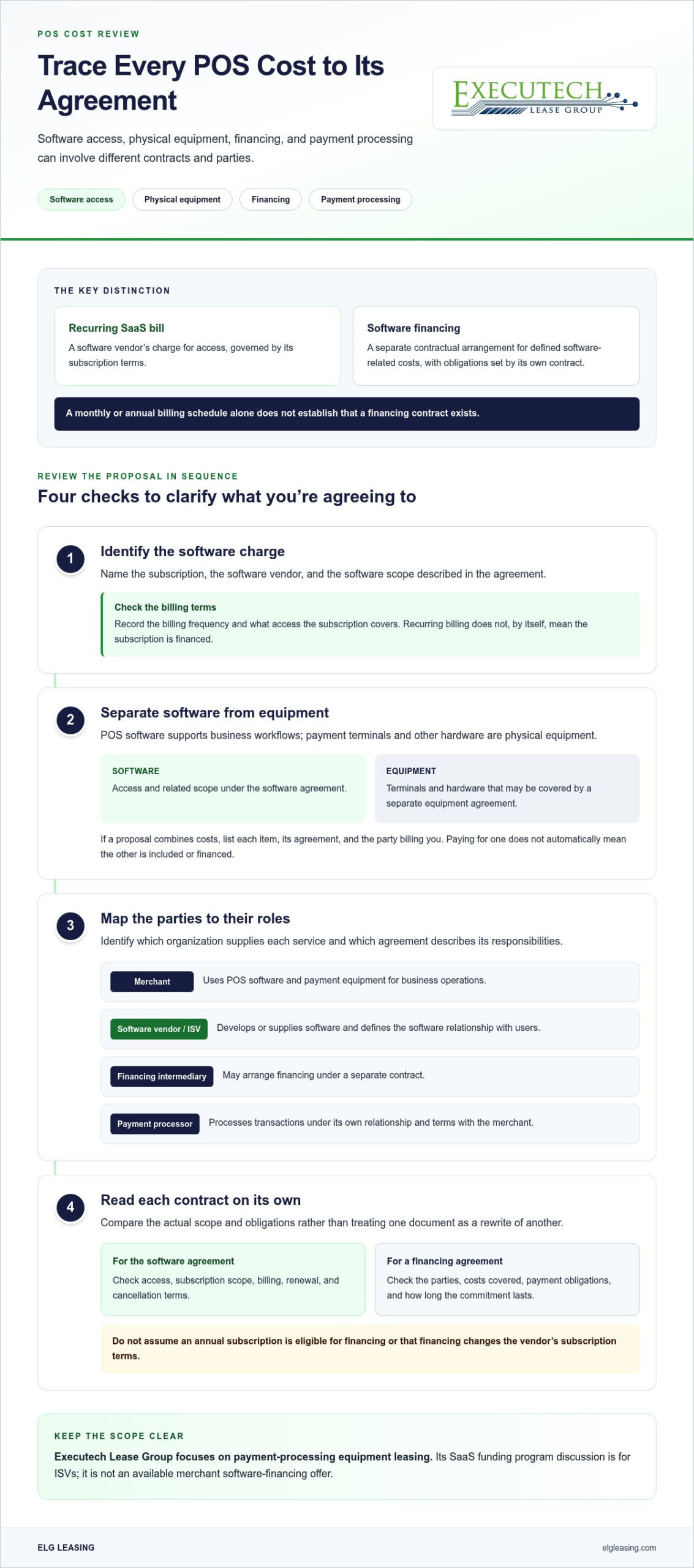
- Use a four-step review: define the software need, identify the contracting parties, examine the scope, and assess the obligations.
- ELG focuses on payment-processing equipment leasing. ISVs can discuss fit for ELG’s SaaS funding program, without treating it as currently available merchant software financing.
What subscription software financing means for merchants
A merchant may see a recurring POS software charge and wonder whether it can be handled like a financed purchase. The distinction starts with the agreement, not the billing schedule. Subscription software financing for merchants refers to a financing arrangement tied to software costs, with obligations set by a separate contract. Ordinary SaaS billing is the vendor’s charge for access under its subscription terms. A recurring payment alone doesn’t make that subscription financing.
In plain language: a software subscription pays a vendor for access under a SaaS agreement; software financing is a separate contractual arrangement for paying defined software-related costs. The contract determines what is covered, who must pay, and for how long. It may create an ongoing obligation, so don’t assume it reduces the total cost or guarantees better cash flow.
How subscription software relates to a merchant POS system
Cloud-based POS software supports a merchant’s point-of-sale workflows. A retailer or service business, for example, might use POS software to manage sales and related operations. That software is not the same as the payment terminal or other physical equipment used at the point of sale.
Keep that distinction in view when reviewing a proposal. A software vendor may bill for access, while a terminal may be acquired through a separate equipment agreement. A proposal can mention both, but the documents should identify which charges relate to software and which relate to physical equipment. Don’t assume that paying for one automatically pays for, includes, or finances the other.
SaaS billing and software financing are different arrangements
SaaS billing is the software vendor’s payment arrangement. The vendor may charge on a recurring schedule for access, with billing frequency and subscription scope set out in its agreement. A monthly or annual charge describes how the vendor bills. By itself, it doesn’t establish that a financing contract exists.
Financing is separate. Its contract defines the parties, covered costs, payment obligations, and other terms. Those details can differ from the software vendor’s subscription terms, so read the documents as distinct agreements rather than treating one as a rewrite of the other. An annual subscription is not automatically eligible for financing, and recurring billing alone doesn’t show that a financing option applies.
Before comparing arrangements, identify what you’re paying for and who receives each payment:
- Software access: Identify the subscription, the vendor, and the software scope described in the agreement.
- Physical equipment: Separate terminals and other hardware from software charges.
- Financing: Review the contract to understand the costs it covers, the parties involved, and your ongoing obligations.
This separation gives you a clearer basis for evaluating a POS proposal. It also prevents a familiar billing pattern from being mistaken for a financing structure. If a single proposal combines several costs, make a simple list of each item, its agreement, and the party billing you before comparing totals.
How merchant software financing fits into the payment-technology ecosystem
A merchant POS setup can involve several businesses, each with a distinct role. Mapping those roles helps you see who supplies software, who arranges equipment leasing, and who handles transaction processing. Keep the agreements separate as you review a proposal. A relationship involving one part of the setup doesn’t automatically define the terms or responsibilities of another.
Here’s the basic map:
- Merchant: Uses POS software and payment equipment to support business operations.
- Software vendor or independent software vendor (ISV): Develops or supplies software and defines the software relationship with its users.
- Financing intermediary: May arrange financing under a separate contract, with obligations defined by that agreement.
- Payment processor: Processes transactions under its own relationship and terms with the merchant.
What merchants, ISVs, and channel partners each need to understand
Merchants use software and equipment, but those needs can involve different agreements. An equipment-lease brokerage arranges equipment leasing; that role is distinct from software billing and transaction processing. For a merchant, the practical question is which organization is named in each agreement and what responsibility that document assigns to it.
ISVs are software businesses. Their relationship with merchants concerns the software they provide, while channel partners may introduce or support business relationships across the merchant-services ecosystem. Each party’s role depends on its own agreement and activities. Don’t infer that a channel relationship makes one business responsible for another party’s software terms, equipment obligations, or processing arrangements.
Keep software, equipment, and payment processing distinct
Cloud-based POS software and physical payment equipment serve different purposes. Software supports point-of-sale workflows, while terminals and other equipment are physical assets used in payment environments. A proposal may discuss both, so identify the item and responsible party attached to each contract before comparing obligations.
Equipment leasing and payment processing remain separate relationships. An equipment lease addresses the equipment described in its contract; it doesn’t by itself establish who processes transactions, set transaction pricing, or change the merchant’s processor obligations. Software implementation, licensing, training, and help-desk services also shouldn’t be assumed to form part of an equipment lease unless the relevant agreement says so.
Match each need to its agreement: software access to the software contract, equipment to its lease, and transaction processing to the processor relationship. For an inquiry about payment-processing equipment, ELG’s equipment leasing inquiry is a way for vendors, ISOs, and merchant services providers to start a conversation. It is an inquiry, not a financing application or credit decision.
Subscription software financing models: what merchants should compare
Recurring charges can reflect different agreements, even when they appear similar on a bank statement. Compare what each arrangement covers, who the contracting parties are, and which obligations continue. A financing structure changes how payments are arranged, but it doesn’t necessarily reduce total cost or business risk. A regular payment schedule alone doesn’t establish either.
Use this table as a starting point. It describes general distinctions, not promised terms for a particular contract.
| Arrangement | Billing structure | Contract scope and ongoing obligation | What the arrangement does not establish |
|---|---|---|---|
| Direct SaaS billing | The software vendor bills for access under its subscription agreement. | The vendor’s agreement defines the software covered and the stated payment terms. | A recurring or annual bill alone doesn’t establish financing or cover physical equipment. |
| Software financing | A separate contract sets payment obligations for the software-related costs it defines. | The agreement identifies covered costs, contracting parties, and applicable obligations. | It doesn’t establish software features, service terms, lower total cost, or a particular outcome. |
| Hardware subscription model | A subscription-style arrangement relates to physical equipment, as defined by its agreement. | The agreement determines which equipment and obligations are included. | It doesn’t establish software access, SaaS funding, or payment-processing terms. |
Questions to assess before comparing financing structures
Begin by identifying the need: software access, physical equipment, or both. Then list the items covered and the parties named in the relevant contracts. If a proposal groups costs together, separate them in your comparison notes. Check invoices and contract descriptions against that list so you can tell whether a charge relates to software, a terminal, or another stated item instead of relying on a general label.
Compare the obligations using only terms written in the applicable agreement. Note the payment schedule, any stated contract period, and other commitments the document describes. Look specifically for the language governing renewal or cancellation rather than assuming either is available on particular terms. Don’t assume included services that aren’t stated. A different payment structure doesn’t prove the total cost or risk has changed.
Why SaaS funding should not be confused with equipment leasing
Equipment leases and SaaS funding concern different categories and have separate terms. Equipment lease durations, end-of-lease options, and other equipment conditions don’t describe software funding. ELG’s equipment-leasing programs are not a merchant software-financing offer. ELG is inviting ISVs to discuss its SaaS funding program and program fit, not presenting confirmed funding terms for merchants. Keep those categories distinct when reviewing a proposal or discussing a potential software-related program.
A useful comparison stays grounded in the documents: identify the software or equipment, the agreement that covers it, and the obligations stated there. This keeps assumptions about one model from being carried into another. When the documents leave a point unclear, make a note of the exact clause or charge that needs explanation.
A practical evaluation path for merchants and software businesses
Use a different review path depending on your role. Merchants need to understand the software arrangement they may enter. ISVs considering a SaaS program conversation need to explain their business and identify the questions that matter to them. In both cases, work from documented terms. A general description is not a promise of eligibility, funding, or a particular contract structure.
A merchant’s checklist for evaluating a software arrangement
For subscription software financing for merchants, a clear review begins with the business need, then follows the contracts. Keep the steps in order so software, equipment, and other charges don’t blur together:
- Define the software need. Write down which software your business uses and the purpose it serves. Record the vendor’s billing cadence as stated in the agreement.
- Identify the contracting parties. Record who provides the software, who bills you, and who is named in any separate financing or equipment contract.
- Review the scope. Separate software charges from physical equipment, payment processing, implementation, and any other services. Attribute each charge only where the agreement places it.
- Assess the obligations. Review payment requirements and contract language as written. Don’t assume cancellation or upgrade rights, or infer terms the agreement doesn’t state.
This sequence gives you a practical way to compare proposals without relying on labels. If a document groups multiple items, list each item and its related agreement before evaluating the overall commitment. For example, note the software charge and terminal charge on separate lines, then identify the document that sets the terms for each.
An ISV’s preparation for a SaaS-program conversation
ISVs have a different starting point. Prepare a concise description of your software business, the merchants it serves, and the business problem the software addresses. Then outline the questions you want to discuss, such as how program fit is considered and what information would help clarify the program’s scope. These are useful discussion points, not established eligibility criteria or application requirements.
ELG is actively staging ISVs for engagement about its SaaS funding program. That is not a statement that funding has begun or that merchants can currently access software financing through the program. The SaaS program information provides context for an ISV discussion; it should not be read as confirmed funding terms, amounts, or repayment structures. Keep those questions separate from any equipment-leasing discussion.
Merchants and software businesses can use this framework to prepare focused questions grounded in their own agreements and needs. For merchants, an inquiry related to payment-processing equipment is separate from an ISV’s discussion of SaaS program fit.
ELG’s role in merchant software financing and the next step
Executech Lease Group (ELG) is a U.S. equipment-lease brokerage serving the merchant-services and payments-technology ecosystem. Its focus is leasing payment-processing equipment. That role is separate from ELG’s SaaS funding program, for which ELG is actively staging independent software vendors (ISVs) to discuss their business and program fit.
That distinction matters for merchants. ELG’s ISV invitation is not a merchant software-financing offer, and it doesn’t establish funding, program terms, or timing. The inquiry form is a contact mechanism, not a SaaS funding application or credit decision. Keep your software agreement and any ISV program discussion distinct from an equipment lease.
What ELG does, and what it does not do
ELG’s equipment-leasing role concerns physical payment-processing equipment. ELG does not process payments, set merchant processing terms, provide equipment warranties, or supply software support. Any equipment warranty comes from the equipment manufacturer. Software access and support are separate from equipment leasing. If your question concerns subscription software financing for merchants, start by identifying the software agreement and the parties involved rather than treating equipment leasing as software funding.
For ISVs, the next step is a conversation about the software business and potential program fit. That conversation is not a promise that funding has started, that a particular ISV qualifies, or that terms have been set. Merchants, software vendors, and channel partners should describe the need they’re bringing forward so the inquiry stays aligned with the relevant relationship.
Start an appropriate conversation with ELG
Vendors, ISOs, and merchant services providers can use ELG’s inquiry form to initiate a conversation. A useful inquiry can briefly identify the business, explain whether the discussion concerns payment-processing equipment or an ISV’s SaaS program fit, and state the questions the business wants to address. The form doesn’t approve financing or establish SaaS funding terms.
For hardware context, ELG’s POS equipment leasing programs describe equipment-leasing options, a different subject from the ISV SaaS funding discussion. Keeping the topics separate helps avoid carrying equipment terms into a software conversation or mistaking an inquiry for a funding commitment.
Use the appropriate path: vendors, ISOs, and merchant services providers can share an equipment-related inquiry, while ISVs can open a conversation about their software business and potential program fit. Clear context makes the first exchange more focused.
Make your next step a clearer one
Turn your notes into a specific question. If you’re a merchant, identify whether your open issue concerns software access, equipment, or the terms in a particular agreement. If you represent an ISV or channel partner, frame the conversation around your business and what you want to understand about program fit.
That clarity matters more than choosing a label. Subscription software financing for merchants is meaningful only when the proposed arrangement, contracting parties, and obligations are clear. ELG focuses on the merchant-services and payments-technology ecosystem, and its ISV conversations concern potential SaaS program fit, not a promise of funding or confirmed terms. The Apply Now form is an inquiry channel, not a SaaS funding application or credit decision.
Bring the relevant context, keep software and equipment questions distinct, and take the next step with a focused inquiry. For vendors, ISOs, and merchant services providers, ELG’s Become a Vendor inquiry form is the appropriate starting point for an equipment-leasing conversation. ISVs can use the SaaS program interest form to discuss their software business and program fit.
Clear questions make complex business decisions easier to approach. Start with the right agreement and a well-defined purpose.
Frequently Asked Questions
What is subscription software financing for merchants?
Subscription software financing for merchants is a financing arrangement associated with software costs, separate from the vendor’s regular subscription billing. For example, if a POS proposal includes software and a terminal, check whether each item appears under its own agreement or whether a financing contract names both. Review the stated parties, covered costs, payment obligations, and contract period. Don’t infer that financing includes hardware, implementation, support, or a lower total cost.
Is SaaS billing the same as software financing?
No. SaaS billing is how the software vendor charges for access; financing is a separate arrangement that may concern software costs. A merchant paying a vendor monthly for cloud POS access shouldn’t assume a financing provider is involved. Compare the vendor invoice with any separate financing document, noting who bills each amount and what each agreement covers. The terms in one agreement don’t automatically replace or revise the terms in another.
Can subscription software financing cover cloud-based POS software?
Coverage depends on the particular program and written agreement. A merchant shouldn’t assume a POS subscription, renewal, or implementation expense is included just because it relates to the same system. ELG is staging ISVs for SaaS program conversations, an invitation to discuss the software business and program fit, not confirmation that funding has begun. Merchants should base decisions on actual written terms, not a general program description.
How should merchants compare software financing options?
Start with a written inventory of what the business needs, such as POS software access or a payment terminal. Then match each charge to its agreement and contracting parties. Compare only terms the documents state, including covered items, payment schedule, and continuing obligations. For instance, don’t count a terminal charge as software coverage unless the contract says so. Avoid relying on assumed savings, renewals, cancellation rights, or included services.
Can an ISV discuss SaaS funding with ELG now?
Yes. ELG is actively staging ISVs for its SaaS funding program and invites conversations about the software business and program fit. An ISV can use the discussion to describe its business and raise questions about the program’s scope. The invitation doesn’t mean funding has started, and it doesn’t establish eligibility, funding amounts, repayment structures, risk transfer, or a launch date. Treat it as an opportunity to engage, not a funding commitment.
Does ELG process payments?
No. ELG does not process payments. Its equipment-leasing role is separate from the merchant’s payment-processing relationship. For example, a lease concerning a POS terminal doesn’t set transaction pricing or change obligations the merchant has with its processor. Keep processor statements and agreements distinct from equipment documents so it’s clear which party governs each service and charge.

Article by
Robert Ensminger
Robert Ensminger is the founder and CEO of Executech Lease Group (ELG Leasing), which specializes in equipment leasing and financing solutions for the merchant-services, payments, POS, and FinTech industries. Robert helps ISOs, payment processors, POS providers, and software companies build practical equipment leasing programs. He founded ELG in 2010. His work focuses on responsive service, transparent program structures, SaaS-monetization programs, and helping ELG’s partners close more business while creating sustainable revenue.