
Could a lease’s financing structure determine its tax treatment? Not by itself. The tax advantages of equipment leasing depend on the contract and your business’s circumstances, so a familiar label or buyout option should not be treated as a tax conclusion.
It makes sense to compare lease structures with taxes in mind. But the terms used to finance POS systems, credit-card terminals, or ATMs do not automatically tell you how a tax professional will assess the arrangement. Lease-to-own and fair market value options have different contract details. Those details are useful starting points for a conversation, not a promise of a particular deduction or outcome.
This article explains why lease tax treatment is not automatic, which contract and business-use details to bring to a qualified tax professional, and how to compare equipment lease structures without assuming a tax result. Executech Lease Group (ELG) is an equipment lease brokerage focused on the U.S. merchant-services and payments-technology ecosystem. ELG arranges equipment leases; tax treatment is a separate question for your qualified tax professional.
Key Takeaways
- Tax advantages of equipment leasing are not automatic. A qualified tax professional can assess how the contract and your business circumstances apply.
- Keep the legal lessee, equipment use, agreement language, and tax year clear when organizing details for a tax review.
- Compare FMV and lease-to-own terms as contract structures, not as promises about tax classification. ELG’s FMV equipment lease ends with a buyout of about 10% of original equipment cost.
- Prepare the signed or proposed agreement, equipment description, lease term, and buyout wording before speaking with your tax professional.
- ELG focuses on the U.S. merchant-services and payments-technology ecosystem, with equipment lease term choices of 12, 24, 36, 48, and 60 months.
Do Equipment Leasing Tax Advantages Apply Automatically?
No. A tax advantage is a possible tax outcome, not an automatic feature of leasing. The tax advantages of equipment leasing depend on more than the fact that a business signed a lease. Contract terms, business circumstances, the applicable jurisdiction, and current tax rules can all matter. A financing decision answers how a business obtains equipment. It does not, by itself, determine how the transaction will be treated for tax purposes.
This distinction matters when evaluating payment-processing equipment such as a POS system, credit-card terminal, or ATM. A business may consider leasing for commercial reasons, including access to equipment or the structure of its payments. Those reasons are separate from the tax review. Do not treat a lease label, payment schedule, or general description of a lease option as a tax conclusion.
Why a lease does not establish a tax benefit
Signing an agreement creates contractual obligations, but it does not determine how the transaction should be treated for tax purposes. Before you rely on a tax conclusion, a qualified tax professional needs to assess the agreement and your specific business circumstances.
Keep the commercial decision separate. Compare equipment options based on the agreement and your business needs, then discuss possible tax consequences as a distinct issue. One decision does not settle the other.
What determines the tax question
A tax professional may need to review the complete agreement alongside the business facts. Relevant details can include the contract language, who is named as the lessee, how the equipment is used, the applicable jurisdiction, and the tax year under review. Current rules may also affect the analysis, so general explanations should not substitute for advice about your situation.
- Agreement: Review the actual signed or proposed terms, not just a product label or summary.
- Business circumstances: Clarify which business is the lessee and how it uses the equipment.
- Timing and location: Identify the relevant tax year and jurisdiction for the professional’s review.
These points help frame the conversation, but they do not determine a tax result. A qualified tax professional should assess the transaction-specific documents and circumstances before you rely on a conclusion. ELG arranges equipment leases and does not provide tax advice.
Lease tax treatment requires transaction-specific review: the agreement and business facts matter, and a qualified tax professional must assess how current rules apply.
Which Lease and Business Details Can Affect Tax Treatment?
A useful review starts with facts, not a savings estimate. Keep the legal lessee, the equipment’s business use, the agreement language, and the relevant tax year distinct. These details give a qualified tax professional a clearer basis for assessing your circumstances. None, on its own, establishes a particular tax result.
The tax review may depend on who signed the agreement, what equipment it covers, how the business uses it, the contract’s terms, and the applicable tax year and jurisdiction. Gather records that answer those questions before discussing possible tax advantages of equipment leasing.
Business use, entity, and recordkeeping
Start with the entity named as lessee in the signed agreement. Then identify the POS system, credit-card terminal, or ATM covered by the contract and describe how it serves business operations. Keep relevant records, such as an equipment inventory or notes on where and how the equipment is used, with the agreement. If use is mixed, describe that accurately and let a qualified tax professional assess its significance.
Keep the business identity separate from the equipment-use details. For example, the company name on a lease identifies the lessee, while operational records can help explain the equipment’s role. A tax professional can consider both alongside the full business circumstances.
Agreement terms and tax-year context
Use the signed agreement, or the proposed version if the lease has not been finalized. Note its equipment description, term, payment provisions, and any buyout language. Do not rely solely on a sales summary or a general lease label. The professional needs to review the wording that governs the transaction.
Tax rules can change, so an example based on an earlier year may not answer a question about a different filing year. Identify the tax year and jurisdiction relevant to your review, then ask a qualified tax professional to assess current rules against your contract and business facts. The IRS’s IRS Publication 535, Business Expenses can provide background, but it does not replace advice tailored to your transaction.
Before that conversation, organize the details in separate categories:
- Lessee: The legal business entity named in the agreement.
- Equipment: The specific POS system, terminal, or ATM covered.
- Use: How the equipment supports business operations, including any mixed use to discuss.
- Contract: The agreement language, term, payment provisions, and buyout wording.
- Tax context: The relevant tax year and jurisdiction.
This checklist helps prepare for a professional review. It is not a way to calculate tax savings or decide how an item should be reported. If you are also evaluating payment-processing equipment lease structures, compare ELG’s equipment lease programs separately from your tax discussion.
How FMV and Lease-to-Own Fit Into Tax Reviews
FMV and lease-to-own options have different contract structures, so their terms give a tax professional useful facts to review. They do not, by themselves, establish how an agreement will be classified or what tax treatment applies. Treat a buyout provision as one part of the full contract, not as a shortcut to a tax conclusion.
FMV equipment lease: the confirmed end-of-lease figure
ELG’s FMV equipment lease ends with a buyout of about 10% of original equipment cost. That figure describes the buyout at the end of the lease. It is not a monthly payment or a statement of the equipment’s total price.
Include the exact buyout wording from your agreement when you speak with a qualified tax professional. The wording is a contract detail for review, not proof of a specific tax classification. Do not infer other end-of-lease terms from the FMV label or buyout figure. Rely on the agreement itself and professional advice about your circumstances.
Lease-to-own equipment lease: a separate buyout structure
ELG’s lease-to-own equipment lease ends with a $1 buyout. This figure applies to that lease-to-own option, not to every equipment lease. It describes the buyout provision, not a monthly payment or the total cost of the equipment.
Do not infer tax treatment or ownership consequences from the $1 figure alone. A qualified tax professional should review the full agreement and relevant business facts before reaching a conclusion. The contract’s label and end-of-lease buyout are useful information, but neither settles the tax question on its own.
For a focused comparison, keep the two options’ documented terms separate:
- FMV equipment lease: Note the stated buyout of about 10% of original equipment cost.
- Lease-to-own equipment lease: Note the $1 buyout provision for this structure.
- Both options: Provide the full agreement and ask your tax professional to assess the terms in context.
This comparison helps you discuss structure without treating one option as automatically more favorable for taxes. Any tax advantages of equipment leasing depend on whether they apply to your situation, which requires a transaction-specific review. Do not compare the buyout figures as if they were monthly payments or complete equipment prices. They serve different roles in the contract.
Before choosing a structure, bring the agreement or proposed terms to your tax professional. Ask how the buyout wording fits into the review alongside the rest of the contract and your business circumstances. ELG arranges equipment lease options; it does not provide tax advice. Keep the financing comparison and tax assessment distinct, then make each decision with the relevant information in hand.
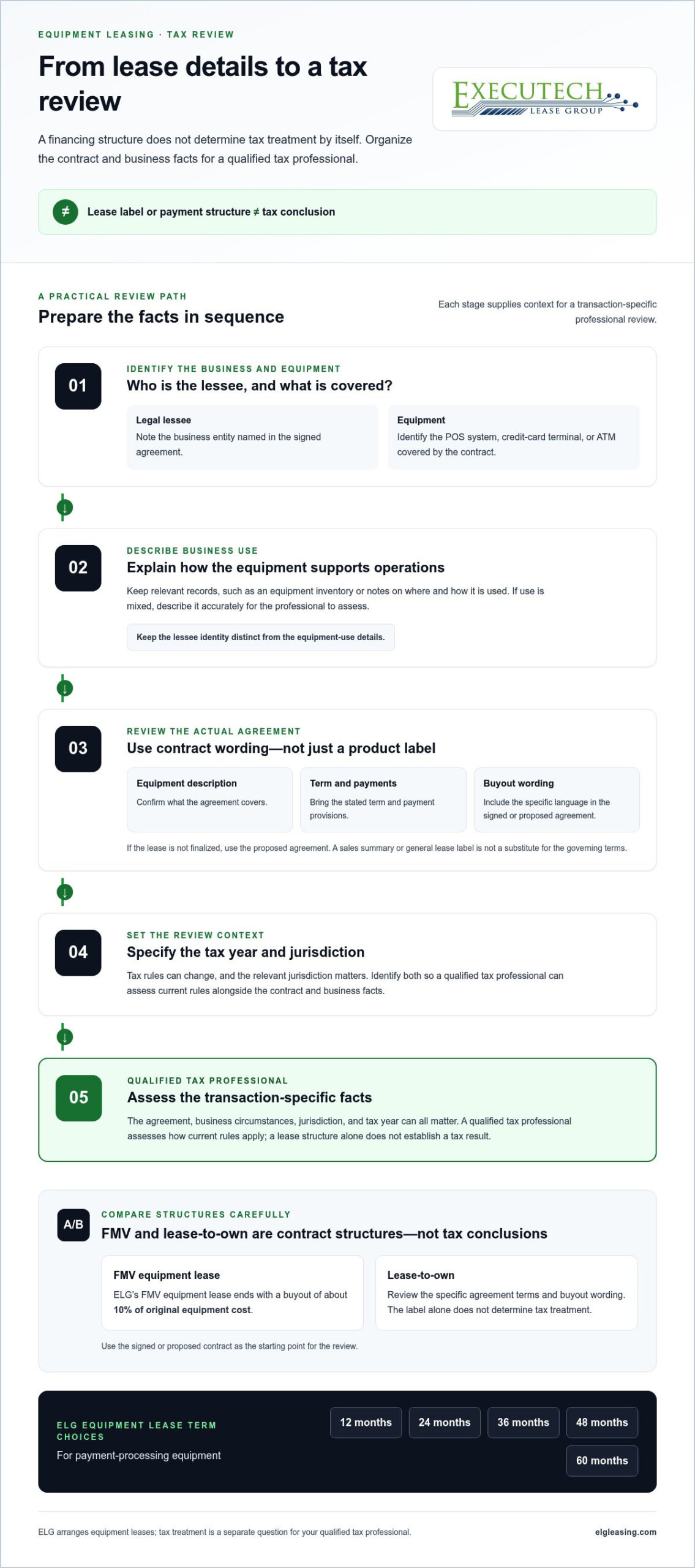
What Should You Prepare Before Discussing Equipment Lease Taxes?
A focused conversation with a tax professional starts with documents and business facts, not an estimate of savings. Bring the signed agreement or proposed contract, identify the equipment, and note the circumstances surrounding its use. This preparation helps the professional assess your specific arrangement rather than rely on a lease label or payment schedule alone.
Gather the equipment and contract facts
Put the key information in one place. Include the complete agreement, not just a summary, and keep equipment details separate from expectations about tax treatment. For broader context on payment-processing equipment options, review the POS equipment leasing programs.
- Identify the equipment. Record whether the agreement covers a POS system, credit-card terminal, or ATM, and copy the equipment description as written in the contract.
- Note the agreement terms. Record the lease term and exact end-of-lease language. If you are reviewing a proposal, bring that version and identify it as proposed rather than signed.
- Describe the business context. Note the legal entity named in the agreement, how the equipment serves business operations, and whether its use is mixed. Keep these details factual and let your tax professional assess their significance.
- Identify the relevant tax period. Note the tax year and jurisdiction you are asking about, so the professional can focus the review appropriately.
Ask focused questions without assuming the answer
Ask how current rules apply to the specific agreement and your business circumstances. Instead of starting with an expected tax result, ask what information the professional needs to assess the transaction and which records will help support that review.
- How should you provide the agreement and equipment description for review?
- Which business-use records or entity details would help clarify the facts?
- Which tax-year and jurisdiction details are relevant?
- Are there additional documents or records to gather before making a tax decision?
Keep the lease economics separate from a tax assessment. The term, payment obligations, and buyout wording describe the arrangement, but they do not determine its tax treatment. Before making a tax decision, obtain a transaction-specific review from a qualified tax professional. ELG arranges equipment leases and does not provide tax advice.
With the contract and questions organized, you can consider equipment lease options on their commercial terms while relying on your tax professional for guidance about tax treatment.
How ELG Equipment Leasing Fits Into a Tax-Informed Decision
Keep the financing decision and tax review in their proper lanes. ELG is an equipment lease brokerage focused on the U.S. merchant-services and payments-technology ecosystem. It arranges leases for payment-processing equipment, including POS systems, credit-card terminals, and ATMs. ELG does not process payments or provide tax advice. A qualified tax professional evaluates how current tax rules apply to your agreement and business circumstances.
Separate leasing facts from tax advice
ELG helps businesses consider equipment lease structures. It does not determine how an agreement should be treated for tax purposes or resolve a tax question. A qualified tax professional can review the contract and relevant business facts to assess the applicable treatment.
ELG offers equipment lease term choices of 12, 24, 36, 48, and 60 months. You can compare a term and contract structure as financing details, then discuss the agreement separately with your tax professional. A term choice does not predict a tax outcome.
Be precise about no-money-down leasing. It refers only to the down-payment requirement. It does not mean the equipment is free or that ongoing lease obligations disappear. Review the agreement’s financial terms as part of your business decision, without treating them as a tax estimate.
Take the next step with the right context
Before moving forward, line up the proposed or signed agreement with the questions raised in your tax review. Compare contract structures using their actual terms, and bring those details to your tax professional for an assessment of your situation. ELG’s equipment leasing program information explains lease structures for payment-processing equipment, not their tax treatment.
ELG can address equipment leasing, while your qualified tax professional can assess tax treatment. Keep those roles separate as you compare financing terms and consider how the agreement fits your business.
Vendors, independent sales organizations (ISOs), and managed service providers (MSPs) can use the Become a Vendor inquiry form to get in touch about an industry relationship. This is a contact inquiry, not a financing application, and it does not produce a credit decision.
Move Forward With Clear, Separate Decisions
Use your tax professional’s guidance for the tax side of the decision, then assess the lease structure against your equipment and business needs. The tax advantages of equipment leasing are not a substitute for reviewing the commercial terms, and a lease inquiry is not a tax assessment. Keep each conversation focused on the decision it can answer.
If you are considering an equipment lease through ELG, our goal is to deliver credit decisions in under 2 business hours. That goal applies only to the credit-decision stage; it does not indicate a tax outcome or establish a delivery or funding date. Bring your equipment needs and preferred lease structure into the inquiry, and continue tax questions with your qualified professional.
With the right details in hand, you can move ahead with greater clarity and make each decision on its own terms.
Frequently Asked Questions
Is equipment leasing automatically tax deductible?
No. Signing an equipment lease does not automatically establish that a payment is deductible or create a tax saving. The tax advantages of equipment leasing depend on the actual agreement and your business circumstances, among other factors. Before recording a lease amount as a tax deduction, ask a qualified tax professional to review the transaction for the relevant tax year and jurisdiction.
Can a business claim depreciation on leased POS equipment?
That depends on how the specific transaction is treated for tax purposes, so do not assume that leasing a POS system means your business can or cannot claim depreciation. Share the complete agreement, including its end-of-term provisions, with a qualified tax professional. They can assess the contract alongside the business’s circumstances and explain which treatment, if any, applies.
How do tax professionals compare an FMV lease with a lease-to-own agreement?
They can compare the full contract terms rather than relying on the option’s name. Relevant details include the equipment, payment provisions, term, and end-of-lease language. ELG’s FMV and lease-to-own options have different buyout structures, but neither label alone determines tax classification. Ask your tax professional to assess the actual agreement and explain how its terms affect your specific review.
Do state tax rules affect the treatment of an equipment lease?
They may. The jurisdiction relevant to your business can be part of the tax review, and rules may differ or change over time. Tell your tax professional which state or states are relevant and which tax year you are reviewing. Do not rely on a general explanation or an example from another jurisdiction as a conclusion about your own lease.
Can a business claim lease expenses when equipment has mixed business and personal use?
Do not assume that mixed-use equipment receives the same treatment as equipment used only for business. For example, if a POS-related device also has personal use, describe that use accurately and provide any records you maintain. A qualified tax professional can assess the circumstances and current rules. Avoid estimating a deductible share or reporting an amount before getting advice.
Does no-money-down equipment leasing mean there are no tax or payment obligations?
No. No-money-down refers only to the down-payment requirement. It does not mean the equipment is free, remove ongoing lease obligations, or eliminate any tax responsibilities that may apply to your business. Review the payment and other terms in the agreement, and discuss tax questions with a qualified tax professional rather than treating the down-payment structure as a tax outcome.
What documents should I bring to a tax professional before leasing payment-processing equipment?
Bring the signed agreement or proposal, the equipment description, lease term, and exact buyout wording. Include any contract revisions you are considering, identify the business entity named as lessee, and describe how the POS system, credit-card terminal, or ATM will be used. Note the relevant tax year and jurisdiction, then ask whether additional records would help assess your situation.
This article reflects the author’s opinion for general information only and isn’t tax, legal, or accounting advice. Consult your CPA or attorney about your specific situation.

Article by
Robert Ensminger
Robert Ensminger is the founder and CEO of Executech Lease Group (ELG Leasing), which specializes in equipment leasing and financing solutions for the merchant-services, payments, POS, and FinTech industries. Robert helps ISOs, payment processors, POS providers, and software companies build practical equipment leasing programs. He founded ELG in 2010. His work focuses on responsive service, transparent program structures, SaaS-monetization programs, and helping ELG’s partners close more business while creating sustainable revenue.