Most merchants view a POS system lease agreement as a financial anchor or a necessary evil. They’re wrong. When structured with professional transparency, these contracts function as a strategic technology-refresh framework. It’s the most effective way to ensure your hardware doesn’t become a paperweight before 2028. You want streamlined efficiency, not a decades-long debt trap that stifles your growth.
You’ve likely felt the anxiety of predatory “evergreen” clauses or the confusion of FMV versus Lease-to-Own options. It’s a valid concern. The industry is often clouded by impenetrable legalese and hidden fees that drain your margins. This guide strips away that complexity. You’ll learn exactly how to master the technicalities of your agreement to secure flexible, technology-forward financing. We’ll show you how to identify contract red flags and establish a clear path for upgrading your equipment mid-term. It’s time to move away from old-fashioned financial burdens and turn your equipment into a powerful, scalable asset.
Key Takeaways
- Distinguish between short-term equipment rentals and professional financial leases to ensure your contract aligns with your long-term business strategy.
- Analyze the specific differences between Fair Market Value (FMV) and $1 Buyout programs to decide between lower monthly costs or total equipment ownership.
- Master the technicalities of a POS system lease agreement to identify and eliminate predatory “Evergreen” clauses before you sign.
- Streamline your financial operations by bundling hardware and SaaS software costs into a single, transparent 12–60 month term.
- Secure a path to mid-term technology upgrades, ensuring your business always operates with the latest Clover hardware and cloud-based software.
What is a POS System Lease Agreement?
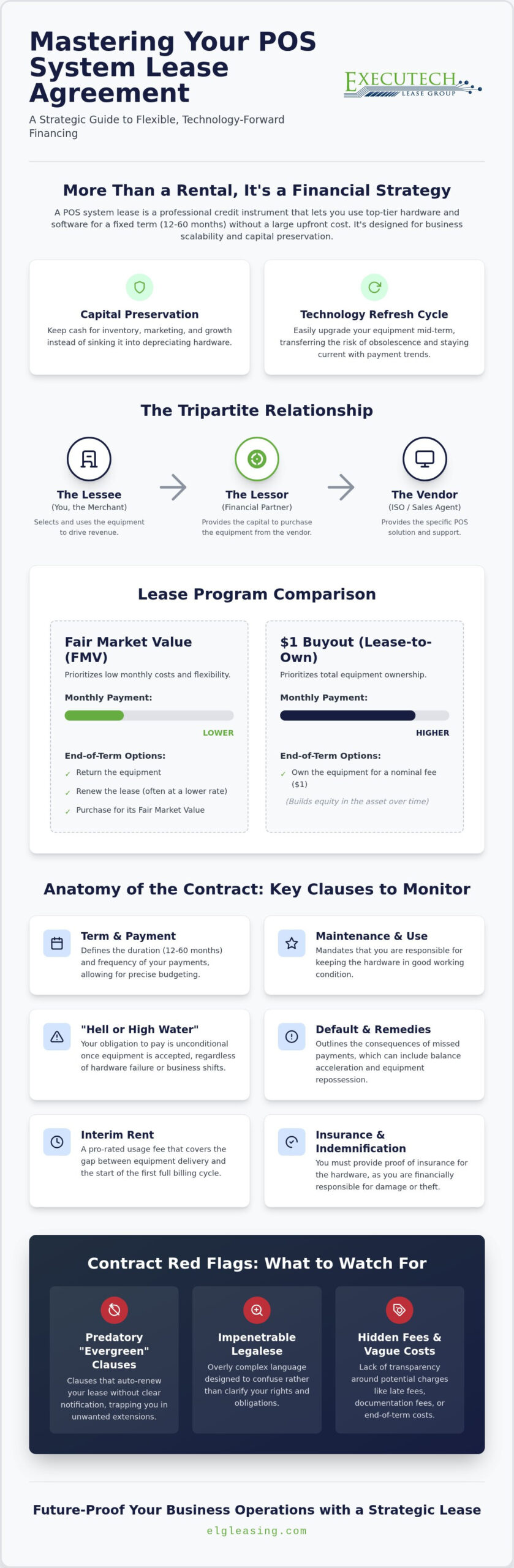
A POS system lease agreement is much more than a simple equipment rental. It’s a legally binding financial contract. Under this arrangement, a merchant gains the right to use hardware and software for a fixed period, typically 12 to 60 months, in exchange for regular payments. Unlike a consumer-grade rental, this is a professional credit-based instrument designed for business scalability. It allows you to deploy a sophisticated Point of Sale (POS) system without the heavy upfront capital expenditure.
Modern leases go beyond physical terminals. They often include “soft costs,” which means you can bundle your cloud-based SaaS software, initial installation, and even staff training into one monthly payment. This creates a predictable financial environment. You aren’t just paying for plastic and glass; you’re paying for a functional business tool. Mastering the POS system lease agreement ensures you aren’t stuck with a legacy system that can’t handle the payment trends of 2026.
This financial structure is unique because it involves a tripartite relationship. While you select the equipment from a vendor, a separate leasing company actually purchases it. This distinction is critical for your balance sheet and your tax strategy. It positions the equipment as an operational resource rather than a stagnant debt burden.
The Purpose of the Agreement
The primary goal is capital preservation. You keep your cash for inventory, marketing, or expansion rather than sinking it into depreciating hardware. It also facilitates a disciplined technology refresh cycle. In an era where contactless payments and AI-driven insights evolve rapidly, you don’t want to own obsolete gear. Leasing transfers the risk of equipment obsolescence to the lessor. You use the tech while it’s current; you upgrade when it’s not. This approach turns a static expense into a dynamic growth tool, a strategy commonly seen in other high-tech sectors where companies like Electron Optics Instruments, LLC facilitate the acquisition of advanced scanning electron microscopes through professional equipment solutions.
Key Parties Involved
A standard lease involves three distinct entities working in tandem to facilitate your technology access. The Lessee is you, the business owner who uses the equipment to drive revenue. The Lessor is the financial partner, such as ELG Leasing, providing the capital that pays the vendor upfront. The Equipment Vendor is the ISO or sales agent who provides the specific POS solution and ongoing support. This relationship ensures that the vendor is paid immediately while you enjoy the flexibility of long-term financing. It’s a streamlined process that removes friction from high-end technology acquisition.
Anatomy of the Contract: Key Clauses to Monitor
Don’t just sign; scrutinize. A POS system lease agreement is built on specific pillars. The “Term and Payment” section dictates the rhythm of your cash flow. It specifies the frequency, duration, and payment method, usually via ACH. Most agreements span 12 to 60 months. This clarity allows for precise budgeting, which is a core component mentioned in the SBA business funding guide. You need to know exactly when the money leaves your account and how long that commitment lasts.
You are responsible for the gear. The “Maintenance and Use” clause in your POS system lease agreement requires you to keep the hardware in good repair. It isn’t just a suggestion; it’s a mandate. Then there’s the “Hell or High Water” clause. This sounds intense because it is. It means your obligation to pay is unconditional once you accept the equipment. Even if the hardware fails or your business model shifts, the lease stays active. This protects the lessor’s capital investment and ensures the financial arrangement remains stable.
What happens if things go wrong? The “Default and Remedies” section outlines the fallout. If you miss a payment, the lessor can accelerate the balance. This means the entire remaining sum could become due immediately. They may also have the right to repossess the equipment or charge significant late fees. Transparency here is vital. You should understand these stakes before committing to a long-term partnership. It’s about managing risk with open eyes.
Understanding Interim Rent and Commencement
Interim rent often surprises new merchants. It bridges the gap between the day your equipment arrives and the start of the first full billing cycle. Think of it as a pro-rated usage fee. This process begins when you sign the “Acceptance Certificate,” confirming the hardware is on-site and operational. The Commencement Date is the legal point where payment obligations begin.
Insurance and Indemnification Requirements
Lessors need to protect their assets. You’ll be required to provide proof of insurance for the hardware. If a terminal is damaged or stolen, the financial responsibility rests on your shoulders. Standard indemnification language also exists to protect the lessor from third-party claims arising from your use of the equipment. It’s a standard B2B protection that ensures the financial partner isn’t liable for your daily operations. To see how these terms can be simplified for your business, you can explore our transparent clover terminal leasing options.
Cash flow dictates strategy. Your choice of a POS system lease agreement structure impacts your balance sheet as much as your daily operations. You must decide between a Fair Market Value (FMV) lease and a $1 Buyout program. These aren’t just names; they represent the functional difference between an Operating Lease and a Capital Lease. Each serves a distinct business lifecycle and requires a different accounting approach.
FMV leases typically offer the lowest monthly commitment. You’re paying for the utility of the hardware during its most productive years without the burden of long-term ownership. Conversely, a Lease-to-Own program has a higher monthly payment because it’s designed to transfer ownership to you for a nominal $1 fee at the end of the term. You’re building equity in the equipment with every check you write. For a deeper dive into these mechanics, consult The Comprehensive Guide to POS Equipment Leasing in 2026.
Strategic Benefits of FMV Leases
Technology moves fast. An FMV lease is the standard for merchants who prioritize staying current with the latest Clover hardware. Because you don’t own the device, you can return it at the end of your 12 to 60 month term and upgrade immediately. This prevents you from being stuck with obsolete gear that can’t handle modern security standards or AI integrations. From a tax perspective, these payments are often treated as operating expenses (OPEX). This allows you to deduct the full payment amount from your taxable income, providing a more immediate fiscal benefit than traditional depreciation schedules.
When to Choose Lease-to-Own
Some hardware is built to last. If you’re financing heavy-duty kitchen printers or durable terminal stands, ownership might be the smarter play. A Lease-to-Own agreement functions as a capital expenditure (CAPEX). You’ll record the equipment as an asset on your balance sheet and depreciate it over its useful life. Once the term concludes, the $1 buyout fee completes the transition. It’s a powerful option for established businesses that want to eliminate perpetual payments for hardware with a long functional lifespan. You gain the asset without the massive upfront cost, keeping your working capital liquid for other investments; for those considering real estate ventures, you can check out Lead Exchange to source off-market property deals.
Transparency is the only way to avoid a financial trap. When you review a POS system lease agreement, you must identify “Evergreen” clauses immediately. These are automatic renewal terms that extend your payment obligation indefinitely if you don’t provide notice. Most reputable lessors require a written notice of intent between 30 and 90 days before the term ends. Mark this date on your calendar the day you sign. Missing it could cost you an extra year of payments for hardware you no longer want.
You also need to scrutinize “Soft Cost” limits. This refers to the percentage of the lease that covers non-tangible items like software subscriptions, installation, or training. While bundling is efficient, many lessors cap these costs to maintain a healthy asset-to-debt ratio. Understanding these limits prevents surprises during the underwriting process. Additionally, expect a personal guarantee. In the B2B world, this is standard procedure. It simply means you are personally responsible for the fulfillment of the contract. It’s a sign of a high-standard financial arrangement, not a red flag.
The Truth About “Non-Cancellable” Agreements
B2B leases differ fundamentally from consumer rentals. They are generally non-cancellable because the lessor has already paid the vendor in full for your equipment. You can’t simply “return” the gear mid-term without consequence. However, a professional agreement provides an exit path through a “Buyout” option. This allows you to pay off the remaining balance and take ownership or return the gear early. Always ask for your early termination schedule upfront. Knowing the cost of an early exit gives you the power to pivot your business if your technology needs change.
Hidden Fees vs. Standard Admin Costs
Don’t confuse standard documentation fees with predatory charges. A one-time doc fee is normal to cover the cost of processing your application and securing your credit line. You will also likely see a UCC filing fee on your first invoice. A UCC-1 Financing Statement is a legal notice of the lessor’s interest in the equipment. It’s a public record that protects the financial institution’s investment and is a standard part of commercial finance. Watch out for recurring “administrative fees” or “service charges” that don’t correspond to a specific service. If you want a contract that prioritizes clarity over confusion, partner with ELG Leasing for your next POS upgrade.
Executing the Agreement with ELG Leasing
Efficiency drives every decision at ELG Leasing. When you execute a POS system lease agreement with us, you aren’t just signing a contract; you’re securing a 12 to 60 month technology roadmap. We specialize in Clover terminal leasing, providing direct access to the latest Station, Mini, and Flex devices. Our structures are built for the modern merchant who demands transparency and rejects the “old-fashioned” friction of traditional bank financing.
We understand that a modern Point of Sale is more than just hardware. That’s why we finance both the physical equipment and the cloud-based SaaS software soft costs. This holistic approach allows you to bundle your entire digital operation into a single, predictable monthly payment. We maintain a high standard for our partnerships, prioritizing “no-nonsense” contract structures that eliminate the ambiguity often found in the broader leasing industry. You get the technology you need today with a financial structure that supports your growth tomorrow.
The Application and Approval Process
We value your time. Our streamlined digital application is designed for rapid decisioning, moving you from submission to approval without unnecessary delays. While we maintain high standards regarding business credit and financial history, our process is transparent and direct. We also act as a powerful facilitator for Independent Sales Organizations (ISOs). By providing consistent and reliable underwriting, we accelerate merchant boarding and help ISOs deliver premium technology to their clients with minimal friction. It’s about getting the right tools into your hands as fast as possible.
End-of-Term Flexibility
Obsolescence is the enemy of retail. Our agreements provide clear, structured paths to upgrade to the next generation of Clover technology. You won’t find “gotcha” clauses here. Whether you choose a simple buyout or a return process, our US-based asset management team provides direct, expert support to guide the transition. We focus on the end goal: keeping your business at the forefront of payment technology. Once your POS system lease agreement reaches its conclusion, you have the power to refresh your hardware and maintain your competitive edge without a massive capital hit.
Future-Proof Your Business Operations
Mastering your POS system lease agreement transforms a standard financial obligation into a powerful tool for growth. You now have the clarity to distinguish between FMV and Lease-to-Own structures, ensuring your choice aligns with your specific tax strategy and hardware lifecycle. By identifying predatory red flags and managing notice requirements, you’ve eliminated the risk of unexpected renewals. Complexity is no longer an obstacle; it’s a manageable variable in your business plan. You’re ready to deploy technology that accelerates your revenue.
Efficiency is the standard for 2026. You deserve a partner that prioritizes transparency over confusing fine print. Secure your next POS system with a transparent ELG lease agreement today. We offer flexible 12 to 60 month terms and specialized Clover hardware financing, all backed by our US-based expert support team. Don’t let obsolete technology or rigid contracts slow your momentum. Access the premium tools your business requires and move forward with unwavering confidence.
Frequently Asked Questions
Can I cancel my POS lease agreement if my business closes?
B2B leases are legally non-cancellable regardless of your business status. Closing your doors doesn’t void the contract. You remain responsible for the remaining payments. Most merchants choose to settle the balance through a buyout to close the account. It’s a standard commercial protection that ensures the lessor recovers the capital they spent on your behalf.
What is the difference between a POS lease and a bank loan?
A lease prioritizes equipment access while a loan focuses on asset ownership. Loans often require heavy collateral and impact your credit lines more significantly. A POS system lease agreement can often be treated as an operating expense, keeping your debt-to-income ratio healthy. Approvals are typically faster because the equipment itself serves as the primary security for the transaction. If you are looking for alternative financing options to manage your cash flow, you can discover ILoveYourLoans for a variety of personal and installment loan products.
You can often deduct the full amount of your lease payments under Section 179 of the tax code. This incentive encourages businesses to invest in new technology by allowing immediate write-offs rather than long-term depreciation. It applies to both hardware and bundled software. Always verify the current 2026 deduction caps with your accountant to maximize your specific year-end tax benefits.
Do I own the equipment at the end of a POS lease?
Ownership is determined by your contract type. If you select a $1 Buyout program, you own the equipment after the final payment. If you choose an FMV lease, the lessor retains ownership. This gives you the flexibility to return the hardware at the end of the term, which is ideal if you want to avoid being stuck with obsolete terminals.
What happens if the POS hardware breaks during the lease term?
The merchant is responsible for repairs unless a specific protection plan is included in the contract. Your payment obligation continues even if the hardware is broken. This is the “Hell or High Water” clause in action. You should ensure your hardware vendor provides a robust warranty or carry insurance that covers accidental damage to avoid paying for a system you can’t use.
Can I add more equipment to my existing lease agreement later?
You can typically add hardware to your existing agreement through a simple addendum. This process is called a “lease up.” It allows you to expand your fleet, like adding more Clover devices, while keeping your payments on a single schedule. It’s a streamlined way to scale without the administrative burden of managing multiple separate contracts with different end dates.
Why do I need a personal guarantee for a business equipment lease?
A personal guarantee is a standard B2B requirement that secures the lease with your personal credit. It acts as a secondary layer of security for the lessor. This is common for businesses that don’t have decades of corporate financial history. It allows for faster approvals and more flexible terms by showing that the owner is personally committed to the success of the agreement.
What is a “Fair Market Value” buyout at the end of the term?
An FMV buyout is the option to purchase your leased gear for its current market price once the term ends. This amount isn’t fixed at the start of the lease. It depends on what the equipment is worth in the open market at that time. It’s the best choice if you want to keep your options open until the very last minute.

Article by
Robert Ensminger
Robert Ensminger is the founder and CEO of Executech Lease Group (ELG Leasing), which specializes in equipment leasing and financing solutions for the merchant-services, payments, POS, and FinTech industries. With more than 20 years of industry experience, Robert helps independent sales organizations, payment processors, POS providers, and software companies develop practical leasing, subscription, and SaaS-monetization programs. He founded ELG in 2010 and guided the company to recognition on the Inc. 5000. His work focuses on responsive service, transparent program structures, and helping ELG’s partners close more business while creating sustainable revenue.