
A lease conversation succeeds when a representative can explain the agreement, not just the payment. Effective training materials for selling equipment leases cover the basics: a lease lets a business use equipment for an agreed term in return for payments, while the contract sets out its obligations and end-of-term options. Salespeople need to explain those details clearly and accurately.
That clarity matters. Buyers want to understand what they’re agreeing to, and representatives need a consistent way to connect lease options to the business’s equipment needs without glossing over important terms.
This guide explains how equipment leases work, which clauses and covenants shape an agreement, and what options may apply when the term ends. It also shows how to build buyer-focused conversations, present terms plainly, and answer questions with confidence. The aim is a practical foundation for discussing leases, not a script that treats every buyer or transaction alike.
Key Takeaways
- Distinguish equipment leasing from loans and factoring by comparing how each approach affects equipment access, payments, and business cash flow.
- Explain the agreement in practical terms: payment structure, each party’s responsibilities, and the clauses that shape the lessee’s obligations.
- Make end-of-lease options and covenants part of the conversation early, so buyers understand what decisions the contract may require later.
- Build sales discussions around the buyer’s needs, then connect relevant equipment features and lease terms to the problem they want to solve.
- Use training guides and practice conversations to strengthen product knowledge, handle common questions, and keep explanations clear and consistent.
What Is Equipment Leasing?
Equipment leasing gives a business the right to use equipment for a specified term in return for payments. Salespeople should also explain how leasing differs from borrowing money or using factoring to access cash.
Leasing Compared With Other Financing
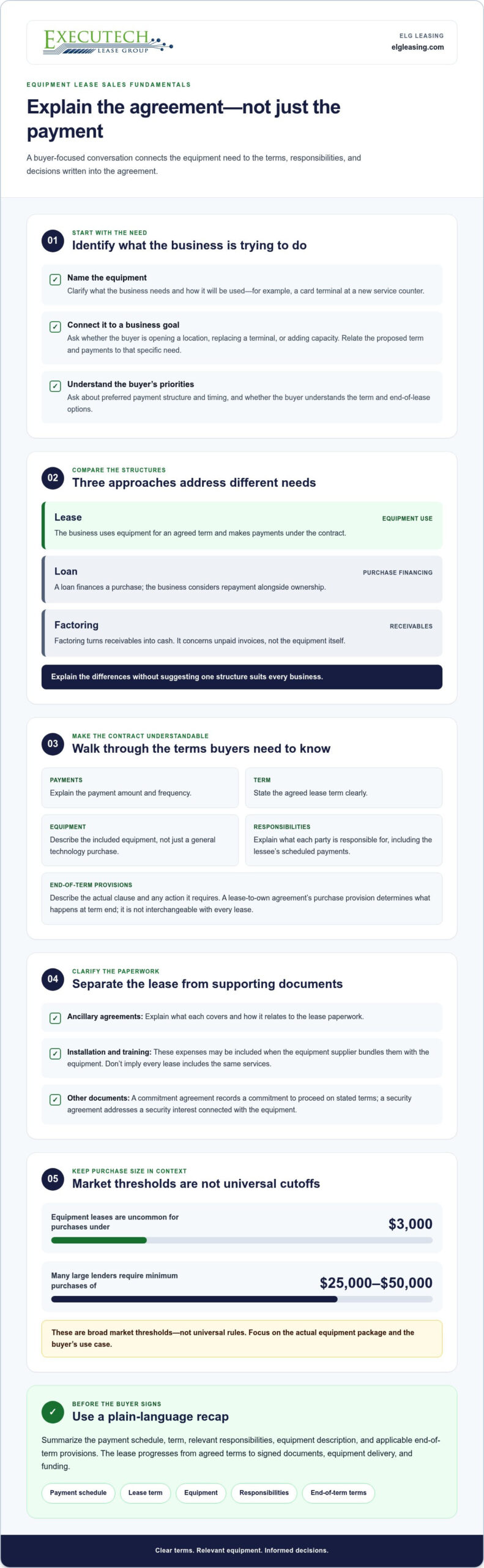
A lease provides equipment use for a term, a loan finances a purchase, and factoring turns receivables into cash. Each addresses a different need. A retailer adding a point-of-sale terminal may consider leasing to access equipment; a business buying an asset with borrowed funds considers repayment alongside ownership. Factoring, by contrast, concerns unpaid invoices, not the equipment itself.
In a lease, the lessor and lessee agree on payments and a term, then the lessee uses the equipment. A loan finances a purchase, while factoring uses receivables as the source of funds. Training materials for selling equipment leases should help representatives explain these differences without suggesting one structure suits every business.
Leasing for Growing Small Businesses
For a small business, leasing can spread equipment payments over an agreed term rather than requiring the full purchase amount upfront. This may be relevant when growth brings new equipment needs before the business has accumulated enough cash to buy. For example, a shop opening another checkout counter may need an additional POS system to serve customers there.
Connect the equipment to the business’s specific plan. Ask whether the buyer is opening a location, replacing a terminal, or adding capacity. Then explain how the proposed lease term and payments relate to that need. The customer should understand the commitment, not just hear that leasing supports growth.
Introducing Leasing to Prospective Customers
Introduce leasing when the buyer discusses equipment needs, budget priorities, or timing. First understand how the equipment will be used, then explain leasing alongside other relevant ways to acquire it.
What questions should salespeople ask customers considering an equipment lease? Ask what equipment the business needs, how it will be used, and which business goal it supports. Clarify the buyer’s preferred payment structure and whether they understand the term and end-of-lease options.
Use a concrete example, such as a café adding a card terminal at a new service counter. Explain what the agreement covers and what the lessee must do. Before signing, summarize the payment schedule, term, and relevant responsibilities in plain language. Don’t call a lease a loan or imply all agreements have identical terms.
Equipment Finance Fundamentals and Purchase Thresholds
Equipment finance fundamentals include identifying the asset, the parties, the lease term, payments, and each party’s responsibilities. Purchase size can affect whether leasing is practical: equipment leases are uncommon for purchases under $3,000, while many large lenders require minimum purchases of $25,000 to $50,000. These are broad market thresholds, not universal cutoffs.
For a payment terminal or POS system, focus on the actual equipment package and the buyer’s use case. Equipment finance professionals can find industry-specific learning through the Equipment Leasing and Finance Association (ELFA). For certification, consult the credentialing organization’s own program information to understand its requirements. Strong training prepares salespeople to define lease terms, compare financing structures, and explain the agreement without overpromising.
How does an equipment lease work?
A lease progresses from agreed terms to signed documents, equipment delivery, and funding. The agreement records the payment schedule, term, and responsibilities governing the transaction.
Agreement Terms and Responsibilities
A lease agreement sets out what the lessor provides and what the lessee must do. The parties rely on its terms throughout the lease, not just during the sales conversation.
Explain the payment amount and frequency, lease term, equipment description, and any end-of-term provisions. For example, a buyer financing a point-of-sale system needs the agreement to identify the included equipment, not just refer to a general technology purchase. The customer should also understand their responsibilities, such as making scheduled payments.
Lease documents may be accompanied by ancillary agreements that address a specific part of the transaction. Installation and training expenses may be included when the equipment supplier bundles them with the equipment. Representatives should distinguish those items from the lease itself, explain how the documents fit together, and avoid implying that every lease includes the same services.
Lease-to-Own Agreements
A lease-to-own agreement combines equipment use during the lease term with a path to ownership set out in the contract. Buyers need to understand whether scheduled payments lead to ownership or whether a separate end-of-term action applies.
Explain the stated purchase terms and timing before the customer signs. Lease-to-own is not interchangeable with every lease. The purchase provision determines what happens at term end, so describe the actual clause rather than promising ownership without qualification.
Other documents can support the transaction. A commitment agreement records the parties’ commitment to proceed on stated terms; representatives should clarify what it covers and how it relates to the final lease paperwork. A security agreement addresses a security interest connected with the equipment. Article 2A of the Uniform Commercial Code is relevant to equipment leasing, so sales training should help representatives distinguish the lease agreement from related documents without treating them as identical.
Funding follows completion of the required transaction documents and the applicable process. Be specific: identify which agreement the customer is signing, what it covers, and what action follows. A brief document review can prevent confusion between the lease, a commitment agreement, and a security agreement.
For a business evaluating equipment financing, starting an equipment lease application can put the proposed transaction into motion.
Lessee covenants and end-of-lease options
Lessee covenants describe commitments during the lease, while end-of-term clauses set out the choices available when it expires. Explain both in the context of the written agreement; similar labels don’t necessarily mean identical terms.
Purchase, Upgrade, and Transfer Options
End-of-lease clauses describe whether a lessee may purchase or return equipment, renew the arrangement, or take another stated option. These choices can shape the buyer’s plans for the equipment after the term.
For example, a merchant nearing the end of a terminal lease may compare the contract’s purchase terms with replacing outdated equipment through a new lease. Discuss upgrades only as an end-of-term possibility, not as a mid-lease change. If the buyer asks about transferring the agreement, explain the written clause without implying that transfer is automatically allowed.
Capital Leases and Ownership Options
“Capital lease” is a term customers may encounter in sales discussions or older materials. The label alone doesn’t establish the ownership options in a particular agreement, so explain the actual contract language.
If a buyer asks whether a capital lease means they’ll own a POS system, for example, point them to the agreement’s purchase provision. Explain any stated option and its conditions without inferring an accounting result or legal classification from the label. Keep the conversation focused on the buyer’s documented choices.
Lease Duration and Renewal Options
Lease duration is the period covered by the agreement’s payment schedule and equipment-use terms. If included, a renewal clause explains whether the lessee can continue the arrangement and under what stated terms.
For a business planning around a terminal’s expected useful life, compare that plan with the contract’s end date. Explain whether renewal is described as an option or whether the agreement requires a separate decision. Don’t suggest renewal happens automatically unless the written terms say so.
Covenants can cover payment duties, equipment use, and other commitments in the agreement. Help the buyer find the relevant clause, understand the action it describes, and note any stated timing. If an end-of-term choice requires advance notice, explain the notice language as written. Don’t invent a deadline or promise a right the agreement doesn’t provide.
For U.S. lease sales, explain the written payment obligations, covenants, and end-of-term choices clearly. The agreement and applicable jurisdiction matter; don’t infer a clause’s legal effect from a label such as “capital lease” or “nominal buyout.”
This article reflects the author’s opinion for general information only and isn’t tax, legal, or accounting advice. Consult your CPA or attorney about your specific situation.
Equipment lease sales fundamentals
Strong equipment lease sales training gives representatives a repeatable process from first conversation through closing. Four stages matter: engage the prospect, identify the business problem, present a relevant proposal, and explain the agreement before the buyer decides.
Start with discovery, not a payment quote. Ask what equipment the business needs, what task it must perform, and why the purchase matters now. A retailer adding a checkout station, for example, may need another point-of-sale system to serve customers faster. The answer helps the representative connect equipment features to a need the buyer recognizes.
Next, decide when to introduce leasing. Bring it up while the buyer is evaluating ways to acquire equipment, not as a surprise after they’ve settled on equipment. Explain how the proposed lease term and monthly payments fit the buyer’s stated priorities. Keep credit discussions accurate: describe the application process and required information without implying a particular credit result is assured.
A useful proposal makes the connection explicit. If a store needs a card terminal for a new service counter, show how the equipment supports the counter’s operation. Then explain the relevant payment schedule, lease term, and end-of-term language. A sales sheet or brochure can support the discussion, but it shouldn’t replace the signed agreement or obscure its terms.
Practice builds consistency. Have representatives role-play a prospect conversation, proposal presentation, and buyer objection about payments. Use the same sales tools they’ll use in the field, such as prospecting scripts, closing scripts, brochures, and sales sheets. Managers can model the process after top producers, then observe whether each representative identifies the need before discussing lease options.
What risks and common sales mistakes should equipment lease representatives avoid? Don’t present leasing as a universal fit, describe an option the agreement doesn’t contain, or treat a buyer’s question about credit as a promise of approval. Explain relevant terms plainly and distinguish equipment features from financing terms.
What are the best books and online courses for equipment lease sales? Choose material that teaches lease terms, questioning, objections, and proposal conversations, then reinforce it with role-play. Practical audio lessons include “Questioning Skills” (9:15), “Overcoming rate as a sales hurdle” (2:40), and “Term Residual Lease (TRL) – Sales Tips” (4:17).
Evaluate the process by observing real sales conversations: did the representative uncover the need, connect equipment benefits to it, and explain the lease clearly? Practice missed steps again. This turns training into a working sales method rather than a stack of materials that never reaches the customer conversation.
Are there free equipment leasing sales training courses or guides?
Yes. A sales team can build a no-cost starter guide from its existing lease documents, product sheets, and sales scripts. Add short practice exercises and focused audio lessons to turn reference material into training. Tie each resource to a skill representatives use with prospective equipment buyers.
Use audio lessons to target one sales skill at a time. Examples include “101’s of selling” (17:24), “Commitment Agreements: taking the deal off the street” (5:06), and “Dealing with Objections to ACH” (1:23). “PG’s are required sir!” (4:05) and “Are there prepayment penalties to my lease” (1:45) address specific customer concerns. Treat each lesson as a prompt for discussion, not a substitute for understanding the actual agreement.
A practical guide can organize those resources into four sections:
- Product: List the equipment offered and the business tasks each type supports.
- Terms: Summarize how to explain payment schedules, lease terms, and end-of-lease clauses.
- Conversation: Provide discovery prompts, opening statements, and objection practice.
- Tools: Include the sales sheets, brochures, and scripts representatives use with buyers.
Build the guide around the dealership’s actual sales process. A script for a card-terminal buyer should uncover the business need before presenting a lease. A point-of-sale equipment example can show how to connect a feature to a specific use, then explain the relevant agreement language. Keep examples aligned with the products and terms representatives discuss.
Free materials are more useful when paired with active practice. Have one representative play a buyer comparing equipment options while another explains the lease. Then switch roles and use a different scenario, such as a buyer asking about end-of-term choices. Managers can note which terms caused confusion and revise the guide accordingly.
Structure the training instead of handing out disconnected files. Set a learning goal, assign a short lesson, practice a customer conversation, and review whether the representative explained the terms accurately. A dealership can model its process on top producers, then document techniques that fit its own sales approach. This turns informal know-how into a repeatable onboarding resource.
Training materials for selling equipment leases should stay current with the dealership’s documents and sales tools. When an agreement or sales sheet changes, update the matching guide section and practice exercise. Representatives then learn the same language they’ll use with buyers, rather than relying on outdated examples.
Executech Lease Group (ELG Leasing): 12-60 Month Credit Card and POS Equipment Leases
Executech Lease Group (ELG Leasing) helps merchant services providers, ISOs, and payment processors offer equipment lease options to their merchants. Its 12-60 month leases cover credit card terminals and POS systems, including Clover devices.
When a merchant needs payment-processing equipment, representatives can explain the available lease structures plainly. Lease-to-own programs fit conversations about a path to ownership, while FMV lease options have a different end-of-term structure. Clear product knowledge helps sales teams connect equipment needs with relevant terms without treating every option as interchangeable.
For equipment lease options that fit your merchant’s payment-processing needs, contact Executech Lease Group (ELG) or visit the ELG Leasing website.
Put Your Lease Sales Process Into Practice
Make the next step practical: turn your training into a living resource that grows with your team. After a customer conversation, note which question clarified the business need and which lease term needed a clearer explanation. Use those observations to improve your examples, role-play, and sales tools.
Strong training materials for selling equipment leases help representatives explain options accurately without forcing every buyer into the same conversation. A consistent process gives your team room to adapt while keeping explanations grounded in the agreement.
Build that discipline one conversation at a time. Clear explanations help buyers make informed decisions and representatives move forward with confidence.
This article reflects the author’s opinion for general information only and isn’t tax, legal, or accounting advice. Consult your CPA or attorney about your specific situation.
Frequently Asked Questions
How quickly will the equipment become obsolete?
Obsolescence depends on how quickly equipment stops meeting business, software, or payment-acceptance needs. A card terminal may still function but no longer suit a merchant’s updated checkout process. Before choosing a lease term, consider expected business changes, manufacturer support, compatibility requirements, and how long the equipment should serve its intended purpose. Compare that outlook with the agreement’s end date and available end-of-term choices.
What Happens at the End of a Lease?
The lease agreement determines what happens when its term ends. It may provide a purchase option, a return process, or a renewal path. For example, a merchant planning to keep a terminal should understand any purchase conditions and timing in the contract. A business that may replace its equipment should understand the return requirements. Review the applicable clause before the end date, since options and procedures vary by agreement.
What is an operating lease?
An operating lease lets a business use specified equipment during a defined term in exchange for payments. The contract sets out the lessee’s obligations and any choices available when the term ends. For example, a business using a POS system under an operating lease should review the agreement to understand its payment schedule and end-of-term options. The contract, not the label alone, provides the practical details.
What training materials are available for selling equipment leases?
Useful resources include a terminology guide, sample sales conversations, product sheets, and role-play scenarios based on buyer questions. Training materials for selling equipment leases work best when representatives practice explaining one concept at a time, such as the payment schedule or a purchase option. A manager can use a short checklist after each role-play to spot unclear explanations and revise the relevant example or script.
What topics should equipment lease sales training cover?
Cover buyer discovery, equipment use cases, lease structure, credit application conversations, contract terms, and end-of-term options. Include objection practice, too. For example, have a representative explain how a business’s planned equipment use relates to its preferred lease term, then answer a question about what happens when the term expires. Training should also teach representatives to distinguish equipment capabilities from the lease’s financial terms.
How do equipment lease sales differ from equipment loans and financing?
Lease sales concern the right to use specified equipment under an agreement, while a loan conversation generally concerns financing a purchase. That difference shapes the buyer’s questions: a lessee may focus on the term, payment schedule, and end-of-term choices; a borrower may focus on repayment and purchased equipment. In either conversation, explain the relevant structure clearly instead of treating “lease” and “loan” as interchangeable.
What steps should a salesperson follow to sell an equipment lease?
Start by identifying the buyer’s equipment need and business objective. Connect relevant equipment capabilities to that need, explain the lease structure and key terms, and answer questions before the buyer decides. For example, when discussing a new checkout station, clarify which equipment is included and how the agreement handles the end of the term. Finish by reviewing the documents so the buyer understands what they’re signing.
How are equipment lease payments, rates, and total costs calculated?
Payments reflect the equipment being financed, the agreement’s term, and the lease structure. To understand total cost, add the scheduled payments and any other amounts required by the contract, including an end-of-term purchase payment if applicable. Don’t infer the rate from a monthly figure alone. Compare the full payment schedule, stated rate, included equipment, and applicable end-of-term amount in the written proposal.
This article reflects the author’s opinion for general information only and isn’t tax, legal, or accounting advice. Consult your CPA or attorney about your specific situation.

Article by
Robert Ensminger
Robert Ensminger is the founder and CEO of Executech Lease Group (ELG Leasing), which specializes in equipment leasing and financing solutions for the merchant-services, payments, POS, and FinTech industries. With more than 20 years of industry experience, Robert helps ISOs, payment processors, POS providers, and software companies build practical equipment leasing programs. He founded ELG in 2010. His work focuses on responsive service, transparent program structures, subscription and SaaS-monetization programs, and helping ELG’s partners close more business while creating sustainable revenue.