What if “wireless” describes how a credit card machine connects, not how you pay for it? Wireless credit card machine financing can sound like one bundled service, but connectivity and equipment acquisition are separate decisions. A terminal can connect wirelessly while a lease determines how your business acquires the equipment and what obligations continue over time.
It’s reasonable to focus on the upfront equipment outlay. But no-money-down leasing doesn’t mean free equipment or no recurring payments. And an equipment lease doesn’t provide payment processing. Keeping those relationships distinct makes the terms easier to evaluate.
Executech Lease Group (ELG Leasing) is an equipment lease brokerage focused on the U.S. merchant-services and payments-technology ecosystem. This guide explains how terminal leasing works, compares 12-, 24-, 36-, 48-, and 60-month options, and clarifies the end-of-lease differences: an FMV lease ends with about a 10% buyout, while lease-to-own ends with a $1 buyout. You’ll also learn which details about the equipment, lease obligations, and separate processing relationship to understand before moving forward.
Key Takeaways
- Wireless credit card machine financing concerns acquiring payment equipment; it doesn’t determine how the terminal connects or process transactions.
- Compare lease structures by their term and end-of-lease obligations, not just the recurring payment.
- Review the equipment description and complete lease terms so you understand what the agreement covers before committing.
- Keep equipment leasing separate from your payment-processing relationship. An equipment lease doesn’t set processing terms.
- Our goal is to deliver credit decisions in under 2 business hours; that goal applies to the decision, not funding, delivery, or installation.
Wireless Credit Card Machine Financing: What It Covers, and What It Doesn’t
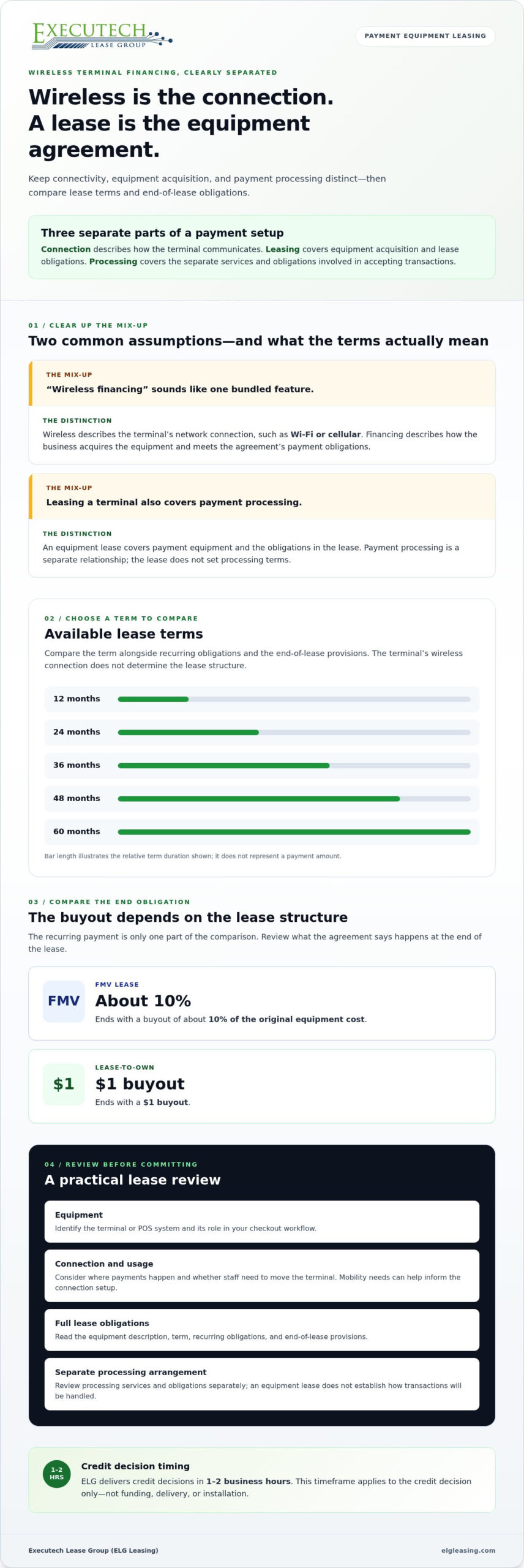
Wireless credit card machine financing combines two separate ideas. “Wireless” describes how a terminal connects to a network. “Financing” describes how a business acquires the payment equipment and meets the agreement’s payment obligations. The connection type doesn’t determine the lease structure, and a lease doesn’t determine how the terminal connects.
In brief: Equipment leasing covers the acquisition of payment-processing equipment and the obligations set out in the lease. Payment processing covers the separate services and obligations involved in accepting transactions. Keeping these arrangements distinct helps you understand what you’re agreeing to, and which relationship addresses each part of your payment setup.
What makes a credit card machine wireless?
A wireless terminal communicates through a connection such as Wi-Fi or a cellular network rather than relying on a fixed network cable. Both are connectivity approaches, not financing products. A payment terminal is the equipment used to facilitate a payment transaction; whether it connects by Wi-Fi or cellular doesn’t change the meaning of its lease.
Consider how the device will be used. A business that takes payments at a counter may have different mobility needs from one that serves customers across a larger floor or moves between locations. The operating environment can help determine whether a wireless connection is useful. It doesn’t, on its own, tell you which lease structure fits your equipment acquisition.
What does equipment financing cover?
For a credit-card terminal or POS payment system, an equipment lease is an arrangement for acquiring the equipment under agreed terms. It creates recurring obligations, so review the full lease and understand its term and end-of-lease provisions before committing. No money down refers only to the down-payment requirement. It doesn’t mean the equipment is free or that payments and other obligations disappear.
Executech Lease Group (ELG Leasing) is an equipment lease brokerage focused on the U.S. merchant-services and payments-technology ecosystem. ELG arranges leases for payment-processing equipment; it doesn’t process payments, supply merchant accounts, set transaction pricing, or control a processor’s obligations. Those belong to the separate processing relationship. An equipment lease alone doesn’t establish how transactions will be handled.
That separation matters in practice. If you’re evaluating a terminal, consider the equipment description and lease terms on one side, and the payment-processing arrangement on the other. Don’t assume that leasing the hardware includes processing services, or that the processing arrangement determines the equipment lease. Wireless credit card machine financing describes an equipment-acquisition path, not a bundled promise about connectivity, transaction terms, or ongoing device services.
How Wireless Credit Card Machine Leasing Works
A clear process starts with the equipment, not the lease form. First define how and where your business accepts payments. Then compare lease structures, review the full obligations, and move forward through the appropriate channel. This order helps keep the equipment decision separate from the financing decision.
Match the equipment to the business workflow
Start with the checkout routine. Do customers pay at one fixed counter, or do staff need to bring the terminal to customers? Identify the payment equipment involved, such as a credit-card terminal or POS system, and describe its role in your workflow. This gives you a practical basis for reviewing equipment terms without assuming a device works with every processor or integration.
Wireless features can support mobility, but the right setup depends on where transactions happen and how the business operates. The U.S. Department of the Treasury outlines mobile payment options in a government context, offering broader background on mobile payment technology. For leasing, keep the focus on the specific payment equipment being acquired and the obligations tied to its lease.
Compare terms and review obligations
Once you’ve identified the equipment, compare the available lease structures and term choices. Read the agreement closely, including recurring obligations and the end-of-lease terms. Wireless credit card machine financing isn’t a single product feature. It’s an equipment-acquisition arrangement whose terms should be understood independently of the terminal’s network connection.
ELG’s equipment leasing process can help you understand the stages involved. Our goal is to deliver credit decisions in under 2 business hours. That goal applies only to the credit decision, not to funding, delivery, or installation. No outcome or deployment date is implied by the decision timeframe.
Also distinguish a vendor inquiry from a financing request. Completing ELG’s Become a Vendor form is an inquiry, not a financing application and not a credit decision. The form alone doesn’t initiate or determine a merchant’s equipment lease request.
Before taking the next step, keep these stages distinct:
- Define the equipment need. Note where payments occur and whether staff move the terminal.
- Compare the lease. Review structure, term, recurring obligations, and end-of-lease provisions.
- Use the relevant channel. A vendor inquiry and an equipment lease application serve different purposes.
- Separate later events. A credit decision is not a promise of funding, delivery, or installation.
When you’re ready to proceed with an equipment lease request, you can use ELG’s equipment leasing application. Review the agreement and equipment details as separate parts of the decision. That simple distinction keeps the financing process focused and helps avoid assumptions about processing or deployment.
Compare FMV and Lease-to-Own Options for Wireless Terminals
For wireless credit card machine financing, the terminal’s connection type doesn’t determine which lease structure you choose. The key distinction is how each option is structured and what buyout applies at the end of the lease. ELG offers FMV and lease-to-own options, with equipment lease terms of 12, 24, 36, 48, and 60 months.
Use this comparison as a starting point. The signed agreement governs the specific terms, so review its complete language rather than treating a summary as a substitute.
| Comparison point | FMV lease | Lease-to-own |
|---|---|---|
| Structure | An equipment lease with an FMV end-of-lease buyout. | A lease-to-own structure with a buyout at lease end. |
| Term choices | 12, 24, 36, 48, or 60 months. | 12, 24, 36, 48, or 60 months. |
| End-of-lease buyout | About 10% of original equipment cost. | $1. |
The buyout figures are end-of-lease terms. They are not monthly payments or total equipment prices. The equipment lease structure details provide further context for comparing the relevant program options.
When an FMV equipment lease may fit
An FMV lease ends with a buyout of about 10% of original equipment cost. Consider whether that stated end-of-lease structure aligns with your plans for the payment equipment. Before proceeding, read the agreement’s full terms so you understand the obligations and the buyout that applies to this option.
When a lease-to-own structure may fit
A lease-to-own option ends with a $1 buyout at lease end. If your plans center on the lease-to-own structure, evaluate that specific end-of-lease provision alongside the term and recurring obligations in the agreement. The $1 figure applies to this option only, not to an FMV lease or every equipment lease.
Neither structure is automatically the better choice for every business. Compare the documented terms against how long you expect to use the equipment and what you want the end of the lease to look like. Don’t infer renewal rules, return requirements, or other end-of-term choices from the option’s name. Rely on the agreement for those details.
Keep the comparison focused on the lease, not the terminal’s wireless capability or your payment-processing arrangement. Wi-Fi or cellular connectivity describes how equipment connects; FMV or lease-to-own describes the acquisition structure. A careful side-by-side review makes the difference clear and helps you assess which stated terms align with your equipment plans.
Evaluate a Wireless Terminal Lease Before Moving Forward
A wireless terminal lease should make sense both for your payment workflow and your budget commitments. Before signing, review the equipment description and the complete lease terms. A device’s connectivity, the lease’s obligations, and your payment-processing arrangement are separate considerations. Clear answers on each point help prevent assumptions from becoming surprises.
A terminal lease does not itself establish payment-processing terms. It covers the payment equipment and the obligations in its lease. Your processing relationship is separate, and the lease doesn’t set processor obligations or transaction pricing.
Questions about equipment and connectivity
Start with how staff accept payments. If customers pay at a fixed counter, your connectivity needs may differ from a workflow where staff move the terminal. Consider whether Wi-Fi or cellular connectivity suits the intended environment, then use the equipment documentation to understand the device’s requirements. Don’t assume a terminal works with every processor or integration.
Keep the equipment choice distinct from both the processing relationship and the lease. A device description identifies what equipment the agreement covers; it doesn’t promise compatibility with every system or define how payments will be processed.
Questions about lease obligations
Read the agreement as a complete document, not just a term summary. Identify the selected term, recurring obligations, and the end-of-lease buyout that applies to that specific structure. Don’t assume terms such as cancellation rights, upgrades, or fees unless the agreement explicitly states them. For tax treatment, consult a qualified tax professional.
Any equipment warranty comes only from the manufacturer. ELG doesn’t provide equipment warranties or repair coverage. Keep that boundary clear as you review what the lease covers and what it doesn’t.
Use this checklist before making a commitment:
- Equipment: Does the equipment description match the payment terminal or POS equipment your business intends to acquire?
- Connectivity: Does the documented Wi-Fi or cellular approach suit where and how customers pay?
- Term: Is the lease term stated clearly in the agreement?
- Obligations: Have you reviewed recurring payments and the full terms that govern the lease?
- Buyout: Is the applicable end-of-lease buyout clearly identified for the selected structure?
- Processing: Have you kept the equipment lease separate from the agreement that governs payment processing?
Wireless credit card machine financing is easier to assess when you evaluate the hardware, lease obligations, and processing relationship in their proper lanes. If the equipment description or contract language doesn’t match your understanding, pause and resolve that discrepancy before committing. A careful review now gives you a clearer basis for the decision.
Explore ELG Financing for Wireless Credit Card Machines
Wireless credit card machine financing is about acquiring payment equipment through a lease, not securing wireless connectivity or payment processing. Executech Lease Group (ELG Leasing) is an equipment lease brokerage focused on the U.S. merchant-services and payments-technology ecosystem. ELG arranges credit-card terminal and POS equipment leases, keeping the equipment agreement separate from the merchant’s processing relationship.
Available equipment lease term choices are 12, 24, 36, 48, and 60 months. ELG offers FMV and lease-to-own options, each with its own end-of-lease structure. No money down refers only to the down-payment requirement. Recurring lease obligations still apply, so assess the complete terms rather than treating the initial payment requirement as the full cost of the arrangement.
What to expect from ELG’s equipment leasing role
ELG’s role is equipment leasing. It doesn’t process payments, supply merchant accounts, set transaction pricing, or control processor obligations. Our goal is to deliver credit decisions in under 2 business hours; that goal applies to the decision only. It isn’t a promise of approval or a timeline for funding, delivery, or installation.
ELG doesn’t provide equipment warranties, maintenance, repairs, replacements, installation, or training. Any equipment warranty comes from the manufacturer. Keep these boundaries clear as you consider a terminal lease alongside your separate processing arrangement.
For a broader view of the equipment category, consider how a POS system fits into your business workflow, including where transactions occur and how staff use the equipment. Then compare the equipment description and lease terms with your needs. Connectivity describes how a terminal connects; the lease describes the equipment-acquisition arrangement.
How channel partners can start a conversation
Vendors, ISOs, and MSPs interested in discussing an equipment-leasing relationship can use ELG’s Become a Vendor form to make an inquiry. It’s a channel-partner contact form, not a merchant financing application and not a credit decision. Keep the purpose clear when starting the conversation: it’s an inquiry about a potential vendor or channel relationship.
For merchants, the next step is different. A credit decision relates to a lease request, while a vendor inquiry starts a conversation about a business relationship. Neither changes the separate terms governing payment processing. That distinction keeps each request focused and helps prevent confusion about what the lease covers.
Before moving forward, have a clear picture of the payment equipment involved and review the lease structure, term, recurring obligations, and end-of-lease terms. For channel partners, outline the equipment-leasing relationship you want to discuss. Direct questions to the right process, and keep processing, equipment, and partner inquiries distinct.
Take the Next Step With a Clear Equipment Plan
Before moving forward, turn your payment-equipment needs into a concise business brief. Note where transactions happen, how the terminal will be used, and what you want the equipment arrangement to support over time. Bring that clarity to your lease review. It can help keep the discussion focused on the equipment and terms that matter to your operation.
Wireless credit card machine financing is easier to approach when you treat it as a deliberate equipment decision, not simply a device purchase. Take time to align the equipment description with your workflow and make sure the agreement reflects your understanding before you proceed. A thoughtful start can make the next steps more straightforward.
With a clear plan in hand, you can move forward with confidence and focus on the payment equipment your business needs.
Frequently Asked Questions
What is wireless credit card machine financing?
Wireless credit card machine financing refers to leasing or financing payment equipment that connects through Wi-Fi or cellular service. “Wireless” describes connectivity; financing describes the equipment-acquisition arrangement and its obligations. For example, a terminal used away from a fixed counter may need wireless connectivity, while its lease remains a separate agreement. The lease doesn’t provide payment processing or guarantee compatibility with a particular processor.
Does ELG require money down?
ELG offers no-money-down equipment leasing, meaning no down payment is required. It doesn’t mean the equipment is free or that recurring lease obligations disappear. Before proceeding, compare the term and end-of-lease structure with your business’s equipment plans. Treat the lease as a financial commitment and review the agreement for the obligations that apply, rather than interpreting “no money down” as fee-free or obligation-free.
How fast does ELG make a decision?
Our goal is to deliver credit decisions in under 2 business hours. That timeframe applies only to the credit decision. It doesn’t guarantee approval or establish when funding, equipment delivery, or installation will occur. Keep those stages distinct when planning an equipment change. A vendor inquiry is also separate: submitting the Become a Vendor form doesn’t submit a financing application or produce a credit decision.
How do ELG’s FMV and lease-to-own buyouts differ?
ELG’s FMV option ends with a buyout of about 10% of original equipment cost. Its lease-to-own option ends with a $1 buyout. Both figures apply at lease end, not as monthly payments or total equipment prices. The $1 figure applies only to lease-to-own. To compare the options, read the buyout alongside the selected term and the other obligations stated in the lease agreement.
Does ELG process payments?
No. ELG leases payment equipment and doesn’t process transactions, supply merchant accounts, set transaction pricing, or control processor obligations. For example, a terminal lease doesn’t determine the processing terms for a transaction accepted on that device. Review your processing arrangement separately, and don’t assume that a particular terminal is compatible with every processor. The equipment lease and processing relationship serve different purposes.
Does wireless terminal financing include a warranty or repairs from ELG?
No. ELG doesn’t provide equipment warranties, maintenance, repairs, replacements, or swap-out coverage. Any equipment warranty comes only from the manufacturer. A lease isn’t a service or protection plan, so don’t assume its payments include equipment repair or replacement. Keep the manufacturer’s warranty information separate from the lease documents, and review each for the coverage and obligations it actually describes.
Can I use the Become a Vendor form to apply for terminal financing?
No. The Become a Vendor form is an inquiry channel for vendors, ISOs, and MSPs interested in discussing a business relationship with ELG. It doesn’t submit a merchant financing application or generate a credit decision. Keep a channel-partner inquiry separate from an equipment lease request. The credit-decision timeframe applies only to credit decisions, not vendor inquiries, funding, delivery, or installation.

Article by
Robert Ensminger
Robert Ensminger is the founder and CEO of Executech Lease Group (ELG Leasing), which specializes in equipment leasing and financing solutions for the merchant-services, payments, POS, and FinTech industries. Robert helps ISOs, payment processors, POS providers, and software companies build practical equipment leasing programs. He founded ELG in 2010. His work focuses on responsive service, transparent program structures, SaaS-monetization programs, and helping ELG’s partners close more business while creating sustainable revenue.