Your current point of sale hardware is a ticking clock. If you wait until the final month to decide your next move, you have already lost your strategic advantage. Most merchants view the conclusion of a contract with a mix of dread and confusion. They feel paralyzed by the fear of hidden evergreen clauses or the anxiety of overpaying for a buyout. Mastering the end of lease options for POS is not just about clearing a balance. It is about reclaiming control over your operational efficiency and security.
We recognize that navigating rigid contracts is frustrating. You deserve a clear path to upgrading your system without the burden of downtime or data security risks. This guide empowers you to master your POS equipment lifecycle by explaining exactly how to handle buyouts, returns, and upgrades. We will analyze the financial logic of FMV versus lease-to-own structures. This ensures you minimize end-of-term costs and transition to modern, cloud-based hardware with absolute confidence. It is time to turn a contract deadline into a powerful technology refresh.
Key Takeaways
- Identify the critical 90-day notification window to prevent automatic evergreen renewals and maintain control over your contract.
- Evaluate the three primary end of lease options for POS, including equipment buyouts and returns, to determine the most cost-effective path.
- Understand the strategic differences between Fair Market Value (FMV) and Lease-to-Own structures to prioritize either cash flow or asset ownership.
- Implement a chronological six-month audit to assess hardware performance and ensure a seamless transition without operational downtime.
- Leverage specialized leasing programs to streamline technology refreshes and access the latest cloud-based POS systems.
Navigating the 90-Day Window: Why End of Lease Options Matter
The end of lease options for POS represent the specific contractual choices you must execute before your primary term expires. These are not mere suggestions. They are binding decisions that determine whether you own your equipment, return it, or enter an expensive extension. In the fast-moving payment industry, managing these options is a core component of your operational strategy. You cannot afford to treat high-tech terminals like static office furniture. Technology evolves too quickly for a “set it and forget it” mentality.
Managing the lifecycle of a payment terminal requires precision. Security standards like PCI DSS 4.0 mean that hardware becoming obsolete isn’t just an inconvenience; it’s a liability. A typical finance lease provides a clear framework for these transitions, but the burden of notification rests on you. Most contracts require a formal notice of intent between 60 and 90 days before the term ends. If you miss this window, you lose your leverage and your ability to control costs.
The Risk of Inaction: Evergreen Clauses
An evergreen clause is an automatic lease extension that triggers if you fail to provide timely notice. It’s a common trap in the industry. Once triggered, the lease continues on a month-to-month or even annual basis at the original payment rate. You continue paying for hardware that has already been fully amortized and likely lacks the latest processing speeds or security patches. To avoid this, your first step is a contract audit. Locate the “Notice of Intent” section in your agreement and mark the deadline on your calendar immediately. This simple act of transparency prevents thousands of dollars in unnecessary end-of-term costs.
Strategic Timing for Merchant Service Providers
For Independent Sales Organizations (ISOs), the end of a merchant’s lease is a critical pivot point. Proactive communication during this window is the best way to retain your clients and prevent them from shopping around. Merchants who feel supported during a technology refresh are less likely to churn. By identifying the end of lease options for POS early, you can offer a seamless upgrade to newer hardware like Clover devices. This strategy monetizes the transition while keeping the merchant’s operation secure and efficient. Review the resources on ELG’s benefits page to understand how we support ISOs in managing these critical merchant lifecycles.
The Three Primary Paths for Your POS Hardware
When you reach the final quarter of your term, you face a strategic choice. The end of lease options for POS typically fall into three categories: buyout, return, or upgrade. Each path impacts your balance sheet and operational efficiency differently. Ownership offers long-term asset use without recurring costs. Returns offer a clean exit. Upgrades offer competitive momentum by ensuring your staff uses the fastest tools available. Choosing correctly depends on your current hardware performance and your three-year growth targets. You don’t want to own a liability that slows down your checkout line.
Option 1: The Buyout Strategy
A buyout allows you to take full title of the equipment. You must distinguish between a $1 buyout and a Fair Market Value (FMV) buyout. A $1 buyout is essentially a lease-to-own arrangement where the asset transfers for a nominal fee at the end of the term. In contrast, an FMV buyout requires paying the current market price of the hardware. This distinction is a core element of the SBA’s guide to equipment leasing. Owning older terminals makes sense for backup units or secondary low-volume stations. However, for primary registers, check our POS Lease to Own Guide for Merchants and ISOs 2026 to evaluate if ownership outweighs the benefits of a tech refresh. Ownership means you are responsible for all repairs and security patches moving forward.
Option 2: Equipment Returns and Upgrades
Returning hardware is the standard choice for merchants who prioritize agility. Logistics matter here. You must return every component, including power bricks and peripheral cables, to avoid “missing equipment” fees. These fees are often significantly higher than the hardware’s residual value. For high-growth businesses using Clover systems, the return path is usually a precursor to a technology upgrade. Transitioning to a new lease term ensures you access faster processors and integrated cloud software. This prevents the performance lag common in terminals approaching the five-year mark. If you are ready for a technology refresh, you can start the upgrade process now to maintain your edge. Detailed logistics for this transition are available in our POS Lease renewal options for merchants: 2026 guide. Upgrading allows you to roll implementation and software costs into a single, predictable monthly payment, keeping your cash flow steady while your technology remains premium.
Comparing FMV vs. Lease-to-Own End-of-Term Realities
Choosing between a Fair Market Value (FMV) lease and a Lease-to-Own agreement is a fundamental business decision. It dictates your long-term cash flow and how you manage technological obsolescence. While both paths facilitate growth, they offer vastly different end of lease options for POS. One prioritizes low monthly overhead and agility. The other focuses on the eventual acquisition of the asset. Understanding the “Total Cost of Ownership” (TCO) over a 36 or 60-month term is essential for maintaining a lean operation.
FMV leases prioritize immediate financial flexibility. You benefit from lower monthly payments because the lessor retains the residual value of the equipment. At the end of the term, you don’t just walk away. You choose to return the hardware, renew the term, or buy the assets at their current market price. This structure keeps your capital liquid and your technology current.
The FMV Flexibility Advantage
The buyout for an FMV lease typically ranges between 10% and 20% of the original equipment cost. For merchants who demand a hardware refresh every 36 months, FMV is a strategic necessity. It prevents you from being anchored to aging terminals that can’t handle modern cloud software. Learn more in our Fair Market Value POS Lease: The Strategic Guide to Equipment Lifecycle Management. This model accelerates your ability to adopt the latest Clover devices without a heavy capital outlay. You stay competitive by using the fastest processing speeds available.
The Lease-to-Own Finality
Lease-to-Own programs focus on the end goal: full asset ownership. These agreements usually conclude with a $1 buyout. It’s a simple, transparent transition. You pay a slightly higher monthly rate in exchange for the certainty that the hardware is yours once the term ends. This is ideal for stable environments where the hardware doesn’t require frequent updates. However, ownership carries specific risks as technology ages.
As we move toward mandatory PCI DSS 4.0 standards, owning hardware that is five years old can become a security liability. Our Lease-to-Own Card Terminals: 2026 Financing Guide breaks down these trade-offs. If your terminal’s operating system can no longer support security patches, the “free” equipment you own becomes an operational risk. ELG structures these programs to match your specific business model. We offer flexible terms from 12 to 60 months, ensuring your end of lease options for POS align with your long-term security and growth requirements. We provide the framework so you focus on revenue, not hardware maintenance.
The Merchant’s Checklist: Preparing for Lease Expiration
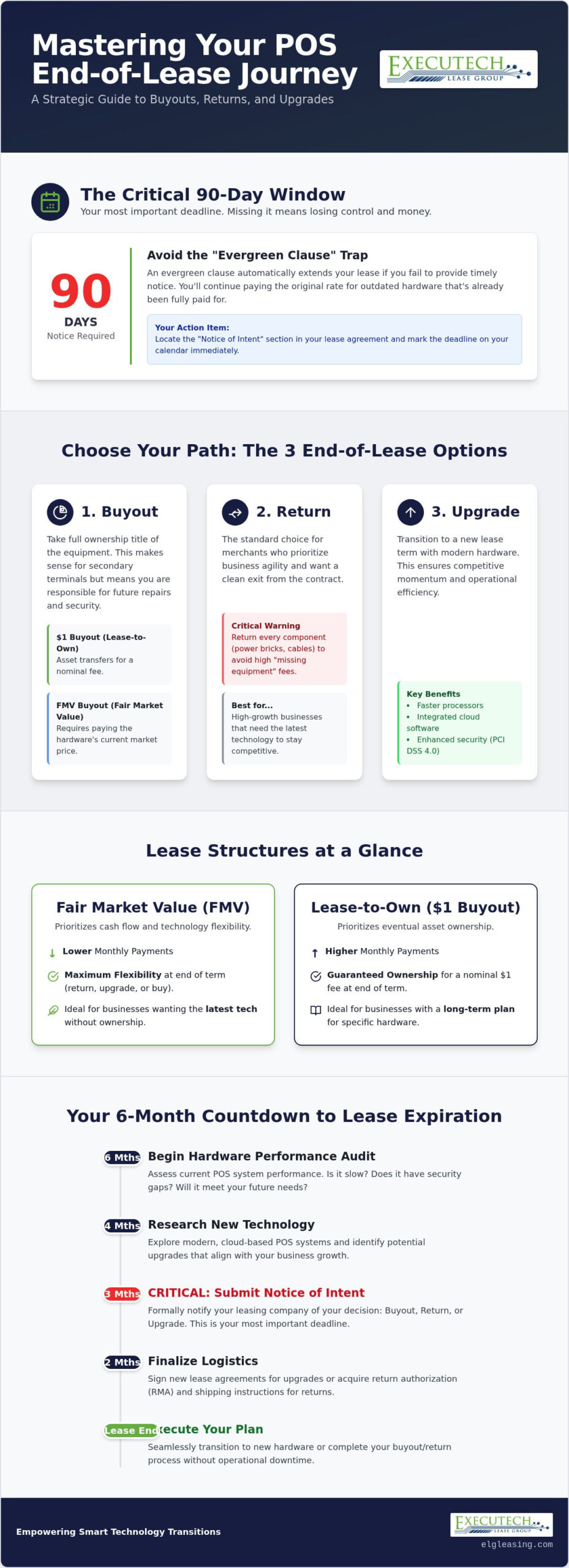
Managing the final six months of a contract requires a disciplined approach. You can’t afford to be reactive when your technology lifecycle is at stake. By following a structured chronological guide, you ensure that your end of lease options for POS are executed on your terms, not the lessor’s. This timeline prevents the evergreen traps that often catch unprepared business owners. It also positions your business for a seamless hardware refresh without disrupting your daily operations.
Start your audit six months before the term ends. Evaluate every terminal, printer, and handheld device in your inventory. If your hardware is lagging or failing to support the latest software updates, a return and upgrade is your best path. Five months out, pull your original agreement. You must identify the exact notification deadline, which typically falls between 60 and 90 days before expiration. By month four, consult with your ISO or leasing partner. Discuss the next generation of hardware to ensure your transition doesn’t cause a single hour of downtime. Finally, execute your chosen option three months early to remain in full control of the process.
Data Security and Hardware Inspection
Protecting your business means more than just returning a box. You must prioritize data security by performing a factory reset on every device to wipe merchant and customer information. This is a non-negotiable step under current PCI DSS 4.0 standards. Once the data is cleared, document the physical condition of the hardware. Take high-resolution photos of screens, ports, and casing. This documentation is your defense against “damage” surcharges that lessors might apply after the return. Ensure every accessory is accounted for, including power bricks, stands, and interface cables. Missing a simple cable can trigger a disproportionate fee that erodes your potential savings.
Documentation and Notification
Your “Notice of Intent” is the most important document in this process. It must be clear, formal, and delivered according to the contract’s specific instructions. Don’t rely on a casual phone call or a standard email that could get lost in an inbox. Properly managing the end of lease options for POS requires a paper trail. Send your notice via certified mail or a tracked digital signature service. This provides an irrefutable record if the lessor claims they never received it. Once the notice is acknowledged, request a Return Authorization (RA) number immediately. Keep this number in your permanent records. It is the key to tracking your equipment through the return pipeline and ensuring your account is closed correctly.
Strategic Technology Refreshes with ELG Leasing
ELG Leasing provides the framework to turn a contract expiration into a competitive advantage. We streamline the process of assessing your end of lease options for POS by focusing on high-standard technology refreshes. Most merchants struggle with the “soft costs” of new hardware, including SaaS implementation, cloud software setup, and staff training. We bundle these costs into your new lease structure. This approach preserves your working capital while accelerating your digital operations. You don’t just get new terminals. You get a fully integrated system designed for contemporary commerce. Our ELG Leasing Programs are built to move as fast as your business does.
We position the end-of-lease window as a moment to monetize your transition. Instead of paying for depreciated assets, you access the newest technology without a massive upfront investment. This financial logic allows high-growth merchants to scale their operations with confidence. We handle the complexity of the finance lease so you focus on your customers.
Upgrading to Modern Clover Systems
The end of a lease is the ideal pivot point to move from basic hardware to premium systems. If you’ve been using a Clover Mini, now’s the time to transition to a more robust Clover Station or a mobile Flex unit. Technology in the payment space becomes obsolete quickly. Security standards like PCI DSS 4.0 and customer expectations evolve faster than five-year hardware lifecycles. We finance the latest features through flexible 12 to 60-month terms. This ensures you always have the most powerful tools in your checkout lane. Review our Clover Terminal Leasing: A Strategic Guide to POS Financing in 2026 to see how we manage these upgrades.
Seamless Transition Management
We eliminate the friction usually associated with a hardware swap. ELG works directly with ISOs and payment processors to coordinate delivery logistics. We ensure your new equipment arrives before your old lease expires. This precision eliminates the threat of operational downtime. Your staff moves from the old system to the new one in a single, organized transition. We act as the disciplined gatekeeper of your technology lifecycle. We manage the logistical hurdles so you can focus on revenue generation. Mastering your end of lease options for POS shouldn’t be a burden. It should be a streamlined path to superior hardware, enhanced security, and better profit margins.
Modernize Your Payment Infrastructure
Your POS lease expiration is a strategic opportunity to accelerate business growth. By mastering the 90-day notification window, you prevent automatic extensions and keep your capital liquid. You’ve analyzed the financial logic of FMV versus ownership. Now, it’s time to execute the path that best supports your operational efficiency. Understanding the end of lease options for POS ensures you don’t settle for obsolete hardware or compromised security standards.
ELG Leasing specializes in streamlining these transitions. We provide high-end Clover financing and flexible 12 to 60 month terms designed for the modern merchant. Our dedicated support for ISOs and business owners guarantees a seamless hardware swap without the typical friction of old-fashioned leasing methods. You deserve a partner that values quality and professional transparency as much as you do.
Take charge of your technology lifecycle and position your business for a powerful, secure future.
Frequently Asked Questions
What is an evergreen clause in a POS lease?
An evergreen clause is a provision that automatically extends your contract if you fail to provide a formal notice of intent by the specified deadline. This deadline usually falls between 60 and 90 days before the term expires. Without active management of your end of lease options for POS, you could find yourself paying for obsolete equipment for an additional 12 months. It is a common industry mechanism that requires merchant vigilance to avoid.
How much does a POS lease buyout typically cost?
The cost of a buyout depends entirely on the structure of your original agreement. In a lease-to-own or $1 buyout program, you acquire the hardware for a nominal fee of one dollar at the term’s conclusion. For a Fair Market Value lease, the cost is determined by the equipment’s residual value. This is calculated based on the hardware’s market worth at the time of expiration as defined in your contract. Always verify the specific calculation method in your agreement.
Can I upgrade my POS equipment before the lease term ends?
You can typically upgrade your equipment before the term concludes by restructuring your agreement into a new lease. This is often referred to as a technology refresh. It allows you to roll the remaining balance of your old equipment into a new 12 to 60-month term with the latest hardware. This strategy is ideal for high-growth merchants who outgrow their current terminal’s processing speed or need advanced cloud-based software features before the contract expires.
What happens if I return my POS hardware late?
Returning hardware late usually triggers automatic monthly billing or significant late fees as outlined in your contract. Most lessors treat a late return as an implied request to extend the lease on a month-to-month basis. This can be significantly more expensive than your original rate. Additionally, you may lose the ability to execute certain end of lease options for POS if you miss the return window. Always secure a Return Authorization number and use tracked shipping.
Do I have to wipe my data before returning a credit card terminal?
Wiping your data is a mandatory step to ensure PCI DSS 4.0 compliance and protect your business from liability. You must perform a factory reset on every terminal to remove merchant IDs, customer transaction data, and stored encryption keys. Failing to clear this information before shipping hardware back creates a significant security risk. Document the reset process for your records. This simple step prevents sensitive information from being accessed by unauthorized parties during the return logistics.
Is a $1 buyout better than a Fair Market Value lease?
A $1 buyout is superior if you intend to keep the hardware for five or more years and don’t mind managing maintenance. It focuses on eventual asset ownership. However, a Fair Market Value lease is often better for merchants who want to stay competitive. It offers lower monthly payments and makes it easier to upgrade to the next generation of Clover devices. The choice depends on whether you value long-term ownership or technological agility.
What documents do I need to end my POS lease?
You primarily need a formal Notice of Intent letter and a Return Authorization (RA) number to conclude your lease. The Notice of Intent should be sent via certified mail to provide a clear paper trail. Once the lessor acknowledges the notice, they will issue an RA number. You should also keep a copy of your original lease agreement to verify return instructions. Maintaining a detailed inventory list of all serial numbers and accessories ensures a smooth transition.
Can I lease just the POS software without the hardware?
Yes, specialized financing is available for cloud-based SaaS POS software independently of hardware. ELG Leasing offers subscription leases and SaaS programs that allow you to bundle software implementation and recurring fees into a predictable monthly payment. This helps you manage the soft costs of a technology upgrade without a large upfront capital outlay. It is an efficient way to access premium software tools while keeping your hardware options flexible for future growth.

Article by
Robert Ensminger
Robert Ensminger is the founder and CEO of Executech Lease Group (ELG Leasing), which specializes in equipment leasing and financing solutions for the merchant-services, payments, POS, and FinTech industries. With more than 20 years of industry experience, Robert helps independent sales organizations, payment processors, POS providers, and software companies develop practical leasing, subscription, and SaaS-monetization programs. He founded ELG in 2010 and guided the company to recognition on the Inc. 5000. His work focuses on responsive service, transparent program structures, and helping ELG’s partners close more business while creating sustainable revenue.