
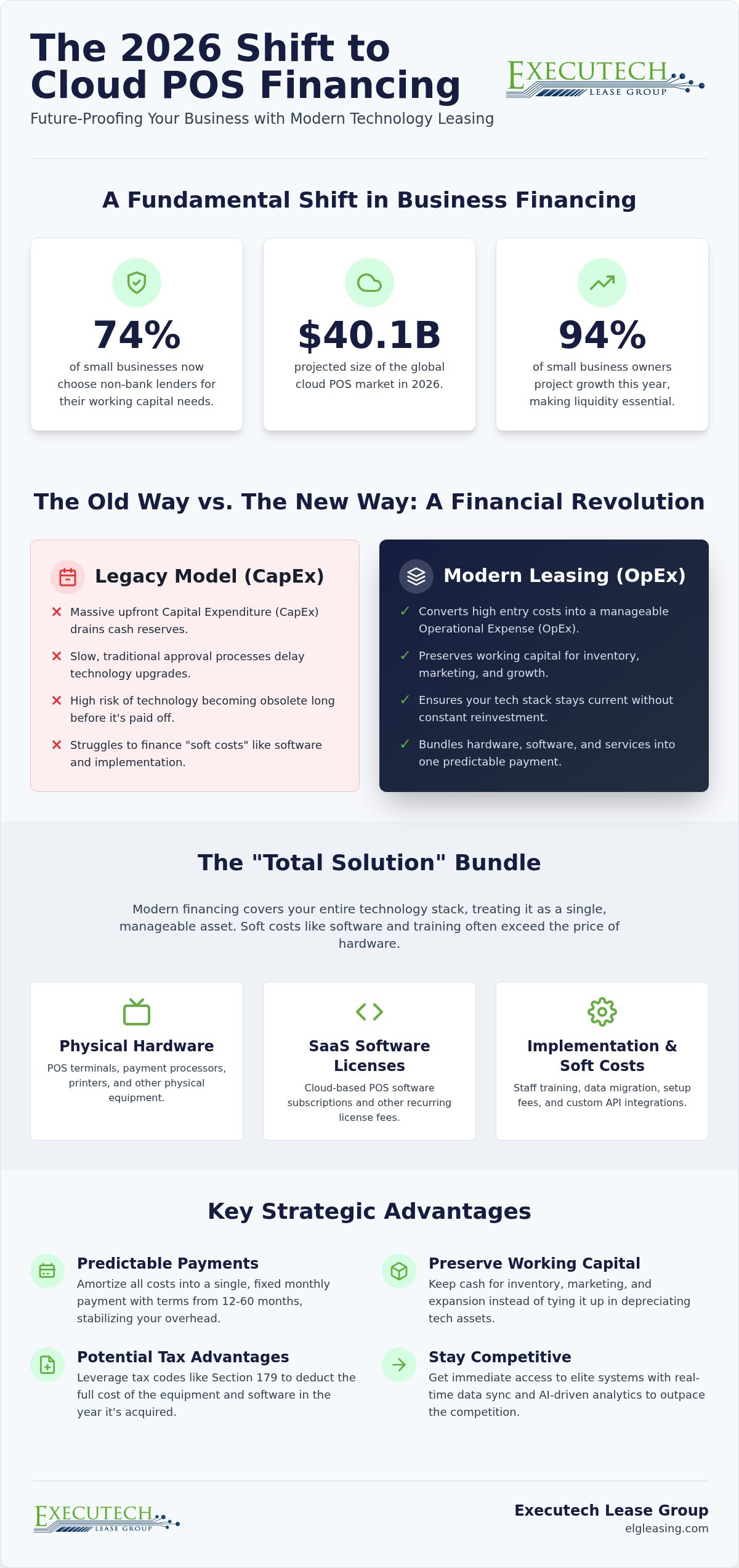
74% of small businesses now choose non-bank lenders for their working capital needs. This shift is driven by a simple reality. You cannot afford to let your technology stagnate while waiting for traditional bank approvals. Modern financing for cloud POS software has fundamentally changed how businesses scale. It eliminates the barrier of high upfront costs for premium systems. You get the tools you need immediately. You keep your cash where it belongs.
You know that a premium cloud system is essential, but the cash flow strain of recurring SaaS subscriptions can be a constant burden. We agree that your financial strategy should be as modern as your software. This analysis reveals how the 2026 landscape allows you to bundle hardware and software into one manageable payment. You will learn how to access elite systems like Clover while preserving your working capital for other growth initiatives. We’ll preview the shift toward total-solution leasing and explain why the distinction between hardware and software financing has finally vanished.
Key Takeaways
- Learn how to amortize software, implementation, and hardware costs into a single, predictable monthly payment over 12–60 month terms.
- Understand the financial shift from capital expenditures to operational expenses and how to leverage tax advantages like Section 179.
- Discover why financing for cloud POS software is now the essential mechanism for replacing obsolete on-premise infrastructure with agile cloud solutions.
- Explore how ISOs can eliminate merchant “sticker shock” and reduce churn by offering comprehensive technology leases that cover non-physical assets.
- Access a strategic framework for future-proofing your tech stack with a partner that understands the intersection of finance and modern payment technology.
The 2026 Shift: Why Financing for Cloud POS Software is the New Standard
The global cloud POS market is projected to reach $40.1 billion in 2026. This isn’t just a technological shift. It’s a financial one. Legacy infrastructure is failing. Decentralized cloud infrastructure has replaced the bulky servers of the past. For many, the hurdle isn’t the technology itself. It’s the cost of entry. Financing for cloud POS software has emerged as the strategic solution. It is a mechanism to amortize software and implementation costs over a lease term. This allows you to scale without draining your reserves. You get the elite tools today. You pay for them as they generate revenue.
Traditional Point of Sale (POS) systems required massive upfront capital expenditure (CapEx). In 2026, that model is a liability. With 94% of small business owners projecting growth this year, liquidity is essential. Growing merchants need immediate access to real-time data synchronization and AI-driven analytics to stay competitive. Financing for cloud POS software turns these high entry costs into manageable operational expenses. It bridges the gap between needing premium tech and maintaining a healthy balance sheet. You preserve your working capital for inventory and expansion.
The Death of the Upfront Software License
The era of buying a software disc is over. Modern systems use recurring SaaS models. However, the “soft costs” of these systems, including configuration, data migration, and staff training, often exceed the hardware costs in 2026. Merchants are moving away from monthly subscription hits that fluctuate or strain monthly cash flow. They want predictable, fixed-rate leases. By financing these soft costs, you lock in your rate. You stabilize your overhead. This predictability is the foundation of modern financial planning. It’s about turning a variable tech burden into a fixed business asset.
2026 Market Trends in Merchant Technology
We see a massive shift toward “Total Solution” bundles. These packages include hardware, software, and ongoing support in one payment. High-volume retail and restaurant sectors lead this adoption. They can’t afford downtime or tech debt. Utilizing cloud based POS financing provides a clear path to scalability. It ensures your tech stack stays current without a constant cycle of reinvestment. This is the streamlined approach for a fast-paced market. It allows you to focus on your customers while your technology works in the background.
Financing Soft Costs: How SaaS POS Software Leasing Works
Most business owners assume leasing is strictly for physical equipment. In 2026, that mindset is obsolete. Modern financing for cloud POS software bridges the gap between tangible hardware and the digital ecosystem that actually runs your business. A comprehensive lease now bundles three critical components: the physical hardware, the SaaS software licenses, and the implementation services. This structure allows you to treat your entire technology stack as a single, predictable monthly line item. While traditional SBA financing options often struggle to value intangible assets, specialized leasing programs are designed specifically for the non-physical nature of modern tech.
The mechanics are straightforward. You select your system. We secure terms ranging from 12 to 60 months. ELG Leasing then funds the software provider directly. This eliminates the need for you to exhaust your cash reserves on upfront licensing or setup fees. We handle the complexity of the vendor payout so you can focus on the deployment. It is a streamlined approach that mirrors the efficiency of the software itself.
Defining “Soft Costs” in 2026
Soft costs represent the “invisible” expenses that often derail a technology upgrade. In 2026, these costs frequently exceed the price of the hardware. They include subscription fees, staff training, data migration from legacy systems, and custom API integrations. Financing these elements protects you from the “subscription trap” where monthly SaaS costs fluctuate or spike unexpectedly. By locking these into a fixed-rate lease, you ensure price stability for the duration of your term. For a deeper look at specific program requirements, you can explore our SaaS subscription lease programs.
The ELG Process Flow for Software Financing
We prioritize speed and transparency. Our process is built for merchants who value their time. It follows a disciplined path to funding:
- Direct Application: You submit your requirements through our streamlined portal.
- Soft Cost Approval: We evaluate the software and implementation components alongside the hardware.
- Vendor Funding: Once approved, we pay your software and hardware vendors in full.
- Consolidated Billing: You begin a single, fixed monthly payment covering your entire solution.
This method removes the friction of managing multiple invoices from different providers. We provide the capital. You provide the vision. If you are ready to modernize your operations without the capital hit, you can start your application today to see which terms fit your growth strategy.
Legacy vs. Cloud: Analyzing the ROI of Total Solution Financing
Winning businesses in 2026 don’t park cash in depreciating software. When you buy a POS system outright, you’re making a permanent bet on temporary technology. A $10,000 upfront investment is a static allocation. In contrast, financing for cloud POS software over a 48-month lease creates a dynamic financial environment. You pay for the system as it generates value. This total solution financing approach covers the hardware, the software licenses, and the necessary support. It transforms a massive capital hurdle into a predictable operational expense. By 2030, the cutting-edge software of today will be a legacy burden. Leasing ensures you aren’t stuck owning an obsolete asset while your competitors upgrade to the next generation of AI-driven tools.
The tax landscape also favors the lease model. Utilizing Section 179 allows many businesses to deduct the full cost of qualifying equipment and software in the year it’s put into service. This immediate tax relief, combined with the ability to categorize monthly payments as an operational expense (OpEx), provides a dual benefit. You get the full power of elite tech without the balance sheet strain of a traditional bank loan. This is about agility. It’s about ensuring your capital is working as hard as your software.
Preserving Working Capital for Growth
Consider the opportunity cost of that $10,000 investment. If you keep that cash and lease your system instead, you can redirect those funds into inventory with a 3x annual turn or a high-converting marketing campaign. The profit generated from that $10,000 in working capital often dwarfs the cost of lease interest. Additionally, leasing software as an operational expense improves a business’s debt-to-income ratio for future loans because it isn’t listed as a significant long-term liability like a large bank loan. This preservation of credit capacity is vital for long-term scalability. The psychological relief of a fixed monthly payment also shouldn’t be underestimated. In a volatile market, knowing your exact tech overhead allows for more aggressive growth planning.
FMV vs. Lease-to-Own for Software
Which model fits your SaaS needs? For most cloud-based systems, Fair Market Value (FMV) leases or subscription models are superior. Soft costs like training and integration don’t hold resale value, making a lease-to-own structure less efficient for pure software components. FMV leases offer the lowest monthly payments and the maximum flexibility at the end of the term. You can upgrade to a new system, return the equipment, or purchase it at its then-current value. For a detailed breakdown of how these models compare, explore our guide on subscription based POS leasing. We help you choose the structure that aligns with your specific technology lifecycle.
Strategic Implementation for ISOs and Modern Merchants
ISOs face a persistent challenge in 2026. Merchants want elite technology but balk at the initial price tag. Financing for cloud POS software removes this friction immediately. It allows you to present a total solution rather than just a processing rate. This shift is critical. When you bundle hardware, software, and implementation into one lease, you eliminate sticker shock. You transition from a commodity vendor to a strategic partner. This approach significantly impacts merchant retention. A merchant committed to a structured technology lease is far less likely to churn for a fraction of a percent in processing fees.
Sales agents must be trained to lead with financing. It is a competitive advantage. By leveraging ELG Leasing’s vendor programs, agents can accelerate the closing process. They provide an immediate answer to capital constraints. This isn’t just about lending. It’s about providing the infrastructure for merchant growth. You give them the tools to compete with enterprise giants. You do it without draining their bank accounts.
Closing the Technology Gap
Small merchants often feel priced out of enterprise-level features. Features like AI-driven analytics and real-time inventory synchronization are no longer optional. Leasing makes them accessible. You can overcome the “I can’t afford the monthly fees” objection by showing the ROI of the software’s efficiency. The “Zero Down” implementation pitch is your most powerful tool. It allows the merchant to start using the system before the first payment is even due. This immediate utility builds trust and secures the deal. It moves the conversation from cost to capability.
Partnering for Efficiency
Modern agents are becoming technology consultants. They don’t just provide a terminal; they provide a business engine. Utilizing ELG Leasing programs allows you to build custom solutions that fit specific industry needs. This selective approach fosters security for both the agent and the merchant. You need a partner that understands the intersection of finance and payment technology. We provide the transparency and speed required to keep your deals moving. We help you monetize the entire tech stack, not just the hardware. We streamline the complex so you can focus on the sale.
Future-Proofing Your Stack with Executech Lease Group
Success in 2026 requires a partner that moves at the speed of software. Executech Lease Group (ELG) isn’t a traditional lender. We are a specialized financial entity built for the merchant services ecosystem. Financing for cloud POS software demands an understanding of recurring revenue and digital assets. We provide that expertise. Our 12–60 month terms are designed to match the lifecycle of modern technology. We help you stay agile. We help you stay competitive. We understand that your business engine is digital, and your financing should be too.
Our role is that of a modern facilitator. We bridge the gap between your need for elite technology and your desire for capital preservation. By treating software as a financeable asset, we allow you to access premium systems like Clover without the initial capital hit. This is the strategic standard for the digital era. It’s about moving away from cumbersome, old-fashioned methods and toward a streamlined, results-driven professional model.
Why ELG? Unwavering Transparency
Our reputation is built on a “No-Nonsense” approach. We prioritize clarity over flowery prose. Our contract terms are direct and easy to scan. The Executech division offers specialized industry knowledge that generalist banks simply can’t match. We understand the technical hurdles of data migration and custom integrations. This deep expertise ensures that your lease structure supports your operational goals. You are not just a number in our system. You are a selective partner. Learn more about our commitment to professional standards at About ELG.
Next Steps: From Application to Implementation
The path to modernization is fast-paced and highly structured. You can Apply Now to secure a quote that covers both hardware and soft costs. The documentation process is straightforward. We require standard business information and a detailed breakdown of your cloud POS modules. Our goal is efficiency. We streamline the funding process to get your equipment and software live in record time. Rapid implementation means immediate ROI. We don’t just fund deals; we accelerate business growth.
Rigid capital structures are a relic of the past. In the digital era, your financial strategy must be as flexible as your cloud infrastructure. Financing for cloud POS software is the only way to maintain a premium tech stack without exhausting your working capital. ELG Leasing provides the security and transparency you need to scale with confidence. Don’t let upfront costs dictate your technological limits. Partner with the experts who understand the intersection of finance and payment technology.
Modernize Without Capital Strain
The distinction between hardware and software financing has vanished in 2026. You don’t have to choose between elite technology and cash liquidity. By leveraging specialized financing for cloud POS software, you can bundle subscriptions, hardware, and implementation into one manageable expense. This approach eliminates the “sticker shock” of modernizing and ensures you aren’t stuck with obsolete assets in the future. It’s a strategic move that prioritizes agility over ownership.
We provide specialized SaaS and subscription financing tailored for Clover and other elite cloud systems. Our 12–60 month flexible terms ensure your tech stack remains current while your working capital remains untouched. This is the efficient path to scalability for ISOs and merchants alike. You get direct access to the tools that drive revenue without the upfront capital exhaustion. We handle the financial complexity so you can focus on your operations.
Build your business on a foundation of modern technology rather than legacy debt. We have the specialized industry knowledge to help you streamline your operations and accelerate your growth. It’s time to secure your competitive advantage today.
Frequently Asked Questions
Can I finance just the cloud POS software without buying hardware?
Yes, you can finance cloud POS software independently of hardware purchases. Specialized SaaS and subscription lease programs are designed to cover soft costs such as licensing, data migration, and custom integrations. This approach allows you to preserve your working capital while accessing elite digital tools. By using financing for cloud POS software, you avoid the heavy upfront hit of implementation and keep your monthly overhead predictable and fixed.
What are the typical lease terms for SaaS POS software in 2026?
Typical lease terms for SaaS POS software in 2026 range from 12 to 60 months. This range gives you the flexibility to choose a duration that matches your specific technology lifecycle. Shorter terms are ideal for businesses that want to stay on the cutting edge of rapid software updates. Longer terms provide the lowest possible monthly payment, which is perfect for stabilizing cash flow while scaling your operations nationally.
Are there tax benefits to leasing cloud-based software instead of paying monthly?
Leasing cloud-based software offers distinct tax advantages over standard monthly billing. You can often categorize these lease payments as an operational expense (OpEx), which provides a direct deduction from your taxable income. Additionally, under Section 179, many businesses deduct the full cost of qualifying software in the year it’s deployed. This strategy accelerates your tax relief and improves your overall return on investment for new technology through professional financial planning.
Can I bundle Clover software subscriptions into my equipment lease?
You can absolutely bundle Clover software subscriptions into your equipment lease. We specialize in Clover leasing programs that combine the physical terminal with the necessary SaaS modules into one single, transparent payment. This eliminates the confusion of managing multiple invoices from different vendors. Bundling hardware and software streamlines your digital operations and ensures you have immediate access to elite systems without exhausting your capital reserves upfront on non-physical assets.
What happens to my software lease if I decide to upgrade my POS system mid-term?
If you decide to upgrade mid-term, your end-of-lease options provide the necessary flexibility. Fair Market Value (FMV) leases are particularly effective for this scenario. You can often roll the remaining balance of your current lease into a new agreement for the latest software and hardware. This prevents you from being locked into obsolete technology. It ensures your business stack remains agile and competitive as new AI-driven tools emerge in the market.
Is cloud POS software financing available for startups or new businesses?
Financing for cloud POS software is available for startups and new businesses that meet specific underwriting criteria. Unlike traditional banks that require years of documentation, modern non-bank lenders often evaluate real-time business data to assess creditworthiness. This makes it easier for new merchants to access premium systems immediately. You don’t have to wait years to afford the technology that will actually help your new business grow and compete effectively.
How does financing cloud POS software affect my business credit score?
Financing your software stack can positively impact your business credit score through consistent, on-time payments. These leases are reported to commercial credit bureaus, helping you build a strong financial reputation. Because these arrangements are often treated as operational expenses rather than long-term liabilities, they keep your debt-to-income ratio favorable. This professional transparency makes it easier to secure additional funding for inventory or marketing as your business expands across the country.
What is the difference between a SaaS subscription lease and a standard equipment lease?
The primary difference lies in what the lease covers. A standard equipment lease focuses exclusively on tangible hardware like terminals and printers. A SaaS subscription lease is designed for the digital era, covering non-physical assets like software licenses, cloud storage, and implementation fees. This total-solution approach is the new standard in 2026. It allows you to monetize your entire technology stack rather than just the physical devices sitting on your counter.

Article by
Robert Ensminger
Robert Ensminger is the founder and CEO of Executech Lease Group (ELG Leasing), which specializes in equipment leasing and financing solutions for the merchant-services, payments, POS, and FinTech industries. With more than 20 years of industry experience, Robert helps independent sales organizations, payment processors, POS providers, and software companies develop practical leasing, subscription, and SaaS-monetization programs. He founded ELG in 2010 and guided the company to recognition on the Inc. 5000. His work focuses on responsive service, transparent program structures, and helping ELG’s partners close more business while creating sustainable revenue.