
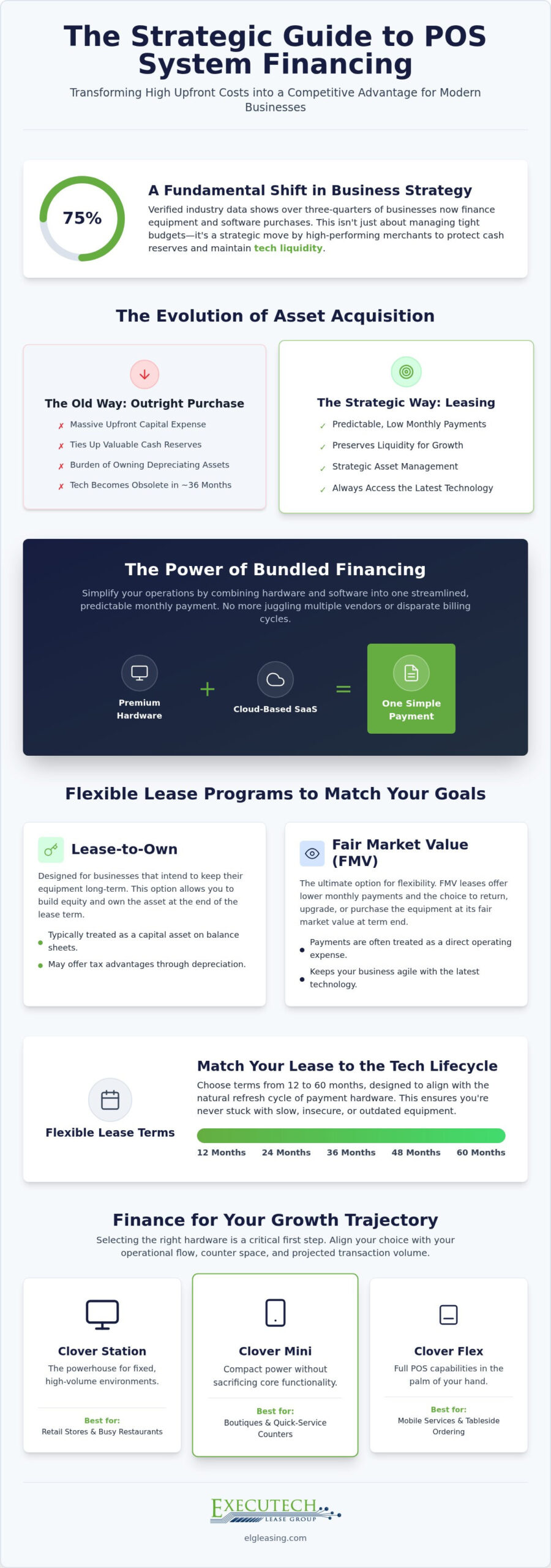
Why would you sink thousands of dollars into a hardware setup that will be obsolete within thirty-six months? Verified industry data shows that businesses now finance more than 75% of their equipment and software purchases to protect their cash reserves. This shift confirms that POS system financing for small business is no longer just a fallback for tight budgets. It’s a strategic tool for high-performing merchants who value tech liquidity. You need the latest tools to compete. You don’t need the burden of massive upfront capital expenditures.
We know the pain of watching modern hardware age while software fees climb. It’s an inefficient way to run a company. This 2026 guide shows you how to acquire premium Clover hardware and cloud-based software through structured leasing. We’ll explore the clarity of predictable monthly payments and the benefits of bundled financing. You’ll discover how to leverage 12 to 60 month terms, including FMV and lease-to-own options, to keep your operations modern and your balance sheet clean. We prioritize efficiency. This guide provides the roadmap to get there.
Key Takeaways
- Transition from high upfront capital expenditures to strategic asset management by utilizing flexible 12 to 60 month equipment leases.
- Understand the critical differences between Lease-to-Own and FMV options to optimize your business balance sheet and tax position.
- Discover how to bundle premium Clover hardware and cloud-based SaaS software into one streamlined, predictable monthly payment.
- Identify the most effective POS system financing for small business by matching your hardware selection to your specific transaction volume and cloud requirements.
- Prepare for a frictionless application process by organizing your essential business documentation for rapid submission through transparent portals.
Understanding the Landscape of POS System Financing in 2026
Acquiring technology shouldn’t deplete your cash reserves. In a high-speed market, POS system financing for small business has evolved into a sophisticated asset management strategy. Rather than paying a massive lump sum for hardware that depreciates, you secure your tools through structured periodic payments. This model transforms a heavy capital expenditure into a predictable operational cost. To understand the mechanics, you first need to recognize what a POS system is in the modern era. It’s no longer just a cash register; it’s a centralized hub for inventory, labor management, and customer data.
Traditional bank loans are often the wrong fit for technology. Banks move slowly. They demand collateral and focus on long-term debt. Specialized equipment leasing is built for speed and efficiency. It recognizes that technology has a shelf life. Leading merchants prioritize cash flow over asset ownership because liquidity allows for rapid pivots. They choose to monetize their operations through specialized leasing programs that cover the entire ecosystem: terminals, stations, and the cloud software that powers them.
Hardware vs. Software Financing: What You Need to Know
Modern POS packages are split between physical assets and digital infrastructure. Hardware financing covers the heavy hitters like Clover Stations and credit card terminals. Software financing addresses the recurring SaaS fees required for cloud integration. We recommend bundling these into a single monthly payment. This creates organizational logic. It simplifies your bookkeeping and ensures your digital tools are always synced with your physical hardware. You get a seamless experience without managing multiple vendors or disparate billing cycles.
The Strategic Advantage of 12–60 Month Lease Terms
Technology moves fast. A 12 to 60 month lease term is designed to match the natural lifecycle of payment hardware. If you buy equipment outright, you’re stuck with it when it becomes sluggish or incompatible with new security standards. Shorter lease terms allow for faster technology refreshes. You stay at the cutting edge. Predictable monthly payments also stabilize your budget. You know exactly what’s leaving your account every month. There are no surprises. This disciplined approach to financing ensures your business remains modern, secure, and ready to scale without the friction of “old-fashioned” ownership models.
How to Evaluate Your Small Business POS Technology Needs
Selecting the wrong equipment is an expensive mistake. You must align your hardware choices with your actual operational flow before committing to a lease. High-volume retail environments require robust, fixed stations. Mobile services or restaurants with tableside ordering need handheld flexibility. While general SBA loan programs provide broad capital, they often lack the specificity required for rapid tech deployment. Effective POS system financing for small business starts with a precise audit of your physical environment and transaction volume. Don’t finance for where your business is today. Finance for your projected growth trajectory over the next 36 to 60 months.
Consider your counter space and customer interaction points. A cluttered checkout area kills efficiency. Conversely, a mobile terminal that can’t handle a rush is a bottleneck. You need to determine if cloud integration for inventory and CRM is a luxury or a necessity for your specific model. In 2026, real-time data is usually the latter. Once you’ve mapped your workflow, you can select the specific tools that will drive your revenue.
Selecting the Right Hardware: Clover Station vs. Mini vs. Flex
The Clover Station is the powerhouse for fixed, high-volume retail. It’s built for speed and durability at the main point of sale. If your footprint is smaller, the Clover Mini offers compact power without sacrificing functionality. It’s ideal for boutiques or quick-service counters. For merchants who need to bust lines or accept payments on the move, the Clover Flex is the essential tool. It brings full POS capabilities to the palm of your hand. Choosing the right mix of these devices ensures you aren’t overpaying for capacity you don’t use or struggling with hardware that can’t keep up.
Factoring in Cloud-Based SaaS and Software Subscriptions
Hardware is only half the equation. The software that runs your system is a critical “soft cost” that can cause budget spikes if not managed correctly. Modern SaaS subscription lease programs allow you to bundle these recurring fees into your primary lease. This prevents the friction of separate billing cycles and unpredictable software price hikes. By utilizing financing for cloud POS software, you lock in your digital infrastructure costs alongside your hardware. This holistic approach to financing streamlines your monthly overhead. If you’re ready to modernize your tech stack, you can start your application today to see which programs fit your needs.
Step-by-Step: Choosing Between Lease-to-Own and FMV Programs
Selecting the right structure for POS system financing for small business depends on your long-term relationship with technology. You aren’t just picking a payment plan; you’re deciding on a strategic asset management path. In the 2026 market, the choice between Fair Market Value (FMV) and Lease-to-Own determines your tech agility and your tax position. One path prioritizes constant innovation. The other prioritizes long-term equity. We don’t offer short-term daily rentals because we focus on the sustainable growth that comes from 12 to 60 month commitments. Strategic POS system financing for small business balances these immediate operational costs with your future ownership goals.
The financial implications of these programs differ significantly. FMV leases typically function as operating expenses, which can keep debt off your balance sheet and preserve your existing credit lines. Lease-to-own programs are generally treated as capital expenses, where you eventually own the asset and depreciate it over time. End-of-term options also vary. With FMV, you can return the equipment, upgrade to the next generation, or purchase it at its current market price. Lease-to-own ends with a $1 buyout. You must consult a CPA to determine how current tax codes and Section 179 deductions apply to your specific business filing.
When to Choose Fair Market Value (FMV) Leases
This is the ideal path for merchants who demand the latest technology every 24 to 36 months. Monthly payments are typically lower because you aren’t paying for the full residual value of the equipment. It’s a high-standard approach for businesses that view software and hardware as tools to be cycled, not burdens to be owned. If you prioritize cash flow and tech agility, FMV is the superior choice. It allows you to pivot quickly as new payment standards emerge without being tethered to aging hardware.
The Long-Term Path: Lease-to-Own Credit Card Terminals
If your hardware needs are stable, lease-to-own provides a clear path to ownership. This program is best for durable, high-performance equipment that doesn’t require frequent digital refreshes. You pay slightly more per month compared to FMV, but you own the asset outright at the end of the term. You can view our specific Leasing Programs for a detailed breakdown of 12 to 60 month options. Ownership is an investment in stability. It’s the right move for established businesses with predictable, fixed-location operations that value long-term asset accumulation over rapid tech cycles.
The Application and Implementation Process: A Streamlined Checklist
Efficiency is the benchmark of a successful technology rollout. Once you’ve selected your program, you must move with precision. Delay in the application phase is simply lost revenue. Effective POS system financing for small business relies on a highly structured submission process that eliminates administrative friction. We prioritize transparency; you should prioritize preparation. By gathering the right data upfront, you accelerate the path from approval to installation.
- Gather Essential Documentation: Have your federal Tax ID, recent bank statements, and ownership details ready for review.
- Submit via Secure Portal: Use a transparent, efficient digital portal to ensure your data reaches underwriters without manual delays.
- Review Lease Specifics: Focus on the 12 to 60 month term length and the specific payment structure to ensure it aligns with your monthly cash flow.
- Coordinate Delivery: Sync with your ISO or merchant services provider to schedule the delivery and setup of your new hardware.
Preparing Your Business for Rapid Approval
Lenders in 2026 look for stability and clarity. Your credit profile should reflect consistent operational history and reliable cash flow. We act as a disciplined gatekeeper; we value quality partnerships. Common pitfalls that delay approval include mismatched business names on legal documents or incomplete financial histories. To see exactly how we move a file from start to finish, you can review the ELG Process Flow. It’s a methodical system designed for speed. We don’t believe in “old-fashioned” waiting periods. We believe in momentum.
Integrating Financed Equipment into Your Operations
The arrival of your Clover hardware is the start of your ROI cycle. Don’t let premium equipment sit in a box. Training your staff on the new interface is paramount. Clover software is intuitive, but a structured walkthrough ensures your team utilizes every feature from day one. You should also activate your cloud-based reporting immediately. This allows you to track transaction volume and inventory shifts in real-time. Managing the transition from legacy terminals to a modern POS system is about more than just switching plugs. It’s about migrating your data and mindset to a digital-first environment. This streamlined approach ensures your financing investment pays dividends immediately.
Strategic Scaling: Why ELG Leasing is the Expert Choice
Success in the merchant services industry requires more than just hardware; it requires a financial architecture that supports growth without creating friction. We specialize exclusively in 12 to 60 month credit card and POS equipment leases. This focus allows us to provide a level of expertise that generalist lenders cannot match. By choosing a partner dedicated to POS system financing for small business, you access a streamlined ecosystem designed for high-performance merchants. We act as the critical bridge between advanced technology providers and the businesses that need them to scale.
Our approach to Subscription-Based POS Leasing is built for modern scalability. We understand that your needs in 2026 will differ from your needs in 2028. Our programs allow you to monetize your operations while maintaining the flexibility to adapt. We don’t just facilitate a transaction; we manage a technology lifecycle. This ensures you aren’t burdened by the “old-fashioned” model of owning depreciating assets that slow down your service delivery.
Accelerating Growth with Selective Partnerships
We don’t work with everyone. We are a disciplined gatekeeper. This selectivity is your greatest advantage. By maintaining high standards for our partnerships, we ensure a more secure and reliable environment for the merchants and ISOs we serve. You benefit from a partner that understands the specific nuances of Clover hardware and cloud-based software. This reliability accelerates your growth by removing the guesswork from equipment acquisition. If you meet our standards for excellence, you can Apply Now to begin our streamlined approval process.
The Future of POS Financing: Staying Ahead of 2026 Trends
The landscape is shifting toward total cloud-based POS software financing. Hardware is no longer a standalone purchase; it’s a vehicle for digital infrastructure. Our refresh programs are designed to prevent technology obsolescence. We ensure you can transition to the latest terminals and software versions without capital spikes. For a deeper dive into how we are reshaping the industry, consult our Cloud-Based POS Financing Guide. Staying ahead of tech cycles isn’t a luxury. It’s a requirement for modern business survival. We provide the tools to make that survival effortless.
Modernize Your Merchant Infrastructure for 2026
Strategic POS system financing for small business is about more than just credit; it’s a tool for tech liquidity. You’ve learned how to contrast FMV and lease-to-own paths to match your specific growth trajectory. By leveraging 12 to 60 month terms, you avoid the capital trap of owning hardware that will eventually age out of the market. This disciplined approach preserves your cash reserves for operational scaling rather than sinking them into depreciating assets.
We specialize in Clover Station, Mini, and Flex financing to ensure you have the precise tools for your unique environment. Our high-standard partnership model provides the transparency and speed you need to stay competitive in a digital-first market. You deserve a seamless transition to modern operations without the friction of outdated financial methods or cumbersome bank processes. We prioritize efficiency so you can focus on your customers.
Your business momentum starts with the right financial foundation. We are ready to help you accelerate your growth with unwavering confidence and professional transparency.
Frequently Asked Questions
Is it better to lease or buy a POS system for a small business?
Leasing is often superior for small businesses because it protects cash flow and prevents technology obsolescence. Buying requires a large upfront capital expenditure and leaves you with hardware that depreciates rapidly. Leasing allows for regular technology refreshes every 12 to 60 months. This is a core component of POS system financing for small business. It prioritizes tech liquidity over the burden of simple ownership, keeping your business modern and flexible.
Can I finance both the POS hardware and the software fees?
Yes, modern programs allow you to bundle physical terminals and cloud-based SaaS fees into a single monthly payment. This creates organizational simplicity and predictable budgeting. You avoid the “soft cost” spikes associated with separate software billing cycles. By financing the entire digital and physical ecosystem, you streamline your overhead and ensure your digital infrastructure stays in sync with your hardware without managing multiple vendors.
How long are the typical lease terms for a Clover terminal?
Typical lease terms for Clover Station, Mini, or Flex terminals range from 12 to 60 months. We specialize in these structures because they align perfectly with the technology’s natural lifecycle. Shorter terms allow for faster technology refreshes, while longer terms provide the lowest possible monthly payment for your business. You choose the specific duration that best fits your operational goals and your long-term asset management strategy.
What happens at the end of a Fair Market Value (FMV) lease?
At the end of a Fair Market Value (FMV) lease, you have three distinct options. You can return the equipment and upgrade to the latest generation of technology, renew the lease for a new term, or purchase the hardware at its current market price. This flexibility is ideal for merchants who want to stay at the cutting edge of payment tech without being tethered to aging or sluggish terminals.
Do I need a high credit score to qualify for POS system financing?
A “perfect” credit score isn’t always required, but lenders do look for business stability. We act as a disciplined gatekeeper, evaluating the overall health of your company, including cash flow and operational history. We focus on building high-standard partnerships. If your business demonstrates consistent performance and reliable revenue, you have a strong path toward qualifying for POS system financing for small business through our streamlined approval process.
What is a SaaS subscription lease and how does it work?
A SaaS subscription lease finances the recurring fees for cloud-based POS software alongside your hardware. It works by spreading the total software cost over the duration of your lease term. This model is essential for merchants who want a predictable, all-in monthly expense. It prevents the friction of managing multiple software vendors and ensures your digital infrastructure is always licensed, active, and fully supported.
How quickly can a small business get approved for equipment leasing?
Approval can happen rapidly when your documentation is organized and complete. We utilize a streamlined digital portal to accelerate the underwriting process. If you have your Tax ID, recent bank statements, and ownership details ready for submission, the transition from application to approval is often seamless. We prioritize momentum because we understand that waiting for essential equipment translates directly into a loss of potential merchant revenue.
Can I upgrade my POS hardware before the lease term ends?
Many leasing programs offer refresh options that allow for hardware upgrades before the term ends. This is a primary benefit of working with a specialized merchant equipment partner. We understand that tech cycles move fast. If your transaction volume outgrows your current terminal, we can often restructure your agreement to include more powerful hardware. This ensures your business never struggles with obsolete tools or inadequate processing capacity.

Article by
Robert Ensminger
Robert Ensminger is the founder and CEO of Executech Lease Group (ELG Leasing), which specializes in equipment leasing and financing solutions for the merchant-services, payments, POS, and FinTech industries. With more than 20 years of industry experience, Robert helps independent sales organizations, payment processors, POS providers, and software companies develop practical leasing, subscription, and SaaS-monetization programs. He founded ELG in 2010 and guided the company to recognition on the Inc. 5000. His work focuses on responsive service, transparent program structures, and helping ELG’s partners close more business while creating sustainable revenue.